

Mecca defence pact moves from paper to action as Turkiye, Saudi Arabia and Pakistan set for first meet
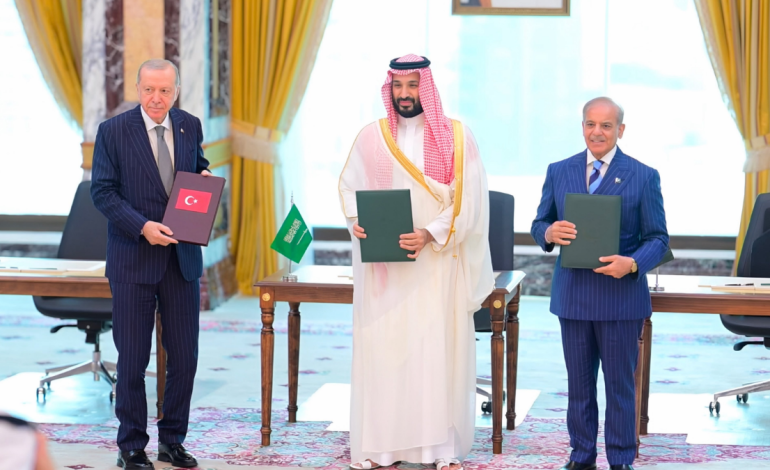
Turkiye, Saudi Arabia and Pakistan set for first meet. (Image courtesy: X/@PakPMO)

New Delhi: Turkiye, Saudi Arabia and Pakistan are set to take their newly signed defence pact into its first phase of implementation, with senior military and diplomatic officials from the three countries planning to meet in Istanbul on Monday. The meeting will be the first committee-level gathering under the Mecca Joint Defence Agreement.
The meeting comes after the three countries signed the agreement on August 7, establishing a mutual-defence framework that has drawn comparisons with Nato’s collective-defence principle. With security tensions continuing across West Asia, the Istanbul talks are expected to provide the first indication of how the trilateral pact will translate into practical military cooperation.
The Istanbul meeting is expected to move the agreement beyond its initial political announcement and towards practical military cooperation.
According to a Turkish foreign ministry source cited by Reuters, the meeting will bring together the foreign and defence ministers and chiefs of staff of all three countries. International security issues are expected to feature prominently, while discussions are also likely to cover strengthening defence capabilities, improving interoperability between the armed forces and expanding cooperation in defence production.
Joint development and manufacturing could emerge as an important area of cooperation as the three countries seek to deepen their defence-industrial links.
The timing of the meeting is significant, with the wider region continuing to face security pressures linked to the Iran conflict and tensions involving Israel and Gulf states. The new framework provides Ankara, Riyadh and Islamabad with a platform to coordinate their security positions while developing a more structured defence relationship.
Mecca Defence Pact expansion debate widens
The possible expansion of the framework has already emerged as an important issue. As RNA Media had reported earlier, Bangladesh had kept open the possibility of joining the Saudi Arabia-Turkiye-Pakistan arrangement, with Dhaka indicating that it could consider membership if a formal invitation were extended.
On August 27, the Bangladeshi foreign minister, Khalilur Rahman, defended the possibility of expanding the pact, saying there was no reason for other countries or communities to be concerned if the arrangement grew. He described it as a mechanism for the collective self-defence of the global Muslim community and said any such expansion should be viewed as an internal matter among Muslim countries.
On the other hand, Iranian officials previously rejected reports that the country had been invited to join the arrangement.
Pakistan has nevertheless indicated that the framework could potentially be expanded, with Islamabad previously signalling that countries such as Iran and Egypt could be considered. Turkiye has also said the arrangement is open to expansion and is not intended to replace existing alliances.
What is the Mecca Joint Defence Agreement?
The Mecca Joint Defence Agreement, signed by Saudi Arabia, Turkiye and Pakistan, establishes a mutual-defence framework under which an armed attack against any one of the three countries would be treated as an attack against all three. The arrangement has subsequently been compared with Nato’s Article 5 principle, although the pact does not lay out the same detailed military obligations as Nato’s collective-defence framework.
The agreement brings together Saudi Arabia’s strategic position in the Gulf, Turkiye’s military capabilities and Pakistan’s defence capacity under a trilateral security framework spanning the Gulf, West Asia and South Asia. The three countries have also indicated that the arrangement is intended to strengthen deterrence while remaining compatible with their existing alliances and partnerships.