



India issues Notam for 2,995km for missile-test in September. Could New Delhi finally unveil Agni-6 ICBM?
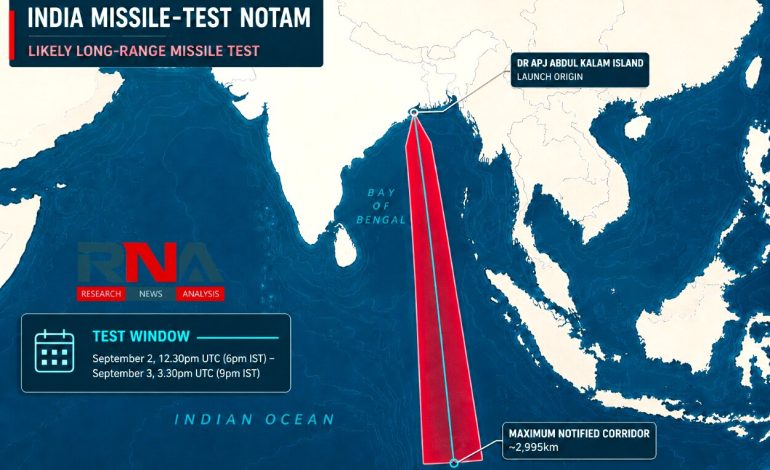
This RNA Media graphic shows the trajectory of the Notam corridor. (Map not to scale.)

New Delhi: India has issued a flight-safety warning covering a nearly 2,995-kilometre corridor across the Indian Ocean region for a probable long-range missile test on September 2–3, renewing scrutiny of the country’s rapidly advancing strategic-weapons programme. The defence ministry and the Defence Research and Development Organisation (DRDO) have not identified the missile, leaving open possibilities ranging from another Agni-series trial to the closely guarded Agni-6 intercontinental ballistic missile (ICBM).
Open-source intelligence analyst Damien Symon published details of the notification on Friday together with a map showing the danger corridor extending seawards from India’s eastern coast. His post on X placed the approximate length of the notified zone at 2,995 kilometres and the test window on September 2 and 3.
A notice to air missions (Notam) is issued to keep civilian aircraft away from airspace in which military launches, falling rocket stages or other hazardous activities may occur. Its dimensions mark the maximum area that authorities want cleared for safety, however, and should not automatically be treated as the tested missile’s range.
The latest warning follows an unusually active period for India’s strategic-missile establishment and is the second substantial Indian Ocean corridor declared within a month. In early August, India first notified a 2,530-kilometre zone before expanding it to about 3,760 kilometres, a revision that RNA Media reported had prompted speculation about the K-4 submarine-launched ballistic missile or an advanced Agni system.
India eventually test-fired the Agni-4 medium-range ballistic missile from the Integrated Test Range at Chandipur on August 6, with the Strategic Forces Command (SFC) validating its operational and technical parameters. The official defence ministry statement did not explain why the associated warning extended much farther into the Indian Ocean than the apparent requirements of that launch.
The 3,760-kilometre Notam remained active after the Agni-4 had been fired, sustaining expectations of a possible second launch before the window closed, as RNA Media reported at the time. No additional test was subsequently announced, demonstrating both the limitations of interpreting safety notices and the possibility that a planned trial can be deferred without explanation.
The September notification nevertheless comes after a sequence of significant Indian missile trials, including the May 8 launch of what the government called an “Advanced Agni” carrying a multiple independently targetable re-entry vehicle (Mirv) system. According to the defence ministry, several payloads were directed towards separate targets spread across a large area of the Indian Ocean, with ground and ship-based stations tracking the flight from launch to impact.
That description was deliberately economical: the government neither gave the missile a numerical designation nor disclosed its range, payload configuration or relationship with the Agni-5. The ambiguity has encouraged competing assessments that it was either a further development of the Mirv-capable Agni-5 or a technology bridge towards an entirely new long-range system.
For the September event, there is not yet an official launch announcement, and the Notam itself could be revised, extended or withdrawn before the test window opens. The 2,995-kilometre corridor is also compatible with several existing or developmental systems, including the Agni-3, Agni-4, a reduced-range Agni-5 trial and the approximately 3,500-kilometre-range K-4.
Agni-6 speculation – and why caution is essential
The Agni-6 has occupied a peculiar place in India’s strategic debate for more than a decade: it is widely discussed by former officials, defence observers and foreign intelligence assessments but has never been formally unveiled by the government. Unlike the Agni-1 to Agni-5 missiles, it does not appear in the publicly acknowledged inventory of the SFC.
The most authoritative open-source assessments consequently use cautious language when discussing the programme. The Federation of American Scientists and the Bulletin of the Atomic Scientists said in their 2024 assessment of Indian nuclear weapons that a new intercontinental-range Agni-6 was thought to be at the design stage but emphasized that its status remained unclear because official information was scarce.
Reports have generally attributed to the proposed missile a range of between 10,000 and 12,000 kilometres, solid-fuel propulsion, canisterized road mobility and the ability to carry multiple warheads. None of those projected specifications has been confirmed by the defence ministry or DRDO, and they should therefore be treated as estimates rather than established facts.
The September corridor’s 2,995-kilometre length does not, on its face, resemble the full-range flight of a missile expected to travel more than 10,000 kilometres. Under the conventional arms-control definition, a land-based ballistic missile must be capable of exceeding 5,500 kilometres to qualify as an ICBM, as set out in the US-Soviet strategic-arms definitions.
That discrepancy does not rule out an Agni-6 development trial because missiles need not be flown to their maximum range during every test. Engineers can employ a highly lofted trajectory, alter the payload, test selected propulsion stages or conduct a deliberately shortened flight to evaluate guidance, stage separation, the post-boost vehicle and the re-entry package.
North Korea’s first acknowledged ICBM test illustrated this distinction: the missile travelled only about 930 kilometres horizontally but climbed to an altitude of roughly 2,800 kilometres, allowing specialists to estimate a range of about 7,000 kilometres on a normal trajectory. The Center for Strategic and International Studies consequently classified it as an ICBM despite the comparatively short impact distance.
India could similarly use an initial reduced-range flight to avoid creating an enormous exclusion zone, limit the number of monitoring ships required and concentrate on specific technological objectives. Such an approach would be particularly relevant if the test were intended to validate a new booster, composite motor casing, Mirv deployment bus, manoeuvrable re-entry vehicle or penetration aids rather than demonstrate maximum reach.
The timing offers a second reason for the Agni-6 theory to persist. India’s successful Mirv trials have already established several of the technologies needed for a more capable missile, while the May “Advanced Agni” launch demonstrated that multiple payloads could be released towards spatially separated targets and tracked throughout their flight.
The Agni-5 provides the technological foundation from which such a system could evolve, combining three-stage solid propulsion with canisterized road mobility and a range officially placed at more than 5,000 kilometres. Independent estimates vary considerably, although CSIS notes that former DRDO officials have discussed a maximum range in the region of 5,500–5,800 kilometres depending on payload and flight conditions.
A genuine Agni-6 would be important not simply because it could fly farther than the Agni-5, but because greater range permits launchers to operate deeper inside Indian territory. That geographical depth would make them harder to locate and attack, improve their survivability during a crisis and allow the SFC to hold distant targets at risk without moving launchers close to contested borders.
If combined with Mirv capability, a longer-range missile could deliver several independently guided re-entry vehicles from one launcher, complicating an adversary’s interception calculations. It could also carry a mixture of warheads, decoys and penetration aids, although there is no public evidence establishing what payload India might eventually select.
The principal strategic requirement would remain deterrence against China rather than an attempt to reproduce the enormous global arsenals maintained by the United States and Russia. Longer-range weapons would allow India to cover the full depth of Chinese territory from protected deployment areas in central and southern India, reducing dependence on launch positions nearer the Himalayan frontier.
Such a development could still alter strategic calculations beyond South Asia because an operational 10,000-kilometre missile would place India among the small group of states possessing unambiguous intercontinental reach. It would also raise questions about whether India’s concept of “minimum” deterrence is evolving in response to China’s expanding missile, submarine and Mirv capabilities.
New Delhi continues to describe its nuclear posture as one of credible minimum deterrence, no-first use and non-use against non-nuclear-weapon states, a position reiterated by the External Affairs Ministry. Longer range and multiple-warhead technology do not automatically abandon that doctrine, but they increase the number of targets that can be threatened and substantially improve the force’s ability to survive and retaliate.
There is a less dramatic explanation for the September warning: it may cover a routine user trial of an existing Agni missile, another Advanced Agni experiment or a K-4 launch connected with India’s sea-based nuclear deterrent. The near-3,000-kilometre corridor is particularly compatible with an Agni-3-class flight and is slightly shorter than the publicly reported range of the K-4.
Previous experience warns against assigning a missile name solely from the size of a Notam. The August notification produced confident predictions of an Agni-6 or K-4 test but culminated publicly in an Agni-4 launch, illustrating how danger zones may include safety margins, alternative impact areas or provisions for trials that do not eventually take place.
Strategic opacity can protect sensitive capabilities, but it also leaves room for exaggerated claims, mistaken threat assessments and foreign surveillance activity. A Chatham House assessment has warned that the convergence of Indian missile testing and Chinese monitoring vessels in the Indian Ocean increases the possibility of misperception and unintended escalation among nuclear-armed states.
The September 2–3 launch window is therefore significant even if the weapon proves to be an existing missile: it reflects the sustained testing tempo of India’s strategic establishment and its continued investment in long-range, survivable delivery systems. If the missile is officially identified as the Agni-6, however, the event will mark India’s transition from possessing a borderline intercontinental capability to testing a system designed for undisputed global reach.
Until a missile leaves the launch pad and the government identifies it, the Agni-6 assessment remains a credible hypothesis rather than a confirmed conclusion.