


Indian Navy to commission Nipun, completing two-coast submarine rescue cover
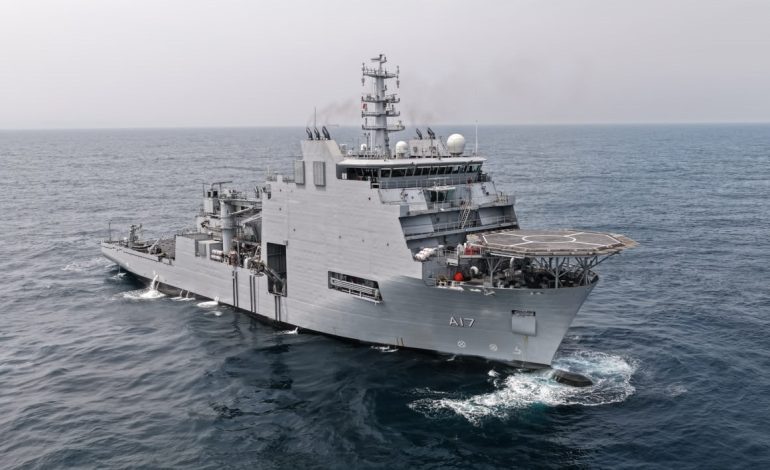
Nipun is the Indian Navy’s second indigenously built diving-support vessal. (Photo: Indian Navy)

New Delhi: The Indian Navy will commission Nipun, its second indigenously built Nistar-class diving-support vessel, at the Naval Dockyard in Mumbai on Sunday. Its induction will strengthen the Navy’s capacity for deep-sea diving, underwater intervention and submarine rescue while completing a specialized rescue arrangement across India’s eastern and western seaboards.
Designed and constructed by the state-owned Hindustan Shipyard Limited (HSL) in Visakhapatnam, Nipun was delivered to the Navy on July 30 this year after an extensive programme of outfitting and trials. The vessel was built in accordance with the classification rules of the Indian Register of Shipping and will formally enter naval service as INS Nipun after commissioning.
The ship has been purpose-built to support sustained diving operations, underwater inspection and intervention, salvage work and the rescue of personnel from a disabled submarine. Its precision station-keeping system allows it to remain almost immobile above an underwater site – a critical requirement when divers, diving bells, remotely operated vehicles or submarine-rescue equipment are deployed below.
Nipun also incorporates modern navigation, platform-management and diver-monitoring systems, as well as medical and life-support facilities for treating personnel subjected to high underwater pressures. These systems bring diving, rescue, medical care and underwater surveillance together on a single large platform, reducing the time required to mobilize separate vessels during an emergency.
As RNA Media had reported on July 31, Nipun is expected to serve as the deep submergence rescue vehicle (DSRV) mothership on the western seaboard. It will complement INS Nistar, the first vessel of the class, which was commissioned at Visakhapatnam on July 18, 2025, and assigned to the Eastern Naval Command.
The two vessels will therefore give the Navy dedicated submarine-rescue support on both coasts for the first time, significantly reducing the distance that specialized equipment must travel during an underwater emergency. This is particularly important because India’s conventional and nuclear-powered submarines operate from bases on both the eastern and western seaboards, where delays in locating and reaching a disabled boat could determine whether its crew can be rescued.
A DSRV can descend to a stricken submarine, establish a watertight connection with its escape hatch and transfer trapped personnel to the surface in successive sorties. The diving-support vessel provides the positioning, command, medical, launch-and-recovery and decompression infrastructure required to operate the rescue vehicle safely at sea.
The Navy’s submarine-rescue capacity has assumed greater importance as undersea activity increases across the Indian Ocean and regional navies expand their submarine fleets. A permanent two-coast arrangement also reduces India’s dependence on foreign assistance during the initial and most time-sensitive phase of a submarine accident.
Nipun’s construction represents a demanding achievement for HSL because diving-support vessels combine ship propulsion, precision positioning, underwater robotics, hyperbaric medicine and life-support technology. The defence ministry’s delivery announcement placed its indigenous content at nearly 75 per cent, while earlier official reporting said approximately 80 per cent indigenous content had been achieved when the two vessels were launched in September 2022.
The ship’s name is derived from a Sanskrit word describing a person who is adept, capable and accomplished in a particular discipline. Its crest combines a whale, symbolizing endurance and prolonged operation at depth, with a modern diving helmet representing the divers and advanced life-support systems at the centre of its mission.
Nipun’s specifications and underwater capabilities
Nipun is approximately 118 metres long and was reported at delivery as displacing more than 8,560 tonnes, although official descriptions of the Nistar class have also cited tonnage approaching 10,000 tonnes under different reported configurations. Its beam is approximately 23 metres, making it a substantial auxiliary vessel rather than a small diving-support craft.
The Nistar-class design uses twin diesel engines and has a reported maximum speed of about 18 knots, or 33 kilometres per hour. The class has an endurance exceeding 60 days at sea, enabling prolonged deployment without frequent replenishment.
A dynamic-positioning system automatically controls the ship’s propulsion and thrusters to maintain an exact position and heading without anchoring. This precision is essential because even limited movement on the surface could endanger divers or damage an umbilical cable, diving bell or rescue vehicle operating hundreds of metres below.
The class can support deep-sea saturation diving to a depth of 300 metres, allowing divers to live for extended periods inside a pressurized complex matched to the pressure at their working depth. This avoids repeated decompression after individual dives and enables teams to carry out prolonged inspection, repair or salvage operations on the seabed.
A side-diving stage allows diving operations to be conducted to depths of 75 metres, while the vessel’s combination of remotely operated vehicles can support diver monitoring, underwater surveys and salvage missions to around 1,000 metres. Side-scan sonar can search the seabed and help locate wreckage, debris or a distressed submarine before intervention begins.
The vessel’s saturation-diving complex includes pressure chambers and facilities for the controlled transfer and decompression of divers. A hyperbaric evacuation arrangement provides an additional layer of protection by allowing personnel to be removed from the ship without abruptly exposing them to normal atmospheric pressure during an emergency.
Nipun will function as a mothership for the Navy’s DSRV, providing the command, launch, recovery and medical infrastructure required for submarine-rescue missions. India’s British-built DSRVs can reportedly operate at depths of about 650 metres, allowing them to reach most submarine-operating depths encountered in the northern Indian Ocean.
The ship carries a 15-tonne subsea crane for deploying and recovering heavy underwater equipment and can support staged helicopter operations at sea. Its medical facilities include an operating theatre, an intensive-care unit, an eight-bed hospital and specialized hyperbaric facilities for treating divers or rescued submariners exposed to pressure-related injuries.
Open-source specifications for the class also list an electronic-warfare suite, Lynx-U2 fire-control equipment and AK-630 close-in weapon systems for self-protection. These defensive systems are secondary to Nipun’s principal mission, which remains deep-sea diving, underwater intervention, salvage and submarine rescue.
Nipun’s commissioning will complete the two-ship Nistar-class programme and provide the Navy with a permanent western counterpart to INS Nistar. Together, the vessels will give India a more responsive indigenous underwater-rescue network and greater capacity to assist its own submarines as well as those of partner navies during regional emergencies.