
Xi Jinping likely to visit India with 400-member delegation for BRICS summit, report says
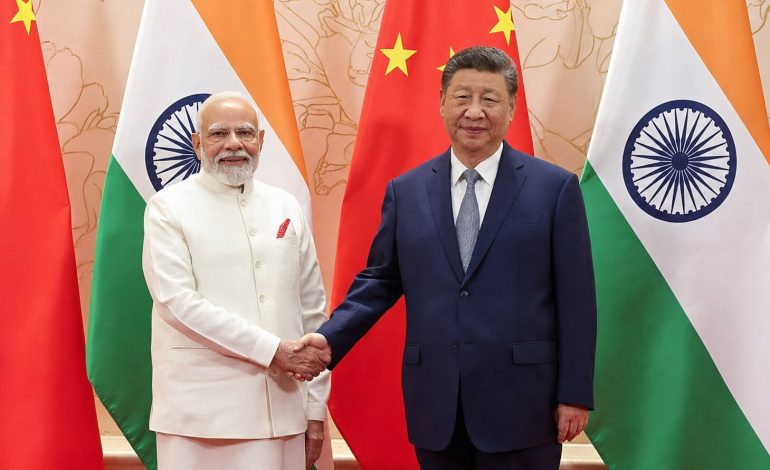
Narendra Modi (L) shaking hands with X Jinping during the 2025 SCO summit in Tianjin.

New Delhi: The Chinese president, Xi Jinping, is likely to travel to New Delhi next month for the BRICS summit, potentially making his first visit to India in seven years, a Reuters report said on Tuesday. It said preparations are reportedly underway for a delegation of about 400 Chinese officials, although Beijing and New Delhi have yet to formally confirm his attendance.
India will host the BRICS leaders’ summit in New Delhi on September 12 and 13, with Xi’s provisional travel plans still being finalized. Chinese officials have been working with their Indian counterparts on hotel arrangements and security protocols, according to people familiar with the preparations cited by Reuters.
The proposed 400-member contingent would be more than twice the size of the delegation that accompanied Xi during his previous visit in 2019. Such a large group would ordinarily include diplomatic, security, protocol, policy and logistical teams, underlining the importance Beijing appears to attach to both the summit and its engagement with India.
The Chinese foreign ministry has said Beijing attaches considerable importance to BRICS cooperation and supports India, as the current chair, in successfully organizing the summit. It has, however, said that it has no information to release about Xi’s participation, while India’s Ministry of External Affairs has not commented on the reported visit.
Xi last travelled to India on October 11 and 12, 2019, for his second informal summit with the prime minister, Narendra Modi, at Mamallapuram in Tamil Nadu. The meeting was intended to build strategic communication between the two leaders, but relations deteriorated sharply less than a year later following the military confrontation in eastern Ladakh.
Twenty Indian soldiers and at least four Chinese troops were killed in the eastern Ladakh’s Galwan valley clashes in June 2020, the deadliest violence along the disputed frontier in more than four decades. India subsequently tightened scrutiny of Chinese investments, banned hundreds of mobile applications linked to China and maintained that normal bilateral relations required peace along the line of actual control (LAC).
A breakthrough came in October 2024, when the two countries agreed on new patrolling arrangements covering the remaining friction points at Depsang and Demchok. The agreement enabled troop disengagement and the restoration of patrolling in those areas, but it did not resolve the wider boundary dispute or reverse the extensive military deployment created since 2020.
Modi and Xi held their first formal bilateral talks in five years on the sidelines of the BRICS summit in Kazan on October 23, 2024. They agreed that the boundary question should be handled through established diplomatic and military mechanisms and that differences should not be allowed to destabilize the entire relationship.
The diplomatic process gathered momentum during Modi’s visit to China for the Shanghai Cooperation Organisation summit in August 2025. During his meeting with Xi, Modi invited the Chinese leader to attend this year’s BRICS summit in India, and Xi thanked him for the invitation, according to the Ministry of External Affairs.
Since then, the two sides have moved to restore several links suspended or disrupted after the border crisis. These have included the resumption of the Kailash Manasarovar Yatra, steps towards restoring direct flights, changes to visa arrangements and discussions on reopening border trade and exchanging hydrological information on transboundary rivers.
The process nevertheless remains vulnerable to fresh military friction and competing territorial claims. Reports of recent patrol tensions near Taksing in Arunachal Pradesh have again highlighted the fragility of the situation, although Indian defence officials reportedly dismissed specific allegations of a Chinese incursion and temporary encampment as unsubstantiated.
A meeting between Modi and Xi in New Delhi would therefore be watched primarily for what it reveals about the bilateral relationship, even though the visit would formally be undertaken for a multilateral summit. Any substantive conversation is likely to cover border management, de-escalation, trade, investment, travel arrangements and the need for stable communication between their militaries.
Economic ties present an equally complicated picture because Indian manufacturing remains dependent on Chinese machinery, electronic components, chemicals, solar equipment and pharmaceutical ingredients. India’s trade deficit with China widened to $112.16 billion in 2025–26, according to figures published by the Indian embassy in Beijing, reinforcing New Delhi’s demand for greater market access and a more balanced commercial relationship.
India has also cautiously relaxed parts of its investment framework without abandoning the security safeguards introduced in 2020. The limited opening reflects an effort to attract capital and technology needed for domestic manufacturing while retaining scrutiny over Chinese participation in sensitive sectors.
For Beijing, attendance by Xi would demonstrate support for India’s BRICS chairship and help prevent the border dispute from pushing New Delhi further towards strategic coordination with Washington and other Indo-Pacific partners. China would also gain an opportunity to promote cooperation between the two largest Asian powers at a time of tariff disputes, supply-chain fragmentation and sharpening competition with the United States.
For India, hosting Xi would strengthen the summit’s diplomatic weight while allowing New Delhi to test whether Beijing is prepared to translate conciliatory language into durable changes along the border and in economic relations. India can engage China through BRICS without diluting its security concerns, strategic partnerships or insistence that peace on the frontier remains essential to sustained normalization.
The possible visit should consequently be regarded as evidence of a managed diplomatic thaw rather than a full reset. Its real significance will depend less on the size of Xi’s delegation than on whether the two sides can preserve border stability, reduce mistrust and produce measurable progress after the summit.