

Indian Navy receives third ASW craft Mangrol, boosting indigenous coastal warfare capability
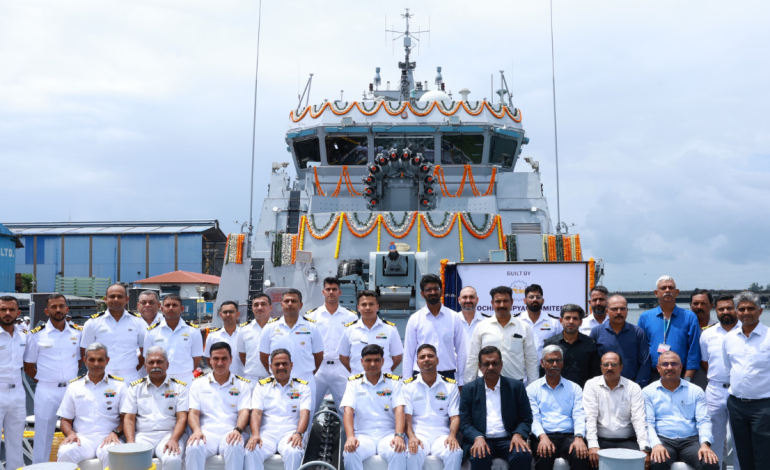
Indian Navy receives third ASW craft Mangrol. (Image courtesy: PIB)

New Delhi: India’s push to strengthen its coastal anti-submarine warfare capability received another boost with the delivery of Mangrol, the third Anti-Submarine Warfare Shallow Water Craft (ASW-SWC) built by Cochin Shipyard Limited (CSL), Kochi, for the Indian Navy on August 21, 2026. The induction comes as the Navy moves ahead with an eight-ship programme to boost its ability to detect and counter underwater threats in coastal waters.
More than 80 per cent of Mangrol’s content is indigenous, reflecting the growing depth of India’s Aatmanirbhar Bharat (self-reliant India) push. The ASW-SWC project is designed for underwater surveillance, anti-submarine warfare, Low-Intensity Maritime Operations (Limo) and mine warfare, with torpedoes, anti-submarine rockets, advanced radars and sonar systems onboard.
Mangrol is the third of eight ASW-SWCs being built by Cochin Shipyard Limited under a contract signed with the Ministry of Defence in April 2019. The first three vessels, Mahe, Malvan and Mangrol, were launched together at CSL, Kochi, on November 30, 2023.
The project has now moved from launch to induction, with the first three vessels delivered to the Navy. INS Mahe, the lead ship of the series, was commissioned in November 2025, followed by INS Malvan, which was delivered on March 31, 2026, before Mangrol joined the group on August 21.
The delivery of Mangrol also brings the Navy closer to completing a class specifically designed for operations in India’s shallow coastal waters. The remaining five vessels of the eight-ship programme are yet to be delivered; their individual delivery timelines have not been disclosed.
The ASW-SWCs are about 78 metres long, displace about 900 tonnes and can attain speeds of up to 25 knots. They are intended to undertake anti-submarine operations in coastal waters, Limo and mine-laying operations, supported by indigenously developed underwater sensors and other onboard systems.
Mangrol is named after the coastal town and minor port of Mangrol in Gujarat’s Junagadh district and preserves the legacy of erstwhile Indian naval minesweepers, the Navy said in a statement. It also continues the name of the former INS Mangrol, which remained in service until 2004.
With INS Mahe, INS Malvan and Mangrol now delivered, the ASW-SWC programme is steadily translating India’s indigenous shipbuilding push into operational capability.