

Moscow warns London as Ukraine’s British drones strike deep into Russia. Can Europe contain fallout if Trump steps back?
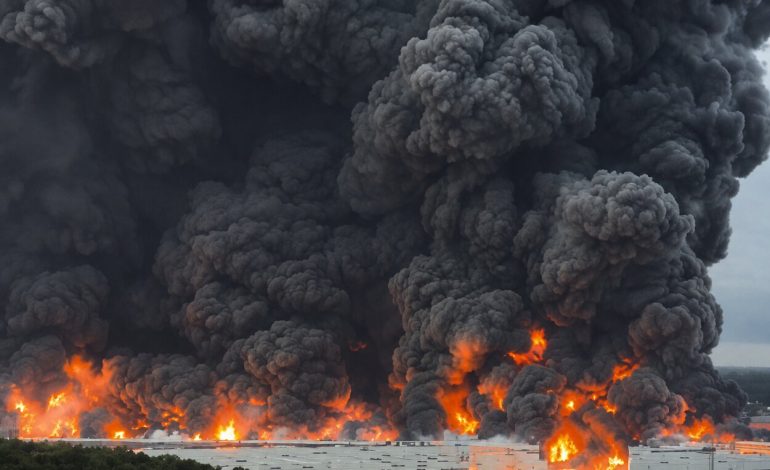
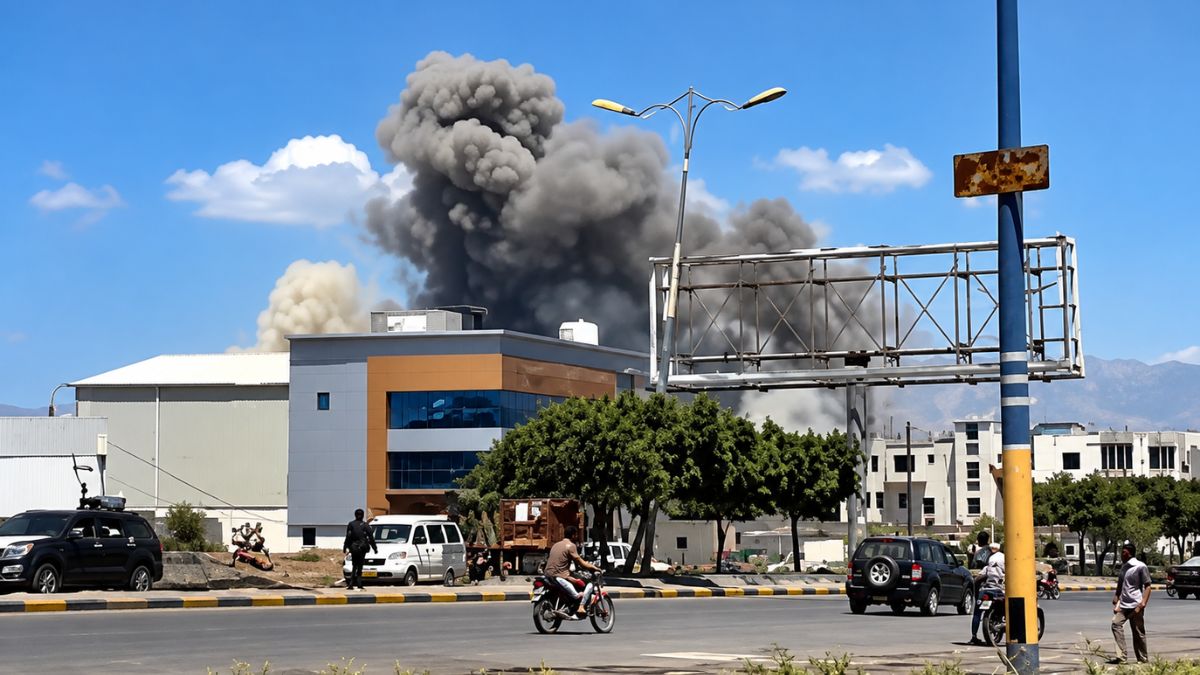
This digitally enhanced screenshot of a widely circulated video on social media shows a vast Wildberries warehouse near Moscow on fire after being hit by Ukrainian drones.

New Delhi: Russia has warned Britain that it will face unspecified consequences after reports that Ukraine used British-made drones for long-range attacks inside Russian territory for the first time. The threat adds a dangerous bilateral dimension to a conflict in which Kyiv and Moscow are increasingly striking industrial, energy and transport infrastructure hundreds of kilometres beyond the front line.
The Russian embassy in London accused Britain of deliberately escalating the war and attempting to inflict damage on Russia through a proxy. It said on Monday that Britain’s actions would “inevitably carry consequences” and warned that the deeper London became involved, the higher the price it would have to pay.
The warning followed a Sunday Times report that weapons manufactured by two British companies had been used during Ukraine’s deep-strike campaign against Russian industrial and military targets. Neither the British government nor Ukraine has publicly provided operational details confirming which attacks involved the systems.
The British defence ministry did not confirm that UK-made drones had struck Russia but rejected Moscow’s attempt to intimidate London. It said Britain remained committed to supplying Ukraine with the equipment required to defend itself against Russia’s invasion and would continue opposing Russian aggression against Ukraine, Britain and its allies.
One of the reported weapons is the Nyan, a jet-powered one-way attack drone made by Callen-Lenz, a subsidiary of BAE Systems, with a stated range exceeding 240 kilometres. The other is an unnamed catapult-launched aircraft said to be capable of travelling more than 960 kilometres, although its manufacturer was withheld for security reasons.
According to Ukrainian military sources cited in the original report, British systems have been employed over the past six months against oil refineries around Moscow and in Yaroslavl and Volgograd. The Nyan has also reportedly been used against targets near Belgorod, close to the Ukrainian border, but the claims have not been independently verified.
Ukraine continues to conduct most of its long-range missions with domestically produced weapons, including the FP-1 drone and the Flamingo cruise missile. British equipment nevertheless gives Kyiv another supply line for comparatively inexpensive weapons that can be launched in numbers without consuming its limited stocks of Storm Shadow and other sophisticated missiles.
A long-range attack drone can cost a fraction of a cruise missile and is easier to manufacture, disperse and launch in large waves. Even when many are intercepted, such raids compel Russia to move radars, electronic-warfare systems and surface-to-air missiles away from the battlefield to protect refineries, airfields, factories and cities across a vast territory.
The distinction between British-manufactured systems and Britain’s wider drone programme is important, however. The British government announced in June that it would finance 150,000 Ukrainian-produced drones by the end of 2026 as part of a £752 million package that also includes more than 350 air-defence missiles and radars.
London’s policy reflects the increasing centrality of unmanned aircraft to the war rather than an acknowledged decision to direct attacks inside Russia. Yet Moscow treats the origin of a weapon, the intelligence supporting its mission and the personnel involved in its operation as politically significant when deciding whether a western country has crossed an escalation threshold.
The dispute comes as Kyiv sharply expands the scale and geographical reach of its attacks. In one of its largest operations of the war, as RNA Media reported, Ukraine sent hundreds of drones towards Moscow and other Russian regions, killing at least six people and setting a major Wildberries distribution centre near the capital on fire, according to Russian authorities.
Russia claimed that more than 800 drones were intercepted during the August 15–16 assault, although the figure could not be independently verified. The attack disrupted airports, damaged warehouses and demonstrated that Ukraine could impose economic and psychological costs well beyond Russia’s border regions.
The campaign has simultaneously moved against strategic maritime infrastructure. A coordinated Ukrainian attack on Novorossiysk, Russia’s principal Black Sea naval base and an important grain and oil-export hub, damaged port installations and forced two grain terminals to suspend operations on August 12.
That disruption briefly pushed wheat prices higher and added to war-risk insurance and shipping costs in the Black Sea. Novorossiysk also handles crude transported through the Caspian Pipeline Consortium system, including oil produced in Kazakhstan by ventures involving major Western companies, making any prolonged interruption an international economic concern.
Ukraine has also intensified attacks on Russian refineries and petroleum facilities in Bashkortostan, Yaroslavl and other regions. Kyiv argues that such installations finance and sustain Russia’s war effort, although strikes near populated areas and commercial facilities inevitably increase the danger to civilians.
There is no public evidence that British drones were used in each of these attacks, and the three campaigns should not be conflated. Taken together, however, they reveal a deliberate Ukrainian effort to attack the economic, military and logistical systems supporting Russia’s war rather than limit operations to troops and equipment near the front.
Why Europe – and particularly London – must take Moscow’s warning seriously
Taking the Russian warning seriously does not require accepting Moscow’s description of British assistance as terrorism or abandoning Ukraine’s right to defend itself. It requires recognizing that Russia has both the means and an established record of retaliating against adversaries through actions designed to remain below the threshold of conventional war.
Britain occupies a particularly exposed position because it is one of Ukraine’s most active European military supporters, a major intelligence power and a producer of long-range weapons. London also co-leads the Ukraine Defence Contact Group with Germany and, alongside France, has played a central role in planning European security arrangements for Ukraine.
The significance of Moscow’s language therefore lies less in the probability of an immediate Russian missile strike on Britain than in the range of deniable alternatives available to the Kremlin. These include cyberattacks, espionage, sabotage, disinformation, interference with transport and logistics, attacks on defence manufacturers and operations against energy or communications infrastructure.
Britain’s own national security strategy says the country faces increasing threats involving assassination, intimidation, espionage, sabotage and cyberattacks. It specifically identifies undersea cables, energy pipelines, data centres, transport networks and logistics hubs as potential targets for hostile states and their proxies.
The concern is grounded in experience rather than speculation. A British government assessment of Russian military intelligence links the GRU’s specialist units to the 2014 explosions at an ammunition depot in Czechia, the attempted murder of Sergei and Yulia Skripal in Salisbury in 2018 and cyber operations against governments, defence organizations and infrastructure across Europe.
The EU and Nato have similarly accused Russia and its proxies of conducting sabotage, political interference, electronic disruption and malicious cyber activity across the continent. Nato says such operations are intended to create fear, disrupt economies and weaken European support for Ukraine without necessarily producing the unambiguous armed attack that would trigger a collective military response.
This area below open warfare is especially dangerous because Nato has stated that a sufficiently serious cyber or hybrid attack could qualify as an armed attack under Article 5. There is no automatic formula for determining when that threshold has been crossed, leaving room for disagreement, delayed attribution and miscalculation between governments.
Moscow may therefore calculate that a disruptive operation against a British company, port, railway, power network or communications system could impose costs without provoking a unified Nato response. London, conversely, could interpret a major incident as state-sponsored aggression, particularly if it caused deaths or seriously damaged critical national infrastructure.
The expansion of Ukraine’s deep-strike campaign adds another layer of uncertainty because drones can be modified, launched through covert networks or routed to complicate attribution. A weapon that malfunctions, strikes a civilian site or crosses into Nato airspace can turn a planned military operation into a political crisis before the facts have been established.
The attacks on refineries, warehouses and Novorossiysk also show how the escalation can move beyond military exchanges. Damage to grain terminals can affect food prices, strikes on oil infrastructure can unsettle energy markets, and repeated attacks around the Black Sea can increase insurance premiums and endanger commercial vessels belonging to third countries.
Ukraine’s strategy has a clear military rationale: reducing Russian fuel production, forcing the dispersal of air defences and raising the domestic cost of continuing the war. Its tactical effectiveness, however, can produce strategic risk if Moscow responds by widening its own target list or blaming European suppliers for operations that cause substantial Russian civilian casualties.
Russia is already attacking Ukrainian energy facilities, ports and cities with drones, cruise missiles and ballistic weapons, creating a reciprocal cycle in which each side justifies escalation as an answer to the other. Ukraine’s shortage of Patriot interceptors makes that imbalance particularly serious because Kyiv can increasingly strike deep into Russia but remains vulnerable to retaliatory ballistic-missile attacks.
The president of Ukraine, Volodymyr Zelenskyy, has said his country possesses only about 1 per cent of the US Patriot interceptor stockpile and needs substantially more to protect civilians through winter. Deliveries have dwindled as the conflict with Iran absorbs American air-defence resources, exposing how events outside Europe can directly weaken Ukraine’s defensive capacity.
This is where the position of the president of the United States, Donald Trump, becomes central to Europe’s calculations. His administration has continued intelligence-sharing and weapons sales, but it has not sought new congressional funding for Ukraine, has stepped back from leading the Ukraine Defence Contact Group and insists that European allies pay for American equipment transferred to Kyiv.
The shift is not complete US abandonment of Nato or Ukraine, and Trump joined other leaders in reaffirming the alliance’s collective-defence commitment at the July 2026 Ankara summit. Washington’s policy is nevertheless increasingly transactional, with Europe expected to finance Ukraine’s requirements and assume primary responsibility for containing Russia.
The reasons extend beyond Trump’s scepticism about open-ended foreign commitments. Washington is managing depleted interceptor stocks, a prolonged confrontation with Iran, competing requirements in the Indo-Pacific and domestic pressure to avoid another war whose costs and risks are seen as falling more directly on Europe.
The US National Defense Strategy explicitly says European allies should take the lead against threats that are less severe for the United States, with Washington providing more limited support. Reports that the US intends to reduce forces available to Nato during crises reinforce European doubts about whether American political and military backing would arrive as rapidly as it once did.
Europe has increased defence spending and expanded arms production, but it cannot yet replace all the intelligence, air defence, strategic transport, surveillance and command capabilities supplied by the United States. It is therefore assuming greater responsibility for Ukraine at the same time that the military risks are increasing and Washington’s appetite for direct involvement is declining.
The most dangerous escalation would probably not begin with a deliberate Russian attack on London. It could emerge from a Ukrainian strike causing mass casualties in Russia, a covert Russian response against British infrastructure, contested evidence about responsibility and political pressure on Nato to retaliate before every government accepts the attribution.
London and its European partners must consequently combine continued assistance to Ukraine with tighter end-use controls, target scrutiny, intelligence coordination and military-to-military crisis communication. They also need stronger counter-drone defences, protected defence-production sites, resilient cyber networks and larger stocks of interceptors capable of absorbing retaliation without immediately depending on Washington.
Moscow’s warning may partly be coercive messaging intended to fracture Western support for Kyiv, but dismissing it as empty rhetoric would be imprudent. Europe’s task is to deter Russian retaliation without creating ambiguity about who controls Western-supplied weapons, because an unmanaged escalation involving Britain would quickly become a test of Nato at a time when American support is less automatic than Europe has long assumed.