


India steps up military drone security as framework awaits defence ministry approval
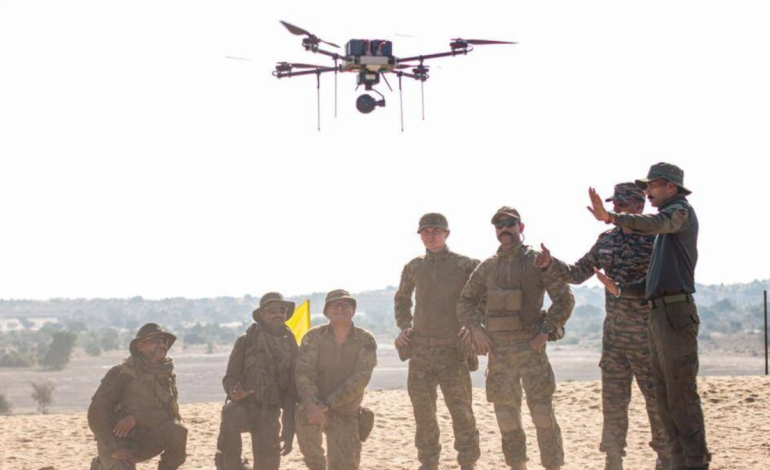
Representational image. (Image courtesy: Wikimedia)

New Delhi: The rapid expansion of military drones is forcing India to look more closely at what goes inside these platforms and not just where they are made. With the armed forces expected to place large orders for unmanned systems in the coming years, the government is working on a detailed system to detect security risks in drone hardware and software.
The proposed security framework has been prepared by the Army Design Bureau and has been awaiting approval from the defence ministry for nearly 18 months since its first draft was published in March 2025. Reports said the latest version has already been sent to the ministry after several rounds of discussions with manufacturers and other stakeholders.
The framework is expected to make laboratory-based testing an important part of military drone procurement. More than 20 tests have been proposed to check critical components and identify vulnerabilities that may not be visible during a normal inspection.
The concern over the security of military drones came into sharper focus after BusinessLine published a series of reports from August 27, 2024, on the use of Chinese hardware and software in drones being supplied as indigenous platforms. The reports raised questions about how effectively the origin and security of individual components were being checked despite India’s ban on imports of complete Chinese drones and their spares since February 2022.
The issue has become even more important after Operation Sindoor, when drones played a major role in military operations. Drone Federation of India president, Smit Shah said tactical drones worth around ₹3,000–4,000 crore have been delivered since then, while the armed forces could procure unmanned systems worth at least ₹15,000 crore over the next two years.
For the industry, some parts of the proposed framework remain difficult to implement. Shah said manufacturers had raised concerns about requirements related to the design of integrated circuits and microchips, while discussions were also continuing on certification and cybersecurity keys.
The government already has checks in place for drones being offered to the armed forces. Boards of officers inspect key components such as flight controllers during the tendering process, while cybersecurity assessments are also conducted using standards followed in the US and Europe, Shah said.
However, industry sources believe physical inspection alone cannot identify every possible threat. A component may appear genuine during an inspection but could still contain hidden functionality or vulnerabilities that require specialized equipment and laboratory testing to detect.
Recent developments in other countries have added to these concerns. The UK defence ministry recently found that Chinese-origin camera components installed on Royal Navy K3 Scout vessels were sending periodic signals to an IP address in China, although no evidence emerged that sensitive information had been compromised.
The incident has highlighted a difficult problem for militaries. Security checks can establish who supplied a component and whether it meets declared specifications, but they may not always reveal what the component actually does once connected to a military network.
This framework is anticipated to address such issues through a more systematic approach to testing. The drones and their key parts will be analysed by an accredited laboratory prior to being used for military operations, eliminating the need for visual and documentary inspection conducted by the vendors.
The push for stronger checks comes as India expands its drone capabilities at both ends of the spectrum. RNA reported that India is leasing two MQ-9B SeaGuardian drones for ₹1,943 crore to strengthen its surveillance capabilities, while the wider expansion of the domestic drone industry is expected to create opportunities for Indian manufacturers.
The challenge now is to ensure that the growth of India’s military drone fleet is matched by equally strong security standards. For an unmanned system operating in a sensitive military environment, proving that it is made in India may no longer be enough unless its individual components and software can also be trusted.