

Taliban marks 5 years in power: India, Russia, China, Iran join Afghanistan’s Victory Day event
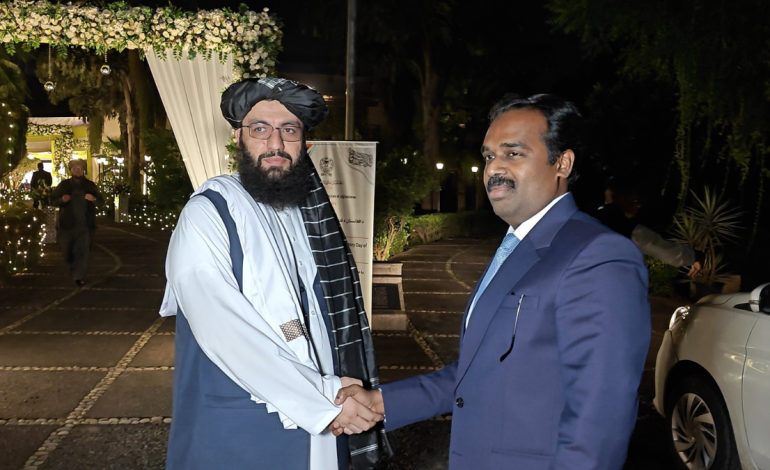
Ministry of external affairs joint secretary Anand Parkash attended the first ‘Victory Day’. (Image courtesy: X/@SamriBackup)

New Delhi: Afghanistan’s Islamic Emirate marked five years since its return to power with its first public Victory Day reception in New Delhi on Monday, attended by ministry of external affairs joint secretary, Anand Prakash as chief guest, reflecting the steady expansion of engagement between Kabul and India. Afghan chargé d’affaires Noor Ahmed Noor used the occasion to call for stronger political trust, economic cooperation and greater connectivity between the two countries, while India continues to engage with Kabul without formally recognizing the Taliban government.
The reception at the Afghan embassy was attended by diplomats, Indian civil society representatives and media. Representatives from India, Russia, China, Iraq, Qatar, the UAE, Palestine, Niger, Oman, Mongolia and Serbia attended the event, with Iranian ambassador Dr Mohammad Fathali among the diplomats present.
Noor said closer ties between the two countries could contribute to wider regional stability and economic development. “Stronger political trust, economic partnership and continued engagement between the two countries will not only benefit both countries, but will also make an important contribution to regional stability, connectivity, and shared prosperity,” he said.
The Afghan diplomat also thanked Indian leadership and the external affairs minister, S Jaishankar for supporting Afghanistan’s international rights and raising the issue at international forums. “We hope that greater attention and practical efforts will be made in this regard,” Noor said, calling for continued international engagement with Afghanistan.
Noor also highlighted the longstanding links between Afghanistan and India, referring to centuries of trade, cultural exchanges and movement of scholars, poets and Sufis between the two regions. He said the historical relationship provided a foundation for developing closer ties in the present, noting that Afghan cities such as Kabul, Herat and Kandahar had historically welcomed Indian traders and caravans.
For India, engagement with Kabul has increasingly acquired a strategic dimension. New Delhi has sought to maintain communication with the Taliban-led administration while focusing on counterterrorism, humanitarian assistance, trade and connectivity, particularly as Afghanistan remains important to India’s wider interests in Central Asia.
India’s approach has become more structured since the Taliban returned to power in August 2021. Afghan foreign minister, Amir Khan Muttaqi, visited New Delhi in October 2025, after which India upgraded its technical mission in Kabul to a full embassy and allowed Taliban-appointed diplomats to operate in Afghanistan’s diplomatic missions in India.
The growing engagement also comes against the backdrop of deteriorating relations between Afghanistan and Pakistan. Tensions over the Durand Line, cross-border militancy and the presence of the Tehreek-e-Taliban Pakistan have strained relations between Kabul and Islamabad, giving India more room to deepen its own diplomatic engagement with Afghanistan.
In New Delhi, on the other hand, there is still a difference made between engagement and recognition. India has not recognized the regime of the Taliban yet and, at the same time, has been insistent on ensuring that Afghan land is not used for terror activities against other nations.
The Taliban has meanwhile sought greater acceptance from regional powers as it completes five years in power. Although the regime has established working relations with several countries, Afghanistan continues to face economic and humanitarian challenges, while restrictions on women and girls remain a major point of international concern.
Even after the new government of Afghanistan took over, India has kept offering humanitarian and developmental aid to Afghanistan, with the most recent Union Budget having a provision of ₹150 crores for Afghanistan. This is an indication that the Indian government wants to maintain its interest in Afghanistan but in accordance with its security and strategic interests.