



India’s ₹1,943 crore MQ-9B SeaGuardian UAV lease bridges surveillance gap, opens wider drone-industry opportunity
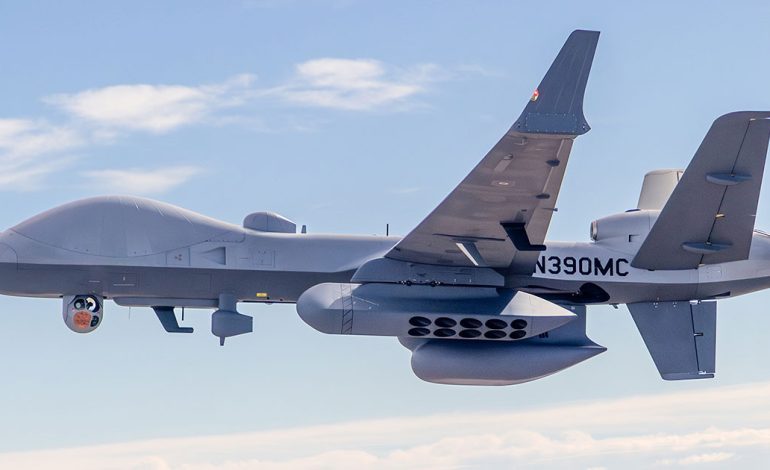
An MQ-9B SeaGuardian drone. (Photo: General Atomics)

New Delhi: India has signed a ₹1,943 crore agreement to lease two MQ-9B SeaGuardian remotely piloted aircraft for 30 months, giving the Indian Navy a timely surveillance bridge until its permanently acquired fleet begins arriving. Beyond filling an immediate operational gap, the arrangement offers India an opportunity to strengthen maritime-domain awareness, retain experienced crews and prepare a domestic maintenance ecosystem for a much larger MQ-9B inventory.
The Ministry of Defence signed the contract with the US-based General Atomics Aeronautical Systems Inc on Monday, in the presence of the additional secretary and director general (acquisition), A Anbarasu, at Kartavya Bhawan-2 in New Delhi. The ministry said the high-altitude, long-endurance aircraft would provide persistent intelligence, surveillance and reconnaissance coverage across large parts of the Indian Ocean region.
The timing is significant because India’s separate acquisition of 31 MQ-9B aircraft from the United States is not expected to produce an operational fleet immediately. Deliveries under that agreement are scheduled to begin in January 2029 and conclude by September 2030, according to an analysis published by the Manohar Parrikar Institute for Defence Studies and Analyses.
A 30-month lease beginning in August would broadly cover the period leading up to the first deliveries, reducing the possibility of a break in long-endurance surveillance capability. It should also allow the Navy to preserve the operational knowledge accumulated since it first began flying leased General Atomics aircraft in November 2020.
That earlier experiment established the value of a platform capable of remaining over distant areas for prolonged periods without committing a crewed aircraft to every surveillance task. General Atomics said in December 2022 that the two aircraft then operated by the Navy had completed 10,000 flight hours in two years and supported coverage across more than 14 million square miles.
The MQ-9B family can remain airborne for more than 40 hours, operate beyond the horizon through satellite communications and carry electro-optical, infrared and radar sensors. The SeaGuardian version has been developed specifically for maritime missions and incorporates systems intended to permit safer integration with controlled airspace.
For India, such endurance translates into a greater ability to monitor shipping routes, naval movements, offshore installations, fishing activity and vessels behaving suspiciously across an oceanic area that cannot be covered continuously by ships alone. The aircraft can cue warships, helicopters and P-8I maritime-patrol aircraft towards a contact of interest, allowing the Navy to employ its more expensive crewed assets selectively.
The operational case has already been tested during real missions rather than routine patrols alone. During the March 2024 operation to free the hijacked merchant vessel MV Ruen, a high-altitude remotely piloted aircraft and a P-8I maintained surveillance while Indian warships and Marine Commandos (Marcos) closed in on the vessel about 2,600 kilometres from the mainland.
Persistent aerial coverage has become increasingly important as the Navy maintains deployments from the Gulf of Oman and the Gulf of Aden to the approaches of the Malacca Strait. Piracy, attacks on commercial shipping, narcotics trafficking, unregulated fishing and the activities of regional and extra-regional navies have collectively increased the demand for reconnaissance aircraft that can stay on station for long periods.
The lease also creates an opportunity to prepare personnel, operating procedures and ground infrastructure before the 31 purchased MQ-9Bs enter service. India’s 2024 agreement allocates 15 SeaGuardians to the Navy and eight SkyGuardians each to the Indian Army and Indian Air Force, making common training, data exploitation and maintenance arrangements important to economical tri-service operations.
A second contract signed in October 2024 provides for performance-based logistics and depot-level maintenance, repair and overhaul in India for the purchased fleet. The latest leased aircraft could therefore help Indian engineers and technicians gain additional familiarity with the platform before the domestic support system assumes responsibility for a substantially larger number of aircraft.
The potential industrial benefit, however, will depend on how far New Delhi can move beyond routine maintenance and assembly. Reports on the acquisition programme have said that 21 of the 31 aircraft would be assembled in India, but that the agreement does not provide for a formal transfer of technology; consequently, local work must be expanded into component manufacturing, systems integration, software support and high-value repairs if it is to create durable capability.
India could also use the accumulated operational data to refine requirements for indigenous high-altitude unmanned aircraft. Understanding sensor performance, satellite-bandwidth demands, maintenance cycles, mission planning and the limitations of a large remotely piloted platform in contested airspace could be particularly valuable for the Defence Research and Development Organisation and private Indian drone companies.
The ₹1,943 crore price nevertheless requires scrutiny because it works out to nearly ₹972 crore for each aircraft over the lease period. That calculation is not equivalent to a unit purchase price – the contract may cover guaranteed flying hours, sensors, ground systems, satellite links, maintenance and contractor support – but the government has not publicly disclosed the cost breakdown or the precise configuration.
Nor does leasing confer ownership or technological sovereignty, and the aircraft’s utility would be constrained in heavily defended airspace against a capable adversary. Its strongest immediate value lies in persistent surveillance over the open ocean, where endurance, sensor reach and rapid information-sharing matter more than survivability against advanced air-defence systems.
The new agreement should therefore be judged on two levels: how effectively it closes the Navy’s surveillance gap over the next 30 months, and how much lasting expertise India extracts from it. If the lease is linked intelligently with local maintenance, tri-service training, indigenous sensor integration and domestic unmanned-aircraft development, it can become more than an expensive interim arrangement.