
India hands over 5 boats to Seychelles as maritime security partnership deepens
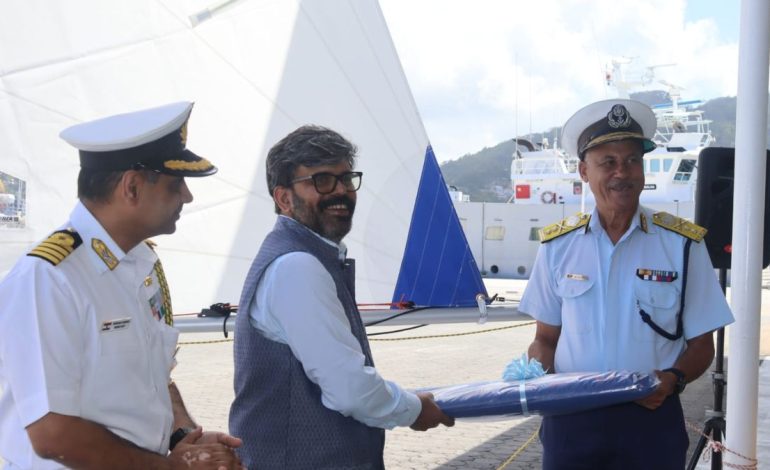
India hands over Laser Radial sailing boats to the Seychelles Defence Forces, strengthening bilateral maritime cooperation. Image courtesy: X.com/@hci_seychelles

New Delhi: India has handed over five Laser Radial (ILCA 6) sailing boats to the Seychelles Defence Forces (SDF), completing a commitment made during Prime Minister Narendra Modi’s state visit to the island nation in June. The boats, meant for seamanship training, were handed over by India’s high commissioner to Seychelles, Rohit Rathish, to the chief of SDF, Major General Michael Rosette.
The transfer is modest in itself but forms part of a wider Indian defence-assistance programme involving patrol vessels, aircraft, maritime surveillance, training and capacity building. That broader relationship gives the latest handover greater strategic significance in the western Indian Ocean.
Modi visited Seychelles from June 27–29 as the country marked 50 years of independence. The visit also highlighted five decades of diplomatic relations between India and Seychelles and produced several new defence and development commitments.
India handed over PS Lespwar, a fast patrol vessel built by Goa Shipyard, to the Seychelles Coast Guard during the visit. The vessel is expected to strengthen maritime surveillance, search and rescue and protection of the country’s waters.
India also supported the refit of the Seychelles Coast Guard Vessel PS Zoroaster and the upgrade of a Dornier aircraft used for maritime surveillance.
The assistance follows a $175 million special economic package announced during President Patrick Herminie’s visit to India in February. The package covers development projects, capacity building and maritime security.
Seychelles strategically vital in IOR
Seychelles has a population and landmass far smaller than many of India’s other partners, but the waters it must monitor are vast. Its exclusive economic zone extends across about 1.37 million square kilometres, making maritime surveillance central to its national security and blue economy.
Its location in the western Indian Ocean region (IOR) also gives it wider strategic importance.
India and Seychelles have identified piracy, narcotics trafficking, illegal fishing, human trafficking and other transnational crimes as common maritime challenges. Their cooperation includes surveillance, information sharing, training and coordinated maritime activity.
Seychelles is also a member of the Colombo Security Conclave, which brings together Indian Ocean countries to cooperate on maritime security, counterterrorism, cyber security and transnational crime.
Military aid beyond platforms
India’s support to Seychelles has developed over several years and is not limited to the supply of ships or aircraft. Training, hydrographic assistance, equipment support, joint surveillance and military exercises have become regular features of the relationship.
Seychellois personnel also undergo specialised training in India.
Five members of the Seychelles Police recently travelled to Kochi for training in visit, board, search and seizure procedures at an Indian Coast Guard facility under the Colombo Security Conclave framework.
Exercise Lamitiye remains another important pillar of military cooperation. Held since 2001, the exercise brings Indian and Seychellois personnel together for training in areas such as counterterrorism, maritime interdiction and tactical operations.
The 2026 edition widened that engagement further, with personnel and assets from all three Indian armed services participating alongside the Seychelles Defence Forces.
Indian Navy ship Trikand also provided critical spares and stores during the exercise, underlining the practical nature of the defence relationship.
For Seychelles, Indian assistance helps build the manpower, equipment and technical capacity needed to monitor a maritime zone far larger than its land area. For India, supporting Seychelles strengthens a trusted partner along important sea lanes in the western Indian Ocean.
The five sailing boats are therefore only one part of a much wider relationship.