

Lashkar commander admits ‘unknown gunmen’ killed 30 of its operatives in Pakistan
RNA illustration for representation.

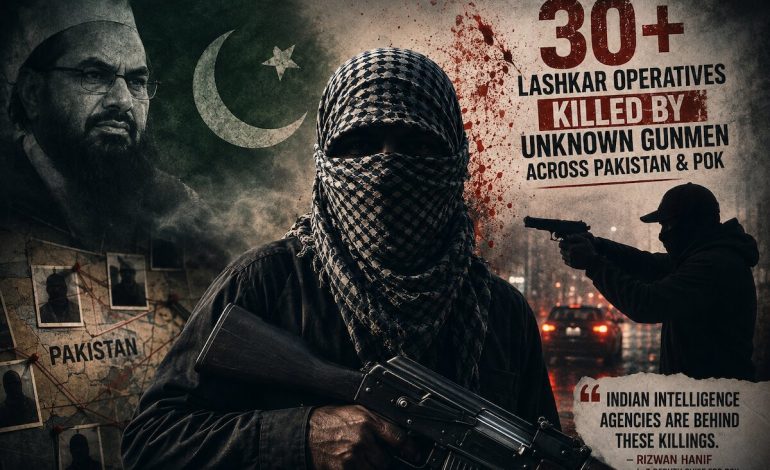
New Delhi: A senior Lashkar-e-Taiba commander has, for the first time, publicly acknowledged that more than 30 of the banned outfit’s operatives were killed by “unknown gunmen” across Pakistan and Pakistan-occupied Kashmir (POK) over the past three to four years. The admission, made in a video that has gone viral on social media, marks a rare crack in the group’s usual silence over the string of unexplained assassinations targeting its operatives.
The commander, Rizwan Hanif, identified as Lashkar-e-Taiba’s deputy chief for POK, named Karachi, Peshawar, Rawalpindi, Muzaffarabad and Rawalakot as the sites where the killings took place. He accused Indian intelligence agencies of orchestrating the attacks through unidentified shooters – a claim New Delhi has consistently rejected whenever Islamabad has raised it in the past.
The video is understood to have been recorded in May this year, although it surfaced widely online only in the past few days. Hanif, who has a documented history of recruiting terrorists and facilitating cross-border infiltration, reportedly used derogatory language against Hindus during the recording, according to multiple Indian news outlets that have viewed the footage.
One linked to 2006 RSS attack
One of the operatives Hanif referred to was Abu Saifullah, also known as Razaullah Nizamani, who was killed in Sindh province. Nizamani had been linked to the 2006 attack on the headquarters of the Rashtriya Swayamsevak Sangh (RSS) in Nagpur, which makes his death one of the more significant losses the group has suffered in this pattern of killings.
Hanif offered no evidence to support his claim that Indian agencies were behind the deaths, a point several commentators have flagged given the seriousness of the accusation. The phrase “unknown gunmen” has, over the years, become a common shorthand in Pakistani media and political circles for unclaimed killings that Islamabad routinely – and without proof – attributes to India’s Research & Analysis Wing.
This is not the first time such killings have been reported, though it is the first occasion a Lashkar figure has openly admitted the scale of the losses. Pakistan’s government and security establishment have periodically accused India of running a campaign of targeted eliminations on its soil, allegations that successive Indian governments have dismissed as baseless and unsubstantiated.
The admission comes at a delicate moment for Pakistan, with Pakistan-occupied Kashmir, Balochistan and Khyber Pakhtunkhwa all witnessing sustained unrest in recent months. It also comes weeks after visuals emerged of Talha Saeed, son of Lashkar founder Hafiz Saeed, attending the funeral of former Pakistan cricketer Shoaib Akhtar’s elder brother in Islamabad, an appearance that Indian officials cited as further proof of the group’s continued, unhindered presence in Pakistan.
NIA separately names Hafiz Saeed
Separately, the National Investigation Agency named Hafiz Saeed as an accused in the Pahalgam terror attack case in July, reinforcing New Delhi’s longstanding position that Lashkar continues to operate with the tacit support of elements within the Pakistani state. Indian investigators have also linked Lashkar commander Latif Bhat and his associate Waris Shah to the recent killings of two non-local labourers in Kulgam and two policemen in Anantnag. International assessments have periodically echoed India’s concerns.
The United States Congressional Research Service, among other bodies, has previously flagged Pakistan’s patchy record in acting against groups such as Lashkar-e-Taiba and Jaish-e-Mohammed, despite both organizations being formally banned under domestic and international sanctions regimes. Whether Hanif’s admission prompts any fresh scrutiny of that record remains to be seen, though the video’s wide circulation has already reopened debate on both sides of the border.