

Bharat Forge, Flying Whales sign pact to build heavy-lift airships in India
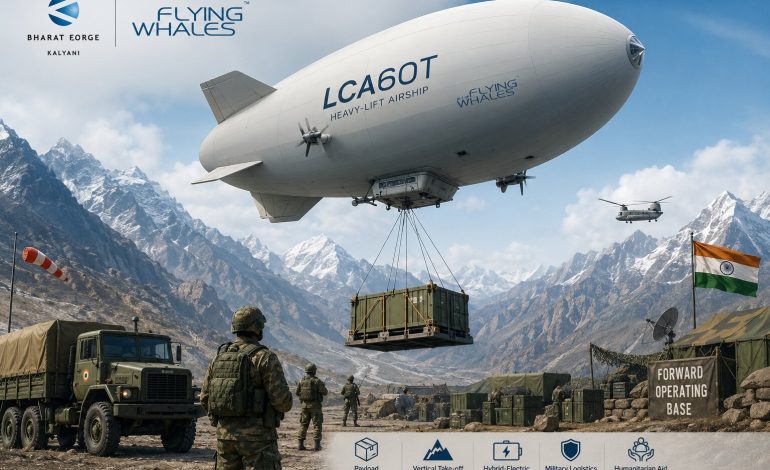
RNA Media illustration for representation.

New Delhi: Bharat Forge’s aerospace division has signed a memorandum of understanding with Flying Whales, the French-Canadian heavy-lift airship developer, to jointly design, build and deploy airships in India for military and strategic logistics use. The pact was signed on Wednesday at the Farnborough International Airshow in Hampshire, England.
The aerospace and defence industry’s marquee biennial gathering, running this year from July 20 to 24. It was signed by Guru Biswal, chief executive officer of Bharat Forge Aerospace, and Sebastien Bougon, president of Flying Whales.
At the centre of the arrangement is the LCA60T, Flying Whales’ next-generation airship, designed to carry payloads of up to 60 tonnes, as RNA Media briefly reported earlier. The platform is built for vertical take-off and landing, runs on a hybrid-electric propulsion system, and needs little in the way of ground infrastructure – attributes the two companies say make it well suited to remote and inhospitable regions.
Under the agreement, the partners will work towards manufacturing, integrating and producing the airships domestically. The intended applications span a wide arc of military logistics: resupplying forward operating bases, moving oversized equipment that cannot easily go by road or rail, intelligence, surveillance and reconnaissance (ISR) work, communication relay, humanitarian and disaster relief (HADR), and rapid deployment along the border and in difficult terrain.
Amit Kalyani, executive vice-chairman and joint managing director of Bharat Forge, described the tie-up as an opportunity to build sovereign capability in a strategically significant segment of aerospace, and to open a fresh avenue for the country’s defence manufacturing base. Bharat Forge said the collaboration was in keeping with the government’s Atmanirbhar Bharat and Make in India programmes, and that a localized production run could, over time, seed a domestic supply chain and create high-technology jobs.
For India, the appeal of heavy-lift airships lies chiefly in geography. Large stretches of the Himalayan frontier – from Ladakh to Arunachal Pradesh – remain accessible chiefly by helicopter or, where terrain permits, by a limited network of roads that are frequently closed by snow or landslides. An airship able to land vertically without a runway, carry tonnage well beyond helicopter capacity and reach altitude with minimal fuel overheads would, at least on paper, offer the Indian Army and Indian Air Force a logistics option that neither fixed-wing transport nor rotary aircraft can fully replicate.
Whether the LCA60T can be adapted to operate reliably at high altitude and in the region’s often severe weather is likely to be tested well before series production is considered.
The Farnborough MoU is the latest in a run of partnerships through which Bharat Forge has been broadening its footprint beyond its traditional business of forgings and components. The company – part of the Kalyani Group – has separately entered into a tripartite arrangement with BEML and Data Patterns (India) to support the AMCA (advanced medium combat aircraft) programme, and signed an MoU with Britain’s Windracers for the local deployment of ULTRA unmanned aerial vehicles under the UK-India Vision 2035 framework.
Together, the deals mark a shift for the company from being a supplier of parts to becoming a designer and manufacturer of complete defence platforms. Markets, for their part, showed little reaction to the announcement. Bharat Forge shares were trading marginally lower through the Farnborough session, broadly in line with subdued sentiment across the counter that day.
Neither company has indicated a timeline for prototype development or first deliveries, and the MoU – as is customary at this stage – does not commit either party to firm production numbers or investment figures.