Trump warns Iran: ‘Bomb them’ if I’m assassinated
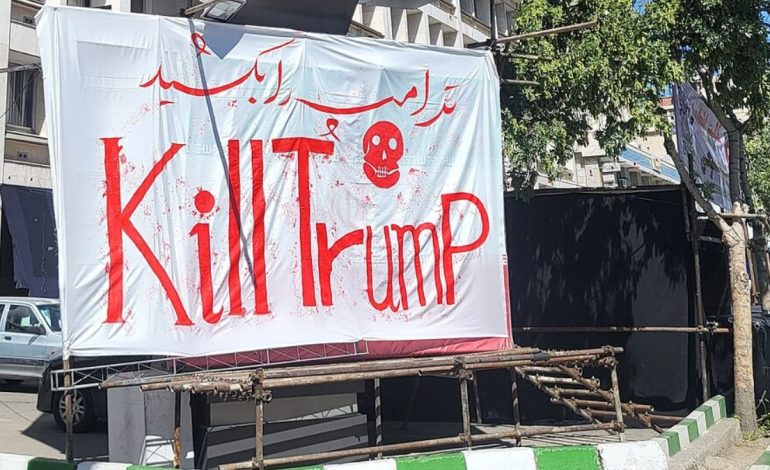
A banner reading "Kill Trump" is displayed on a street in Tehran. Image credit: Wikimedia

New Delhi: The US president, Donald Trump, said he has left standing orders for the US military to strike Iran with massive force if he is assassinated. But legal experts say no such order can legally survive his presidency.
Trump made the claim in two separate statements. In an interview with the New York Post, he said he had left instructions for the military to retaliate against Iran “at levels that they’ve never seen before” if anything happened to him. He later posted on Truth Social that 1,000 missiles were “locked and loaded” and ready to strike Iranian targets under his standing orders.
The Wall Street Journal first reported that Israel had shared intelligence with the US about a plot to assassinate Trump. The CNN later reported that the details of the plot were not immediately clear, and that American intelligence agencies had not independently vetted the information or been tracking it before Israel’s warning.
The remarks came amid heightened concern over Iranian hostility toward Trump. Tensions trace back to the 2020 killing of Iranian commander Qasem Soleimani, after which Iranian officials repeatedly vowed revenge. Tensions escalated further after the death of Ali Khamenei during the 2026 conflict, when funeral processions in Iran featured chants calling for Trump’s death, according to multiple reports.
Despite Trump’s public claims, constitutional experts say a sitting president cannot create a binding, automatic military order that takes effect after death. Under the 25th Amendment and the Presidential Succession Act of 1947, presidential powers, including command of the military, transfer immediately to the vice president if a president dies in office. That would make the US vice president, JD Vance, the sole authority on whether, when and how the US responds to any attack, regardless of any instructions Trump has said he left behind.
This is not the first time a US president has faced security threats linked to Iran. In 2022, the Justice Department charged a member of Iran’s Revolutionary Guard Corps with plotting to assassinate John Bolton, who served as Trump’s national security adviser during his first term.
Trump has faced threats to his life before. He survived two assassination attempts during the 2024 presidential campaign, and a gunman also stormed the White House Correspondents’ Association dinner he was attending in April.
Sabrina Singh, a former Biden administration Pentagon spokesperson, said threats from Iran against senior American leaders should be taken seriously. “Iran wanting to target senior American leaders is something that we know is happening,” she said.
Iran’s supreme leader, Mojtaba Khamenei, responded hours after Trump’s post, saying Iranians would continue to avenge the killing of his father, Ali Khamenei, who died in the strikes that started the 2026 war. He said retaliation “is the will of our nation and must certainly be carried out.”
For now, the question of retaliation remains hypothetical. But Trump’s remarks have reopened a debate over how far a president’s authority can stretch beyond their own time in office.