


Centre sends notices to WhatsApp, Telegram and Signal over username features amid fraud concerns
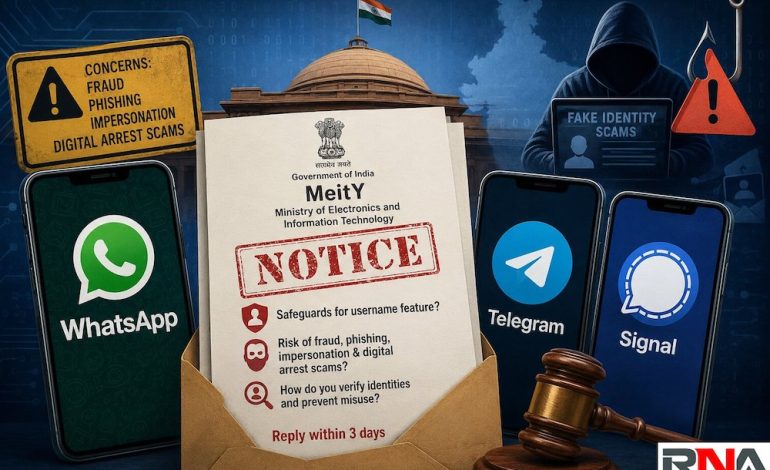
RNA illustration for representation.

New Delhi: The Ministry of Electronics and Information Technology (MeitY) has issued notices to WhatsApp, Telegram and Signal within the space of two days. The government is questioning the safeguards built into each platform’s username feature and demanding explanations over concerns that the identifiers could fuel online fraud, phishing, impersonation and digital arrest scams.
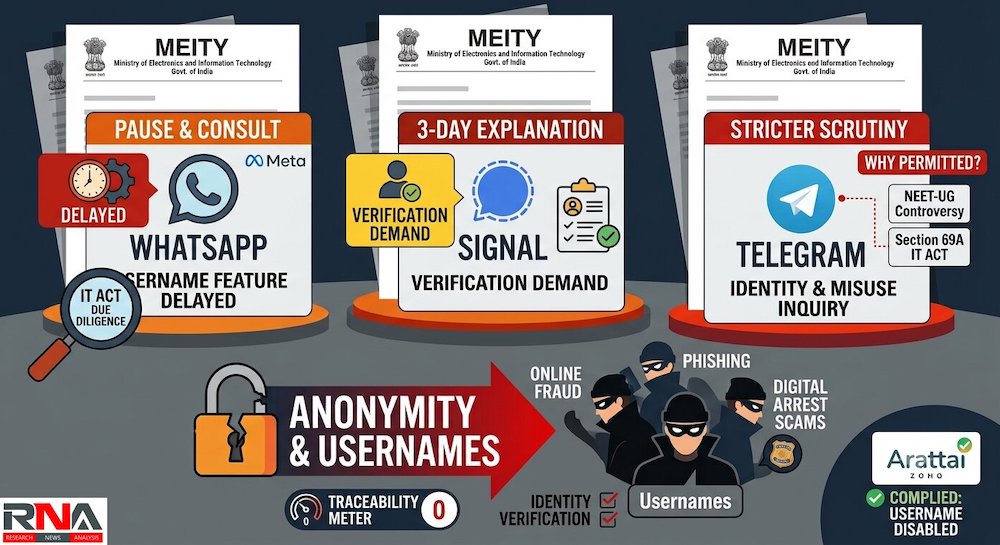
Meta-owned WhatsApp was the first to be pulled up, on Wednesday, over a username feature it had announced but not yet rolled out in India. The ministry directed the company to pause the launch until consultations with the government were completed “to the satisfaction of the government”. A day later, on Thursday, notices went out to Telegram and Signal – both of which already offer the feature, unlike WhatsApp – and give each platform three days to explain how they verify identities and prevent misuse.
At the heart of the government’s concern is traceability. Usernames let people message each other without sharing a phone number, and officials fear this could let bad actors solicit and message victims while shielding their identity. The government has warned all three companies that the feature could materially increase online fraud, phishing, digital arrest scams – in which criminals pose as police or government officials to extort money, and impersonation attacks.
The three platforms are not being treated identically. Telegram has offered usernames for years and Signal’s version is optional, while WhatsApp’s feature has only been announced. According to a government source, the notice to Telegram goes further than a request for safeguards, asking the platform to explain why it should be permitted to continue offering the feature at all – a markedly tougher line than that taken with Signal or WhatsApp, and one that follows Telegram’s own recent run-in with Indian regulators over the NEET-UG paper-leak controversy.
In its notice to WhatsApp, the ministry also asked Meta to explain why action should not be initiated under the Information Technology (IT) Act if the feature increases cybercrime, reminding the company of its due diligence obligations as a significant social media intermediary. India is WhatsApp’s largest market, with more than 500 million users, which exceeds Telegram’s user base in the country by a wide margin.
WhatsApp has defended the feature, saying it built in safeguards including reserved usernames for public figures, celebrities, government entities and verified accounts, limits on contact attempts by unknown users, and no public directory of usernames. The company also published a set of frequently asked questions online addressing concerns around impersonation and unwanted contact.
Homegrown platforms are already recalibrating in response. In a post on X, Zoho co-founder and chief scientist, Sridhar Vembu, announced that the company’s messaging app, Arattai, would disable its username-based account feature to comply with the regulatory change.
Telegram’s ban and NEET connection
Telegram’s notice lands only weeks after the platform’s own confrontation with Indian regulators. MeitY had temporarily blocked Telegram and its associated web services from June 16 to June 22, 2026, invoking section 69A of the IT Act on a recommendation from the National Testing Agency (NTA). The block was tied to the NEET-UG 2026 re-examination, held on June 21 after the original exam was cancelled following a leak controversy.
According to the NTA, organized rackets used Telegram channels – some operating under names claiming access to “leaked” papers – to defraud anxious candidates and their families of sums ranging from a few thousand rupees to several lakh. Investigators found that fraudsters exploited Telegram’s message-editing tool to insert fabricated question papers into old posts after the exam concluded, exploiting the original timestamps to make the papers appear genuine.
The NTA maintained throughout that no authentic leaked paper existed outside its secured examination chain, and that every such offer was fraudulent.
Alongside the platform block, MeitY separately directed Telegram to disable message-editing for existing content until June 30. Telegram’s founder, Pavel Durov, challenged the restriction in the Delhi high court as unconstitutional and disproportionate, arguing it penalized ordinary users rather than the individuals behind the leaks.
The court, however, upheld the restriction on June 19, with the presiding judge observing that Telegram’s architecture – large public channels, mirror groups, cloud storage and editable messages – made it especially prone to abuse. The access ban lapsed on June 22 as scheduled, though the broader legal challenge continues before the court.
That episode appears to have shaped the tone of the government’s latest notice to Telegram, which questions not merely the safeguards around usernames but whether the feature should be permitted at all.
What happens next
The notices do not, on their own, amount to a ban on username-based messaging. But together, they show the government treating WhatsApp, Telegram and Signal as a single regulatory question rather than isolated cases – a review of anonymity-enabling features across the messaging ecosystem. Neither Telegram nor Signal had issued a public response as of Friday.
The outcome of the three-day window could determine whether uniform compliance requirements emerge across platforms, or whether Telegram faces separate, stricter conditions given its recent regulatory history.