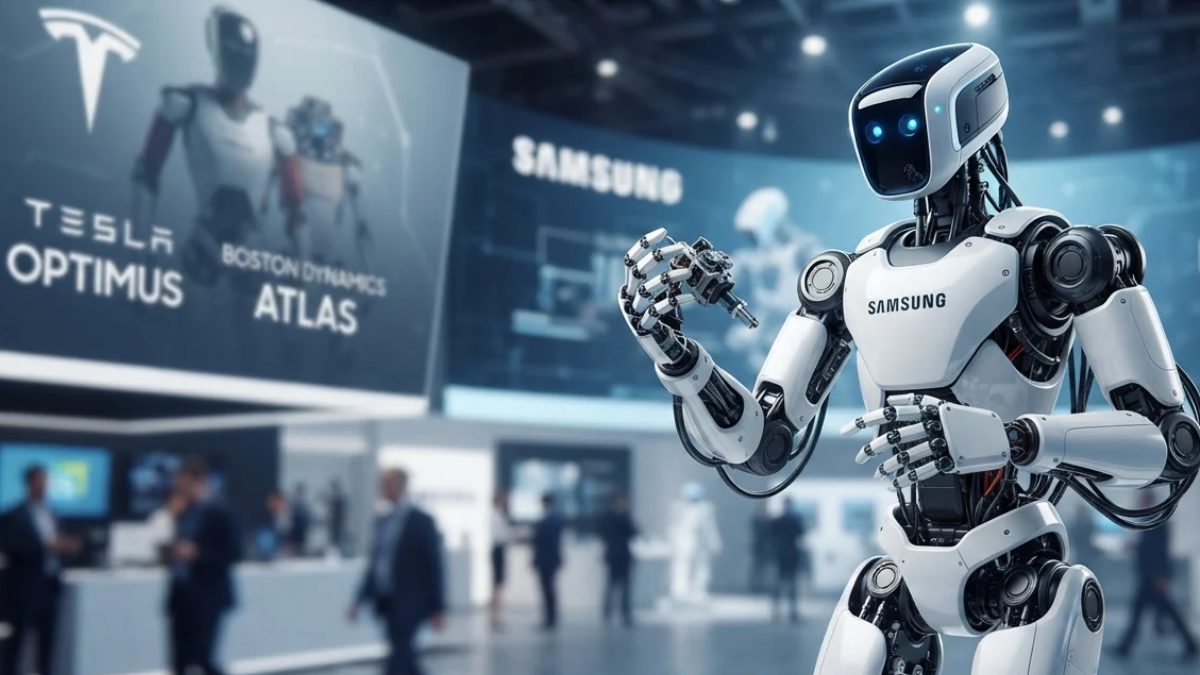




Samsung to unveil humanoid robot at CES 2027, joining Tesla and Boston Dynamics in robotics race
RNA Media illustration for representation.

New Delhi: Samsung plans to unveil a prototype of its humanoid robot at CES 2027, joining other global players in the emerging field. The South Korean company is expanding its business as competition in robotics grows.
Samsung presented the prototype to its board last week at the company’s robotics research centre in Seoul, Reuters reported. Executives, including co-CEO TM Roh, watched the robot demonstrate full-body control and pick up and manipulate objects with its arms and hands.
The planned debut puts Samsung alongside Tesla, China’s Unitree and Hyundai-owned Boston Dynamics. These companies are investing in humanoid robots designed to perform tasks in industrial and everyday environments. The challenge is no longer limited to making robots walk or keep their balance. They must also perform complex tasks with precision and consistency.
What is Samsung developing?
Samsung’s humanoid robot programme aims to build robots that can interact with their surroundings through coordinated body movements and hand manipulation, such as picking up objects and handling materials. That would let them work in environments built for humans.
The company formed its Robotics eXperience (RX) division in July 2026 as part of this initiative. The division works under Roh and manages research and strategic planning for robotics products.
Why is hand manipulation important?
One of the hardest aspects of humanoid robotics is hand manipulation. Making a robot walk, lift things and balance is comparatively simple, but handling small parts and fragile material requires precision. A small error could make the machine unfit for industrial tasks.
Kris Hauser, who leads the robotics group within the RX division, raised the issue in September. He said factory owners would never accept a robot with a 99 per cent success rate, and that it needs accuracy of almost 99.99 per cent.
Such reliability matters in industries where one error can disrupt production. Robots must also perform tasks safely and repeatedly over long periods.
How does Samsung compare with its rivals?
Samsung is joining a market where several firms have already begun to establish humanoid platforms. Tesla is developing a robot called Optimus for manufacturing and repetitive work. Samsung also faces competition from China’s Unitree. Boston Dynamics, now owned by Hyundai Motor Group, continues to develop its humanoid robot, Atlas.
The race is gradually shifting from demonstrations to workplace applications.
Samsung has experience in electronics and technology. Yet its product will have to show it can meet the demands of practical use.
Which industries could be affected?
Manufacturing and warehousing are among the sectors that could benefit from humanoid robots. In factories, they could eventually handle assembly work, move materials and perform repetitive operations. Warehouses could use them to sort packages, manage inventory and move goods.
The humanoid shape could also be an advantage because it would make the robots compatible with workplaces designed for humans.
If businesses automate routine and manual tasks, the impact could be large. Human workers could end up supervising machines and automated processes. However, how far this goes depends on how well the technology works.
What does this mean for the future of robotics?
Samsung’s planned unveiling fits into a broader trend in the tech industry towards machines that can engage with the physical world. Advances in artificial intelligence (AI) could enable humanoid robots to recognize objects, understand instructions and adapt to new environments.
But commercial success will not depend on AI alone. Sensors, mechanics and better battery efficiency will be equally important.
CES 2027 will offer a chance to assess Samsung’s progress and ambitions in the field. The test will be whether it can turn the prototype into a commercial product that performs routine tasks.