
Nvidia crisis triggers global AI stock rout as Jensen Huang’s exit exposes risks across multitrillion-dollar industry
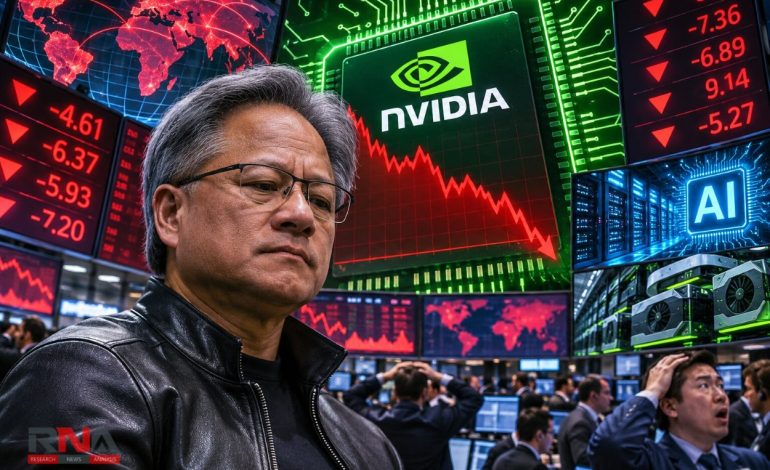
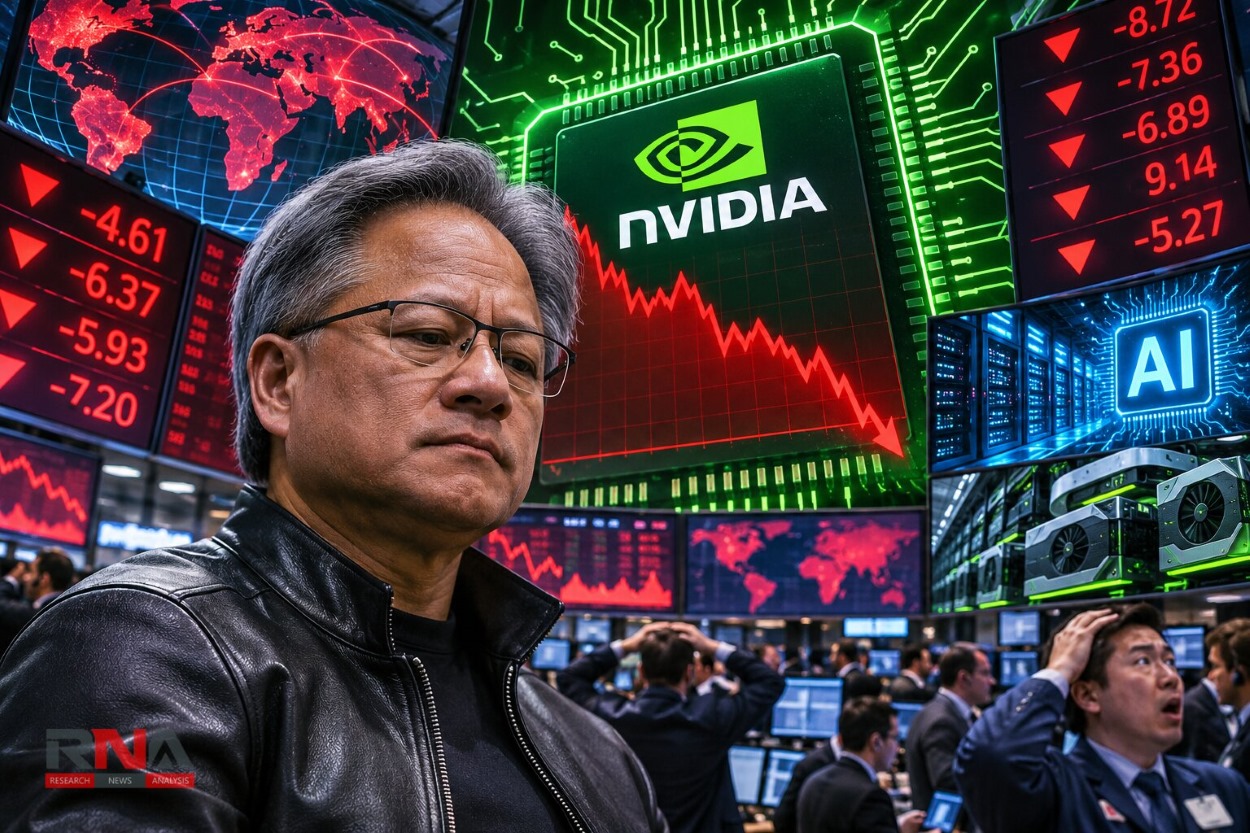
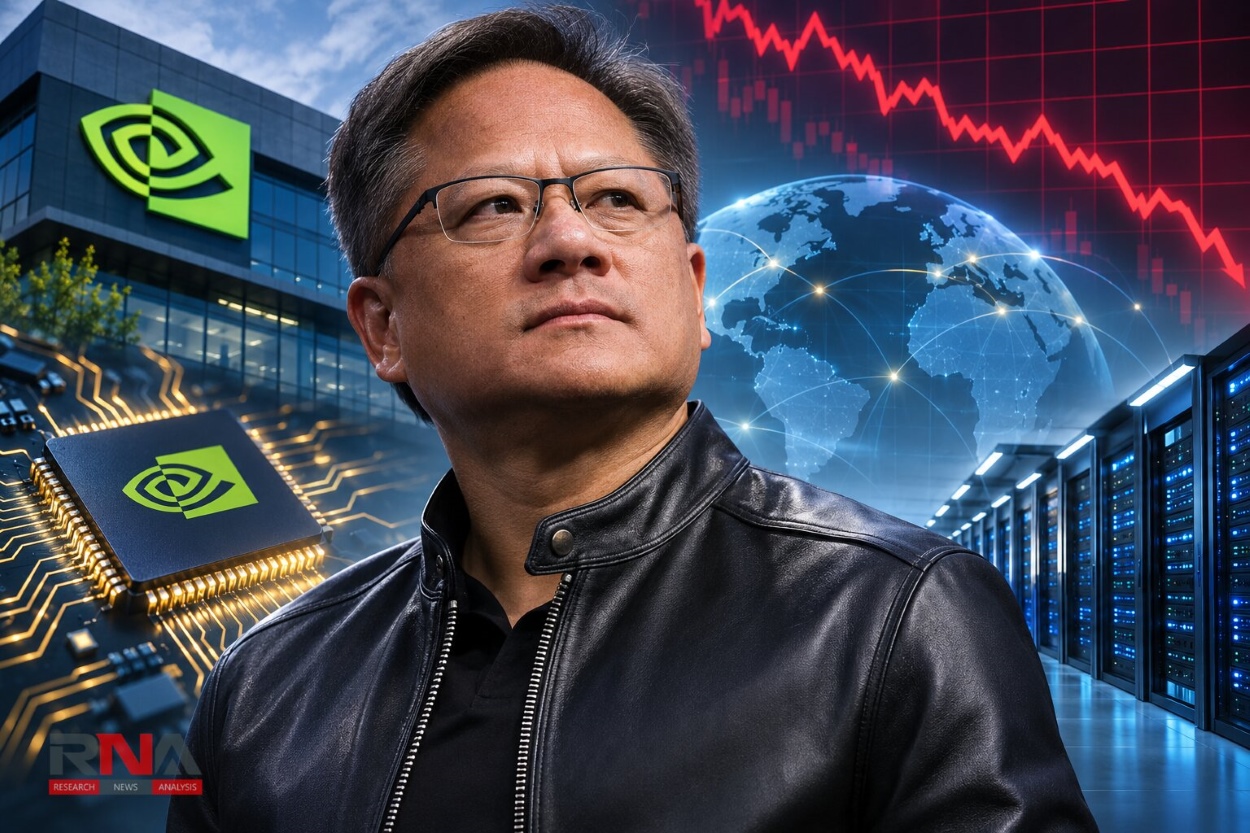
RNA Media illustration featuring Jensen Huang for representation.

New Delhi: A deepening crisis at Nvidia has sent shockwaves through global technology markets, triggering a broad sell-off in artificial intelligence stocks as investors assess the consequences of the abrupt departure of its co-founder and chief executive, Jensen Huang. The turmoil has exposed concerns about the financial relationships underpinning the AI boom, raising questions about whether the industry’s extraordinary expansion has created vulnerabilities that extend far beyond the American semiconductor giant.
Nvidia shares fell 8.2 per cent in early trading on Thursday, reaching their lowest level in more than 16 months and putting the company on course to slip below $4 trillion in market capitalization. The chipmaker has lost more than $550 billion in market value since its board announced an investigation into Huang’s relationship with a businesswoman suspected by American authorities of having links to Chinese intelligence.
The immediate trigger was Huang’s resignation following allegations involving two extramarital relationships, including one with a woman reportedly suspected of working for Beijing. Nvidia has appointed its chief financial officer, Colette Kress, as interim chief executive and named Harvey C Jones its first board chairman, initiating a search for a permanent successor.
The controversy has also acquired a national-security dimension because of Nvidia’s central role in supplying advanced processors that power sophisticated AI systems. As RNA reported earlier, the company appointed outside legal counsel to investigate whether Huang had been targeted by foreign intelligence operatives, although Nvidia maintained that it had no evidence of compromised company secrets or American national-security interests.
Sell-off spreads across global AI industry
The repercussions quickly spread to businesses whose expansion depends heavily on Nvidia’s technology, financing and commercial partnerships, particularly specialist cloud-computing companies known as neoclouds. CoreWeave, in which Nvidia holds a substantial investment, declined 9.1 per cent, reversing part of a 27 per cent rally recorded in the previous session following encouraging earnings.
Nebius plunged 16.2 per cent after warning that its annual revenue would reach the lower end of its previous forecast, compounding concerns about the sector’s financial outlook. Other infrastructure providers, including IREN and Applied Digital, also declined as investors reconsidered the risks associated with financing large AI computing facilities.
The pressure extended across semiconductor manufacturers, storage specialists and data-centre equipment suppliers, with the Philadelphia semiconductor index falling 1.3 per cent. Marvell Technology lost 3.8 per cent, Oracle declined 2.6 per cent and Micron Technology slipped 2.5 per cent, while Dell, Lumentum and Coherent suffered losses ranging from 3 to 5.1 per cent.
However, the decline was not universal, suggesting that investors were distinguishing between companies exposed to Nvidia’s difficulties and those potentially positioned to benefit. Competing chipmakers AMD and Broadcom advanced 3.7 per cent and 5.6 per cent respectively, while Alphabet, Amazon and Microsoft also recorded gains.
Asian and European markets reflected the uncertainty, with Japanese and South Korean benchmarks closing approximately 0.7 per cent lower and European technology shares declining around one per cent. Earlier weakness in Taiwan and other semiconductor-heavy markets highlighted the international reach of Nvidia’s influence over the AI supply chain.
Why Nvidia’s troubles threaten the wider AI boom
The deeper concern involves Nvidia’s unusually extensive financial and commercial relationships with companies purchasing and deploying its processors. Beyond selling chips, Nvidia has invested in parts of the infrastructure ecosystem that generates demand for its products, creating interdependencies that could become problematic if financial conditions deteriorate.
These arrangements have helped accelerate AI infrastructure construction but have also attracted scrutiny over circular financing, where investments and commercial commitments reinforce demand across interconnected businesses. A reduction in Nvidia’s financial support could particularly affect smaller companies that lack the balance-sheet strength of established technology giants.
The crisis has struck when investors were already questioning whether the enormous expenditure on AI data centres would generate sufficient commercial returns. Regulatory opposition to energy-intensive facilities, concerns about electricity and water consumption, and uncertainty over future funding have added pressure to an industry accustomed to exceptionally rapid growth.
Nvidia’s valuation has consequently undergone a dramatic adjustment, with its shares trading at approximately 12 times projected earnings over the following year, their lowest such multiple since November 2012. Although a lower valuation does not necessarily indicate deteriorating technology or demand, it reflects sharply reduced investor confidence in the company’s leadership and growth prospects.
The implications also extend to the United States-China technological rivalry, particularly restrictions on exporting advanced American semiconductors to Chinese entities. Recent procurement disclosures concerning Nvidia processors reaching a Chinese military-linked university have intensified questions about the effectiveness of export controls and supply-chain oversight.
For India, which is expanding AI infrastructure and pursuing semiconductor manufacturing capabilities, the turmoil illustrates the risks of depending on a concentrated international supply chain. Any prolonged disruption involving Nvidia could influence computing costs, infrastructure investments and access to advanced AI hardware, although the extent would depend on how effectively the company maintains production and deliveries.
Nvidia has assured investors that its technology roadmap, customer commitments and operations will continue without interruption under Kress. The company’s next major test comes on November 17, when its quarterly financial results will offer investors an opportunity to distinguish its underlying business performance from the leadership crisis.