




Delhi hostel collapse: 7 dead, 5 officials suspended. Why did the building crumble?
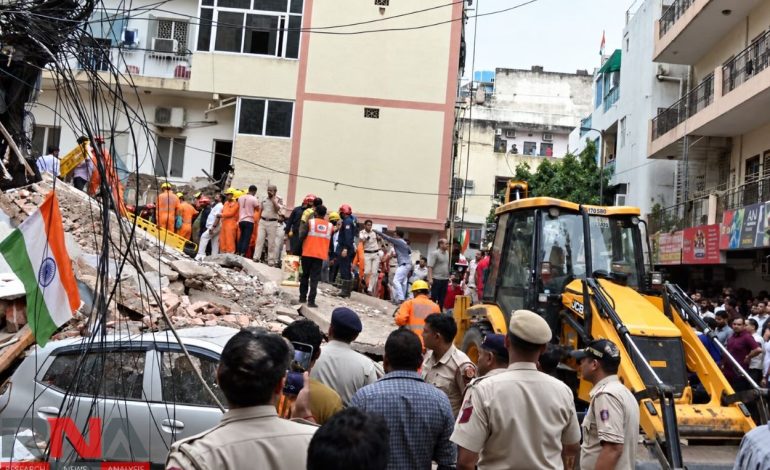
This digitally enhanced screenshot of a widely circulated amateur video on social media shows rescue workers at the site of the south Delhi building collapse.

New Delhi: The death toll in the collapse of a private student hostel in Delhi’s Satya Niketan rose to seven on Monday, as authorities suspended five municipal officials. The action came a day after the building collapsed during renovation work, prompting investigations into its structural condition and possible failures in civic oversight.
Those suspended include the Municipal Corporation of Delhi’s (MCD) south zone deputy commissioner, a superintending engineer, an executive engineer, an assistant engineer and a junior engineer. The suspensions followed directions from the chief minister, Rekha Gupta, as authorities began examining responsibility for the disaster.
The building, which provided paying guest accommodation near Delhi University’s South Campus, collapsed at about 1.30pm on Sunday while repairs were underway. Police described it as a roughly 40- to 50-year-old structure comprising a basement and five upper floors, with accommodation for about 75 residents.
Search operations continued overnight and into the following day, involving the National Disaster Response Force, Delhi Fire Service, police and other emergency agencies. Police subsequently confirmed that another body had been recovered, taking the number of deaths to seven.
Residents told AP that the premises had reopened to tenants in August after months of renovation, although work remained unfinished. One resident said labourers were digging in the basement when the building collapsed, adding to questions about the circumstances in which students had been allowed to occupy it.
The Delhi government ordered a magisterial inquiry, while police registered a first information report against the alleged owner and others. Investigators are examining whether alterations compromised the structure and whether those responsible for the premises complied with safety requirements.
Gupta announced plans for periodic structural audits and safety certification for buildings accommodating public activities, including student residences, schools and nursing homes. The proposed policy would prevent such establishments from operating without the required clearance.
Why did the building collapse?
The preliminary explanation centres on the combination of an ageing structure, water accumulated in its basement and ongoing repairs. After inspecting the site, Gupta attributed the collapse to water accumulation and construction activity, although the precise sequence of structural failure remains to be established.
NDTV reported that preliminary information suggested a pillar had become unstable during the basement work, compromising the building above it. However, The Times of India quoted a resident who said the structure had no pillars, a discrepancy that makes it premature to identify a particular column as the confirmed point of failure.
The engineering concern is nevertheless clear: work at the bottom of an occupied building can disturb the support on which the floors above depend. Britain’s Health and Safety Executive warns that even comparatively shallow excavations can undermine foundations, making a structural assessment and properly designed temporary support essential where stability could be affected.
This means that work described as a repair can carry substantial structural risk if it involves removing supporting material or disturbing the ground beside foundations. Whether that happened in Satya Niketan will depend on evidence about what workers were doing, where they were digging and what precautions had been taken.
Water adds another potential complication because groundwater entering an excavation can reduce the strength of the surrounding ground, particularly close to existing foundations. That provides a plausible explanation for why basement water and construction activity together attracted official scrutiny, but does not establish that soil failure caused this particular collapse.
Reports of additional floors raise a separate question about the demands placed on the original structure. The former Delhi Fire Services director, Atul Garg, told the Times of India that the building had been constructed for residential use and subsequently expanded, raising concerns about whether its structural strength was sufficient.
An investigation must therefore reconstruct both the building’s construction history and the sequence of recent alterations, rather than treating the word “renovation” as evidence that the work was harmless. Structural safety guidance emphasizes identifying how a building is supported, surveying it before potentially destabilizing work and designing temporary supports to withstand the loads they will carry.
The available evidence points towards basement work as a possible immediate trigger, with water accumulation and the condition of the older structure potentially contributing to its vulnerability. The inquiry must establish which support failed first, whether alterations or excavation caused that failure, and why residents remained inside while the work continued.