



Bike-borne forest staff chase lion in Gujarat safari park, three workers removed after video sparks outrage
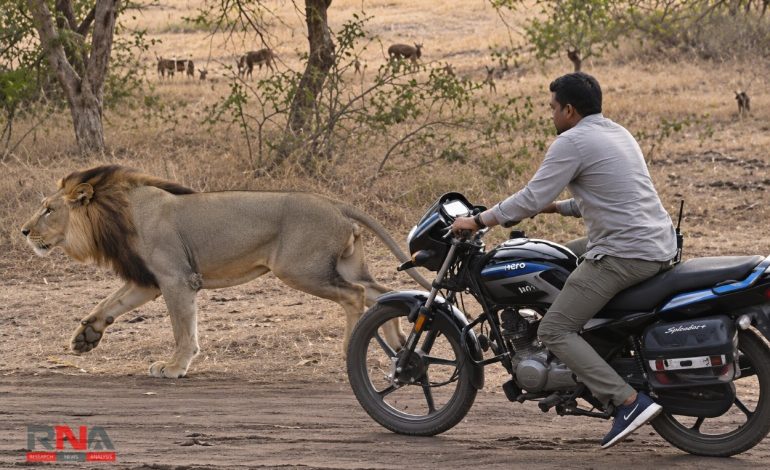
This digitally enhanced screenshot of the viral video clip on social media shows a forest staffer chasing the lion on a bike.

New Delhi: Three outsourced forest personnel have been removed from duty after a video showing them pursuing an Asiatic lion on motorcycles inside Gujarat’s Ambardi safari park triggered widespread criticism and questions about wildlife management practices. The incident, which occurred during the Diwali holiday period in Amreli district, has prompted an official inquiry, although forest authorities insist that the employees were attempting to guide the animal back to its designated enclosure rather than deliberately harass it.
The video, widely circulated on social media, shows three men riding separate motorcycles behind a lion as it moves across an open stretch of the safari park. At one point, the animal appears to turn towards its pursuers, raising concerns about the risks posed both to the lion and to the personnel involved in the operation.
One of the motorcyclists was seen carrying a walkie-talkie, while a forest department Bolero vehicle was also seen in the vicinity. The footage prompted allegations that the animal had been deliberately disturbed, with some reports suggesting that staff were trying to facilitate closer lion sightings for VIP visitors during the festive season.
However, the allegation involving VIP visitors has not been independently substantiated, and forest officials have offered a different explanation for the incident. They maintain that the personnel were carrying out a routine animal-management exercise but had departed from the usual procedure by using motorcycles instead of a jeep.
Forest department explains action against employees
The principal chief conservator of forests, Jaipal Singh, confirmed that an inquiry had been initiated after the footage surfaced and that the three personnel involved were subsequently relieved of their duties. Speaking to the news agency PTI, Singh explained that staff were attempting to direct the lion towards a fenced enclosure, locally known as a “kraal”, where the animals are normally fed.
Singh acknowledged that the exercise is ordinarily conducted using a jeep, making the deployment of motorcycles an unusual departure from established practice. A notice was issued following the incident, and action was taken against the three outsourced workers, although authorities have not publicly detailed any further disciplinary proceedings.
The assistant conservator of forests and in charge of the safari park, Mitesh Vaniya, also rejected allegations that the animal had been intentionally harassed. He said the footage was recorded during the Diwali holidays, when the safari park was experiencing heavy visitor traffic and forest personnel were working extended shifts of up to 12 hours.
According to Vaniya, lions at the park are fed at approximately 5pm inside a fenced area measuring 100 metres by 100 metres. The animal featured in the video had reportedly moved away from the designated area, prompting staff to intervene and direct it back towards the enclosure.
A separate account published by Gujarat Samachar identified the lion as Simba and reported that it had strayed into another lion’s territory. According to that account, the personnel were attempting to prevent a possible territorial confrontation, although this additional explanation has not been independently verified.
Why incident raises questions about wildlife management
Irrespective of the employees’ intentions, the episode has brought attention to the procedures used to manage large carnivores in controlled safari environments. Directing a lion’s movement requires careful consideration of its behaviour, the surrounding terrain and the potential for an unpredictable reaction when an animal encounters vehicles at close quarters.
The footage alone does not establish whether the lion suffered physical injury or lasting distress, and authorities have not reported any such finding. Nevertheless, the use of motorcycles raises a legitimate operational question about whether the method was appropriate for moving a powerful predator within an enclosed wildlife facility.
The distinction between managing an animal for its safety and disturbing it unnecessarily is particularly important in facilities where conservation objectives coexist with tourism. Wildlife-management decisions must account not only for visitor expectations but also for animal welfare, staff safety and adherence to established operating procedures.
Ambardi safari park, officially known as the Ambardi Wildlife Interpretation Zone, was established in 2017 near Dhari, approximately seven kilometres from the town, on the banks of the Shetrunji river. According to the Gujarat Forest Department’s official website, the facility covers more than 365 hectares and was developed to support Asiatic lion conservation awareness and provide an additional wildlife tourism destination.
The park forms part of the broader Gir landscape and also supports leopards, chinkara, nilgai, spotted deer and several smaller wildlife species. Unlike unrestricted wildlife tourism in a natural forest, an interpretation zone involves closer management of visitor access and animal movements, making clearly defined operational protocols especially important.
Asiatic lion conservation adds significance
The controversy comes against the backdrop of a substantial recovery in India’s Asiatic lion population, regarded as one of the country’s major wildlife conservation achievements. Gujarat remains the only state with a naturally occurring wild population of Asiatic lions, making the management of the Gir landscape particularly significant.
According to the Union environment ministry’s parliamentary disclosure in February this year, the population increased from 674 in 2020 to 891 in 2025, representing growth of approximately 32 per cent. The expansion has also brought lions into additional forest areas, river corridors and other landscapes beyond their traditional strongholds, increasing the importance of scientific monitoring and responsible management.
The Gujarat government has undertaken several measures to strengthen lion conservation, including habitat improvement, veterinary support, satellite-based monitoring and the deployment of trackers to manage interactions between people and wildlife. These initiatives reflect the increasingly complex task of protecting a growing population of large carnivores in a landscape shared with settlements, agriculture and tourism.
For now, the immediate administrative action involves the removal of three outsourced personnel, with no independently confirmed finding that the lion was deliberately mistreated. The unresolved issue is whether the motorcycle pursuit represented an isolated lapse in judgement or exposed a broader weakness in the park’s animal-handling procedures.
The incident has consequently placed renewed scrutiny on the standards expected of personnel entrusted with protecting one of India’s most important wildlife species. The outcome of the inquiry will be important in establishing whether existing safeguards were followed and whether additional training or operational changes are necessary.