


Siang dam standoff deepens: 69 arrested, NDA ally demands withdrawal of central forces
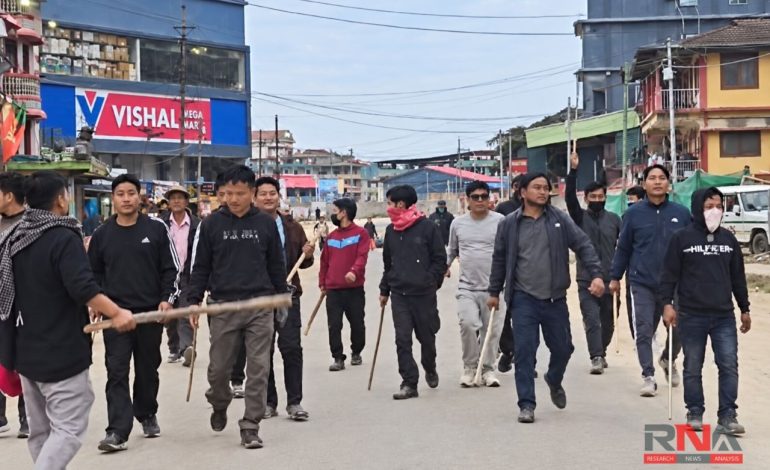
This digitally enhanced screenshot from a widely circulated video on social media shows a group of youths carrying sticks in Pasighat while protesting against the Siang dam.

New Delhi: Arunachal Pradesh’s confrontation over the proposed Siang Upper Multipurpose Project has intensified, with police reporting 69 arrests across three districts and the People’s Party of Arunachal (PPA) demanding the withdrawal of central forces. The dispute over the roughly 11,000MW project now combines a widening security operation with unresolved questions about indigenous land rights, public consent and India’s response to China’s upstream hydropower development.
The PPA president and legislator, Nabam Vivek, called on the state government on Tuesday to release arrested anti-dam protesters and begin discussions directly with affected villagers. His intervention brought criticism from within the National Democratic Alliance (NDA), with Vivek saying his party’s membership of the ruling coalition did not oblige it to support the suppression of public opposition.
Speaking in Doimukh, Vivek argued that using security forces to facilitate a pre-feasibility survey would deepen mistrust and make any subsequent construction harder to secure public support for. He also urged protesters to reject violence, saying attacks on public property would inflict losses on the state rather than resolve their grievances.
The PPA’s demand for withdrawal of forces followed a substantial reinforcement of security across East Siang, Siang and Upper Siang districts. The inspector general of police, Hibu Tamang, told reporters on Tuesday that 30 companies of central armed police forces (CAPFs) and three companies of Assam Police were deployed alongside Arunachal Pradesh Police personnel.
Earlier reporting by the Arunachal Times described a 30-company deployment that included three Assam Police companies, leaving a discrepancy in the published totals. Its account identified contingents from the Central Reserve Police Force, including the Rapid Action Force, the Indo-Tibetan Border Police and the Sashastra Seema Bal, supported by state police and Indian Reserve Battalion personnel.
Police have linked the arrests to alleged rioting, assaults, vehicle-burning and damage to offices and homes during the agitation. Security was also strengthened at the residences of the state BJP president, Kaling Moyong; the legislators, Ninong Ering and Oni Panyang; and the MP, Tapir Gao.
Published case totals also differ: an earlier police account listed 53 cases across the three districts, while Tamang subsequently told media that 55 had been registered. A separate East Siang police statement on Monday recorded eight cases concerning the Pasighat violence, 26 people apprehended, including five juveniles, and six others detained for questioning.
That district statement identified alleged offences under the Bharatiya Nyaya Sanhita, with one case also invoking the Prevention of Damage to Public Property Act. Reports have separately recorded detentions under the Arunachal Pradesh Unlawful Activities (Prevention) Act, 2014, although the available accounts do not establish a consistent breakdown of the legal provisions applied to everyone in custody.
The immediate escalation followed a 12-hour shutdown on Friday last week called by organizations opposing the project and seeking the release of previously detained activists. Their demands also included a halt to survey activities, withdrawal of security personnel and reinstatement of suspended village headmen.
In Pasighat, an NHPC office was set on fire, vehicles were burned and properties associated with political leaders were vandalized after the daytime shutdown ended. The office of the Adi Bane Kebang was also attacked, while a boundary wall at the police station was damaged and vehicles within its premises were torched, according to local reports on the violence.
Accounts differ over how the confrontation escalated, with officials describing continued roadblocks and resistance to dispersal, and protesters pointing to the use of tear gas as a trigger. Police personnel and protesters were injured, while four women treated following a separate confrontation at Dite Dime were discharged after medical observation, according to a PTI report.
The anti-dam activist and advocate, Ebo Mili, and the youth leader, Otul Jerang, surrendered to police on Saturday. Both condemned the violence, with Jerang saying that the destruction ran contrary to the movement’s objectives and that participants had attempted to restrain the crowd.
The chief minister, Pema Khandu, has defended the security deployment while renewing his offer of talks. Speaking at Palin on Monday, he said personnel were deployed to protect residents and maintain public order, and rejected allegations that their purpose was to intimidate communities.
Khandu maintained that completing the pre-feasibility report would not make construction inevitable, saying any decision would depend on expert assessments, consultations and public consent. He had also offered to meet opposing organizations in Itanagar, Pasighat or another location of their choosing, with officials available to answer questions about the project.
At meetings with legislators and indigenous organizations on Sunday, Khandu called for greater transparency and attributed some public apprehension to misinformation. The discussions covered national security, environmental concerns and the interests of Siang valley residents, but did not resolve the opposition to field surveys.
The central disagreement concerns whether preliminary investigations can proceed while affected communities remain opposed to the project itself. Organizations representing indigenous residents fear that a large reservoir would submerge ancestral land, displace settlements and damage farming livelihoods and cultural ties to the river, while also introducing environmental risks in a seismically active Himalayan region.
Vivek said consultations with officials and students’ organizations could not substitute for engagement with people whose land would be affected. He urged the government to present a clear project blueprint and address the Adi community’s concerns before seeking acceptance of its national-importance argument.
The dispute has also drawn support from the Arunachal Frontier Tribal Front, whose chairman, Tadak Nalo, demanded the release of arrested youths, withdrawal of forces and treatment for those allegedly injured by police action. On Saturday, he warned of further democratic protests in Itanagar if the government did not change its approach.
The proposed scheme remains an assessment exercise rather than an approved construction programme, and its frequently reported capacity should be understood in that context. NHPC’s annual report for 2023–24 records three alternatives – Uggeng at 11,600MW, and Dite Dime and Parong at 11,200MW each – examined after the ministry of jal shakti assigned the pre-feasibility work in April 2022.
NHPC’s earlier disclosures state that preliminary alternatives were submitted in December 2022, after which a government technical committee sought further geological investigations before a site could be selected for detailed planning. The recommended drilling at the three locations helps explain why field investigations remain central to a project whose preliminary documentation began several years ago.
The government’s strategic case rests on the river’s transboundary geography: the Yarlung Tsangpo flows from Tibet into Arunachal Pradesh as the Siang and subsequently forms part of the Brahmaputra system. It argues that storage on the Indian side could help regulate flows and moderate flooding as China develops major hydropower infrastructure upstream, although the proposed Indian scheme’s technical suitability remains subject to assessment.
Khandu has said subsequent stages would involve environmental and social impact assessments, detailed project preparation and separate arrangements for land acquisition, compensation and rehabilitation if the scheme advances. For opposing villagers, however, the immediate demand remains a halt to investigations undertaken under heavy security, rather than assurances about safeguards at a later stage.
The Siang confrontation is unfolding alongside resistance to another major project in Arunachal Pradesh, the proposed 1,605MW Subansiri Upper Hydroelectric Project, also known as the Menga dam. A shutdown in Upper Subansiri on Monday disrupted normal life and a scheduled public hearing was cancelled, underscoring the broader difficulty of securing local acceptance for the state’s hydropower expansion.