
Sheikh Hasina addresses maiden news conference after ouster, her son says Bangladesh will turn into Pakistan; Dhaka ‘outraged’
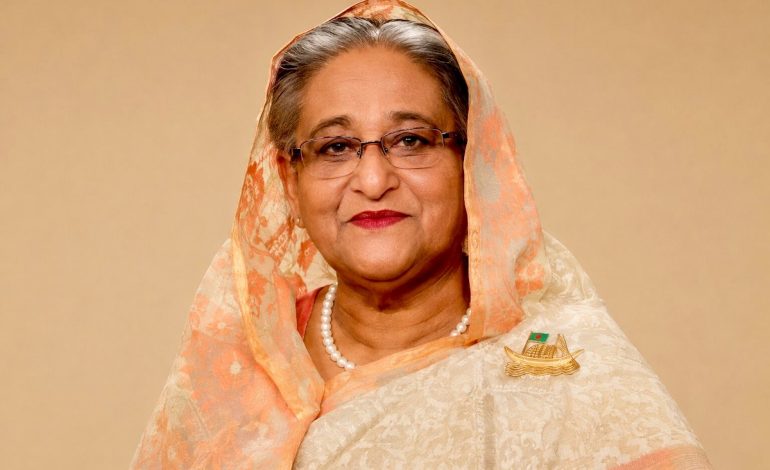
Sheikh Hasina. (Photo: X/@FCCNewDelhi)

New Delhi: Sheikh Hasina, the ousted prime minister of Bangladesh, held her first full news conference in exile on Wednesday – precisely two years after a student-led uprising, one that she and her loyalists continue to call a coup, forced her from office. Speaking only by audio link to a packed hall at the Foreign Correspondents’ Club of South Asia in New Delhi, the 78-year-old was heard but not seen by the reporters gathered for the occasion.
Her son, Sajeeb Wazed Joy, joined from the United States by video link, marking the first time mother and son had fronted the international media together since fleeing Bangladesh in August 2024. Wednesday’s session differed from a recorded address Hasina had sent to the same forum in January; this time she took live questions from the journalists in the room.
Vows to return despite death sentence
The centrepiece of her appearance was a declaration that she plans to return home in December, though she stopped short of naming an exact date. She said she was prepared to face arrest or imprisonment on arrival, framing the decision as a duty to her supporters rather than a bid to reclaim power, and insisted that her return was about setting Bangladesh back on what she called the right path, not about office.
It may be noted that she was sentenced to death in absentia by a tribunal for “crimes against humanity”. The charges stem from her role as the principal architect behind the violent state crackdown on mass student-led protests in 2024, which resulted in the deaths of roughly 1,400 people.
Hasina grew visibly emotional recalling August 1975, when her father, the founding president of Bangladesh, Sheikh Mujibur Rahman, was assassinated along with most of the rest of her family in a military coup while she happened to be abroad. She said she had survived 19 attempts on her life since then, including a grenade attack on August 21, 2004, and that this history was why she no longer feared for her own safety – only for her country’s future.
She called for the restoration of media freedom, judicial independence and what she termed constitutional order in Bangladesh.
‘Another Pakistan’
Hasina’s son Wazed, for his part, delivered a far starker message, warning that Bangladesh risked becoming a failed state. “Another Pakistan on India’s eastern front” was how he put it, alleging that Pakistan’s Inter-Services Intelligence now enjoyed a free hand inside the country.
He went on to allege that hundreds of convicted militants had been quietly released from Bangladeshi prisons since his mother’s fall, that the hardline group Hizb ut-Tahrir now marched openly, and that individuals linked to al-Qaida had addressed public rallies unhindered. He predicted that the next wave of global terrorism would originate from Bangladesh unless the trend was reversed soon, adding that neither he nor his mother remained in contact with the government in Dhaka.
He did, however, thank India’s prime minister, Narendra Modi, for what he called the dignity shown to his mother throughout her exile.
It was a striking claim to make from Indian soil about a neighbour with which New Delhi has tried, uneasily, to keep the peace.
Dhaka ‘outraged’
Bangladesh’s reaction came within hours. The country’s foreign ministry issued a strongly worded statement late on Wednesday describing Hasina as an “absconding convicted genocider” and accusing her and her associates of directing hostility at the Bangladeshi state from Indian territory. The ministry said it had conveyed its concerns to the government of India well in advance, warning of the likely fallout for bilateral ties, only for the event to proceed regardless.
The statement said: “Bangladesh is outraged that the absconding convicted genocider Sheikh Hasina was allowed this evening to engage in live interaction with the media in New Delhi where she and her henchmen launched venomous vitriol against the State of Bangladesh and her people.”
Dhaka noted, pointedly, that the news conference fell on the second anniversary of what it calls the July Revolution, the movement that toppled Hasina’s government, and characterized her remarks as an insult to those killed in the unrest. Citing United Nations findings, the ministry said more than 1,400 people, including minor children, had died in the crackdown ordered by her administration between mid-July and early August 2024, and dismissed her comments as a doomed attempt to rewrite that record.
“On a day when the people of Bangladesh are observing the second anniversary of the July Revolution, this interaction by Sheikh Hasina on the Indian soil stands as an affront to the sovereignty of Bangladesh and a grievous insult to the martyrs of the July Revolution,” it said.
The statement reiterated Bangladesh’s position that the country would never again submit to what it called authoritarian rule, and that neither Hasina nor members of her erstwhile government would have any future role in national politics. It also renewed a longstanding grievance: Dhaka’s request for Hasina’s extradition, filed under the 2013 treaty between the two countries, remains unanswered by New Delhi – more than a year after it was first submitted, and again since a Dhaka tribunal sentenced her to death in absentia in November 2025 over the crackdown.
The friction had, in truth, been building for days. M Humayun Kabir, an adviser to the prime minister of Bangladesh, Tarique Rahman, met India’s acting high commissioner in Dhaka on Monday to formally protest the planned appearance. Separately, Bangladesh’s information ministry and its cybersecurity agency instructed domestic media not to broadcast or publish Hasina’s remarks at all, citing an existing tribunal order barring dissemination of her statements.
New Delhi distances itself from ‘private’ event
India’s response, by contrast, was calibrated caution. Ahead of the news conference, as reported by RNA Media, the spokesman for the Ministry of External Affairs, Randhir Jaiswal, told reporters that the event was being run by a private media entity and that the government had “no involvement whatsoever” in it, nor did it endorse anything that might be said there.
That formulation has become familiar. New Delhi has used similar language before to explain why Hasina, who has lived under Indian protection since fleeing Dhaka, continues to make political statements from its territory despite repeated objections from Bangladesh. As recently as December 2025, the ministry rejected an earlier round of Bangladeshi criticism outright, maintaining that India had never allowed its soil to be used for activity harmful to Bangladesh’s interests, while also urging Dhaka to hold free and credible elections.
The balancing act reflects the delicacy of a relationship both sides insist they wish to preserve even as one irritant follows another. Rahman, whose Bangladesh Nationalist Party swept to power in a landslide in February this year after the Awami League was barred from contesting, is due in New Delhi next month for the BRICS summit.
The summit will be an occasion that may show whether Wednesday’s outrage hardens into something lasting, or fades, like previous flare-ups, into the uneasy routine that has defined ties between the two capitals since Hasina’s fall two years ago.