

Seven dead, dozens feared trapped after landslide seals Sikkim tunnel as massive rescue operation continues
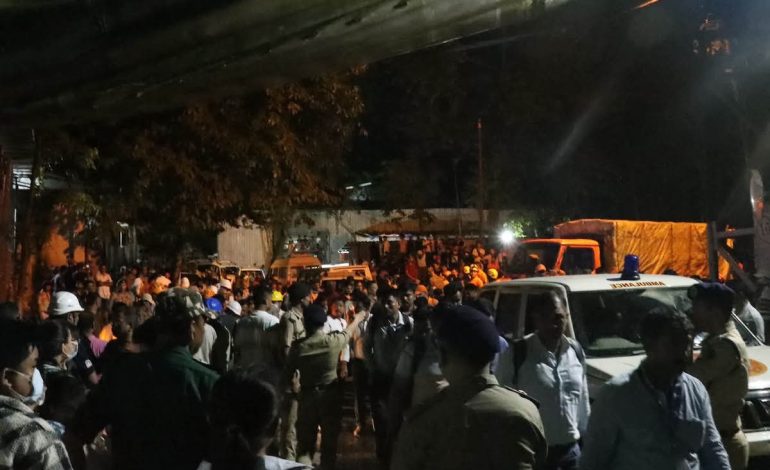
Rescuers at the Sikkim Teesta Stage VI Tunnel entrance, which has been blocked by debris following a landslide near the site at Namchi district. (Photo: AIR Gangtok)

New Delhi: At least seven people have died and several others are feared trapped after a massive landslide struck the entrance of an under-construction tunnel in Sikkim’s Namchi district on Monday, triggering one of the state’s biggest industrial rescue operations in recent years. Indian Army personnel, the Border Roads Organisation (BRO), the National Disaster Response Force (NDRF), the Sikkim State Disaster Response Force (SDRF), police, fire services and district authorities continued round-the-clock efforts to reach the trapped workers despite unstable terrain, heavy rain and the threat of fresh landslides.
The incident occurred at Samardung, where an under-construction tunnel forms part of the National Hydroelectric Power Corporation’s (NHPC) Teesta Stage VI hydroelectric project. Officials said a rain-triggered landslide brought down a huge volume of earth and boulders, completely sealing the tunnel entrance while dozens of workers were inside.
According to officials, 43 workers were initially inside the tunnel when the landslide struck. Sixteen managed to escape before the entrance was completely blocked, while 27 remained trapped inside. As rescue operations progressed, seven bodies were recovered from the debris, with the remaining workers still feared trapped. Authorities cautioned that the casualty figures could change as access to the tunnel improves.
Rescue teams have been battling exceptionally difficult conditions. Besides tonnes of debris choking the tunnel entrance, officials said there were concerns over a possible build-up of hazardous gases inside the tunnel, making operations slower and more hazardous. Heavy machinery, excavators and specialised cutting equipment have been deployed to clear debris while maintaining the stability of the remaining structure.
The Army was among the first central agencies to join the rescue effort, working alongside BRO engineers, who brought in earth-moving equipment and technical expertise to reopen access to the tunnel. NDRF teams equipped for confined-space rescue operations were also deployed, supported by SDRF personnel, Sikkim Police, fire and emergency services and local civil administration. Medical teams and ambulances remained stationed near the site to provide immediate treatment to anyone rescued.
Officials said rescuers were proceeding cautiously because further excavation without adequate stabilisation could trigger secondary collapses and endanger both survivors and rescue personnel. The region has witnessed persistent monsoon rainfall over the past several days, increasing the risk of fresh landslides in the surrounding hills.
Senior officials from the Sikkim government visited the site to oversee rescue operations and coordinate among multiple agencies. District authorities said every available resource had been mobilized and that rescue work would continue without interruption until all trapped workers had been accounted for.
Police officials told reporters at the site that the immediate priority remained reaching the workers safely rather than accelerating excavation at the cost of additional risks. They said rescue plans were being continuously modified based on geological assessments and conditions inside the tunnel.
The Army and BRO have been working in close coordination to improve access roads for heavy equipment, remove unstable rock and create safer operating conditions around the tunnel entrance. Their role has become particularly important because of the mountainous terrain and the specialized engineering support required for rescue operations in such environments.
Officials involved in the operation said maintaining communication with those trapped remained a major challenge, as debris had completely cut off normal access to the tunnel. Engineers were simultaneously assessing whether alternative access routes or boreholes could be created if direct excavation proved too dangerous.
The Teesta Stage VI project is one of several hydropower developments in Sikkim’s Teesta basin, a region that has repeatedly experienced landslides and flash floods because of its fragile Himalayan geology and intense monsoon rainfall. The state suffered widespread destruction during the October 2023 glacial lake outburst flood, highlighting the vulnerability of infrastructure projects in the region to extreme natural events.
Experts note that tunnel construction in the Himalayas presents unique engineering challenges because of highly fractured rock formations, steep slopes, high rainfall and frequent geological disturbances. During the monsoon, prolonged precipitation often weakens hill slopes, increasing the likelihood of landslides that can affect roads, tunnels and hydropower projects.
While no official statement has yet attributed responsibility for Monday’s disaster, authorities are expected to conduct a detailed technical investigation once rescue operations conclude. Such inquiries typically examine geological conditions, construction practices, weather patterns and compliance with safety protocols before determining the cause of the incident.
The Sikkim government has appealed to the public not to circulate unverified information regarding casualty figures or the status of those trapped, emphasizing that only official updates should be relied upon as rescue efforts continue.
With unstable slopes, continuous rainfall and difficult terrain slowing progress, officials acknowledged that the operation could take considerable time. However, they stressed that all agencies remained committed to rescuing survivors and recovering those still trapped.
Rescue operations continued late into Monday night and were expected to carry on through Tuesday, with additional engineering resources and disaster-response personnel remaining on standby if required.
Meanwhile, there have been reports of landslides triggered by heavy monsoon rains in Jammu & Kashmir and the northeast. As RNA Media has reported, several people have been killed in the Jammu region due to floods, falling boulders from higher reaches, etc, while several lost their lives in massive landslides in Nagaland’s Mon district.