


Security beyond borders: India, Israel oppose Pakistan-backed UN arms-control draft
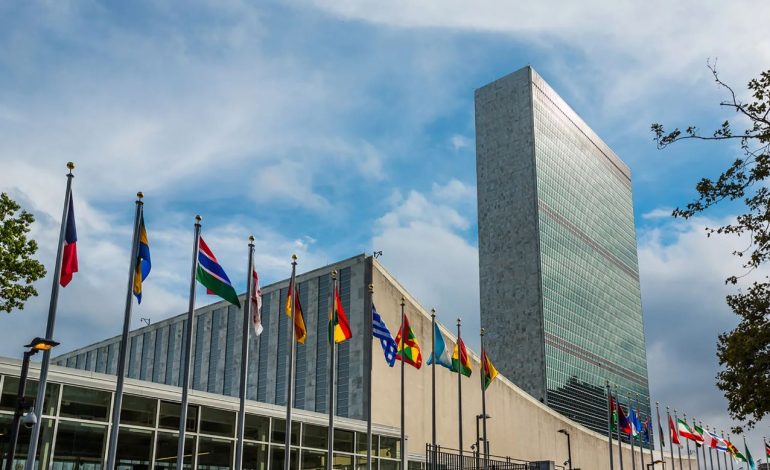
The UN HQ in New York.

New Delhi: India and Israel have voted against a Pakistan- and Belarus-sponsored draft resolution on regional conventional arms control, with New Delhi arguing that national security threats cannot be confined within geographical boundaries. The proposal nevertheless secured overwhelming support in the UN general assembly’s first committee on Monday, passing with 180 votes in favour, two against and no abstentions.
The draft, titled “Conventional arms control at the regional and subregional levels”, seeks to encourage agreements that strengthen regional security while keeping weapons and military forces at the lowest possible levels. India’s objection centred on its emphasis on regional military balances and a request for fresh UN deliberations on principles that New Delhi said had already been extensively examined.
Explaining the decision, the first secretary at India’s permanent mission to the UN, Anmol Sher Bedi, said conventional arms control needed to be addressed as a global issue. He described India’s opposition as consistent with its established position, questioning whether regional and subregional arrangements should be the principal framework for pursuing it.
“This assumes that the security concerns of States politely stop at their regional borders. They do not,” Bedi said, challenging the draft’s approach to balancing defence capabilities within particular geographical areas. He argued that countries’ security concerns extended beyond those boundaries, making the proposed understanding of regional military balance unrealistic.
What the resolution proposes
The Pakistan-Belarus proposal rests on the argument that many threats to international peace since the end of the Cold War have arisen between countries within the same region. It therefore favours regional and subregional arms control arrangements and assigns particular responsibility to countries with substantial military capabilities to help advance such agreements.
India also separately opposed a paragraph referring to conventional arms control proposals concerning South Asia. That passage acknowledged initiatives in different regions, including consultations among some Latin American countries, and recognized the contribution that conventional arms control could make to regional security.
The disagreement consequently concerns both the geographical basis for arms control and the machinery proposed to take it forward. India’s explanation challenged the assumption that a country’s defence requirements could be assessed primarily against the capabilities of others within a narrowly defined region.
India questions duplication at the UN
A second objection concerned the draft’s request that the UN Disarmament Commission consider formulating principles to guide regional conventional arms control agreements. In his explanation of India’s vote, Bedi questioned the need for another exercise when the commission had already produced three consensus outcomes on related subjects.
He cited guidelines and recommendations on regional disarmament adopted in 1993, guidelines on conventional arms control and disarmament agreed in 1999, and recommendations on practical confidence-building measures involving conventional weapons adopted in 2017. His argument was that reopening this ground risked duplicating earlier work rather than addressing an unresolved gap in the UN’s deliberations.
UN records document the 1999 consensus guidelines, which addressed conventional arms control, limitation and disarmament, with particular emphasis on consolidating peace. The UN secretary general’s account of the 2017 outcome also records the commission’s adoption of practical confidence-building recommendations after nearly two decades without such an agreement.
What the vote means
Conventional arms cover a broad range of military equipment, including tanks, artillery, combat aircraft, warships and small arms, as distinct from weapons of mass destruction. As the UN’s disarmament overview explains, international law does not generally prohibit states from possessing conventional weapons; arms control seeks to regulate or limit them and their use.
The resolution is part of a recurring UN debate, and India’s opposition predates the latest vote. Reporting on earlier versions records India voting against the proposal in both 2017 and 2024, while Israel abstained in the 2024 first committee vote.
The latest decision represents approval by the first committee, which handles disarmament and international security, rather than final adoption by the full general assembly. The draft now proceeds to the assembly for consideration, leaving India’s objections on record while advancing a regional approach supported by a large majority of participating states.