
Naga peace talks get ministerial push. Explainer on why flag, constitution and rival accords still block a settlement
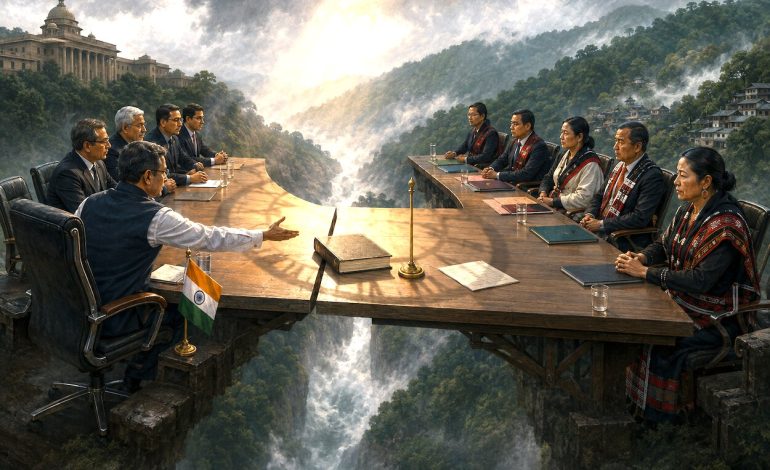
RNA Media illustration for representation.

New Delhi: The Centre has constituted a ministerial-level committee to steer the Naga peace talks, the chief minister of Nagaland, Neiphiu Rio, announced on Saturday, signalling a fresh attempt to end one of Asia’s longest-running political conflicts. The intervention comes after 29 years of formal negotiations, but deep differences over sovereignty, a separate flag and constitution, territorial integration and the terms of an inclusive settlement remain unresolved.
Addressing the 80th Independence Day celebrations at the Secretariat Plaza in Kohima on Saturday, Rio said the committee would be headed by a Union minister of state for home affairs. He did not identify its chairperson or disclose the panel’s full composition, mandate or timetable for beginning negotiations.
Rio said the Nagaland cabinet had met the Union home minister, Amit Shah, in February and asked that the dialogue be restored to the “highest political level”. The state government wanted an interlocutor with sufficient political authority and the confidence of the central government to negotiate decisions that bureaucratic representatives may not be empowered to make.
“As assured by the Union home minister in the meeting, a committee under the chairmanship of minister of state for home affairs, has been recently constituted to lead the Naga peace talks,” Rio said. He described the decision as a response to appeals from the state government, Naga civil-society organizations and sections of the political leadership seeking renewed momentum in the process.
The chief minister called upon the central government to engage all negotiating groups with urgency and clarity so that the committee could begin substantive work. He also reaffirmed that the Nagaland government would continue to act as a facilitator rather than a formal negotiating party in the talks.
The announcement fulfils an assurance Shah gave a Rio-led delegation on February 5, when he indicated that a minister of state and senior home ministry officials would be assigned to the process. The delegation included state ministers and Nagaland’s two members of Parliament, reflecting the broad political support within the state for negotiations at the ministerial level, according to the Nagaland government.
The change, however, comes against an uncompromising public position from the National Socialist Council of Nagalim – Isak-Muivah, or NSCN-IM, the most influential armed Naga organization in the negotiations. During the group’s observance of Naga Independence Day on August 14, the general secretary of NSCN-IM, Thuingaleng Muivah, reiterated that Naga sovereignty, territory, flag and constitution remained non-negotiable.
Muivah insisted that any settlement must be based on the letter and spirit of the Framework Agreement signed between NSCN-IM and the Indian government on August 3, 2015. Other Naga political organizations observing the occasion supported an inclusive settlement but differed considerably over what was achievable within India’s constitutional system, Nagaland Post reported.
Saturday’s official celebrations were also marked by the absence of student parade contingents after the Naga Students’ Federation asked educational institutions not to send pupils to the programmes. The federation was protesting against the compulsory rendition of the complete version of Vande Mataram at official functions.
The student body said it did not oppose India’s Independence Day or the observance of the national flag, national anthem and other national symbols. It argued that the devotional imagery in parts of the song conflicted with the conscience and religious beliefs of some students in the predominantly Christian state.
The disagreement followed a January 28 home ministry order prescribing a detailed protocol under which the national song is to precede the national anthem when both are performed. The federation has also invoked the protections accorded to Naga religious and social practices under Article 371A of the Constitution.
Why have the Indian government-Naga talks dragged on for so long?
The present deadlock cannot be reduced to a disagreement over two symbols, although the flag and constitution have become its most visible expression. The negotiations involve competing understandings of sovereignty, rival claims to represent the Naga people and demands extending beyond Nagaland into Manipur, Assam, Arunachal Pradesh and Myanmar.
Modern Naga nationalism acquired an organized political form through the Naga National Council, which declared Naga independence on August 14, 1947, and organized what it described as a plebiscite in 1951. Armed confrontation intensified during the 1950s, prompting the deployment of the Army and the enactment of the Armed Forces (Special Powers) Act, or Afspa, in 1958.
The 16-Point Agreement between the Indian government and the Naga People’s Convention in 1960 led to the creation of Nagaland as a state in 1963. It also produced Article 371A, which protects Naga religious and social practices, customary law, customary justice and rights over land and its resources from automatic application of parliamentary legislation.
The settlement did not end the conflict because the underground Naga leadership did not accept the Naga People’s Convention as the legitimate representative of the movement. The Shillong Accord of November 11, 1975, under which representatives of underground organizations accepted the Indian Constitution and agreed to deposit their weapons, generated another serious division.
Muivah, Isak Chishi Swu and S S Khaplang rejected that accord and established the National Socialist Council of Nagaland in 1980. The organization split in 1988, producing NSCN-IM and NSCN-K, followed eventually by several further factions with overlapping constituencies and competing leadership structures.
A ceasefire between the Indian government and NSCN-IM took effect on August 1, 1997, opening the formal peace process that continues today. The truce sharply reduced large-scale fighting, but the absence of a final settlement allowed ceasefire arrangements, designated camps, armed cadres and parallel structures of authority to persist.
After scores of negotiating rounds, the government and NSCN-IM signed the Framework Agreement on August 3, 2015, in the presence of the prime minister, Narendra Modi. The government said it had recognized the “unique history, culture and position” of the Nagas, while NSCN-IM had acknowledged the Indian political system and its complexities, according to the official announcement.
The optimism proved premature because the agreement established principles without publicly defining their constitutional translation. Expressions referring to shared sovereign power, peaceful coexistence and two entities were interpreted differently by the signatories, leaving each side convinced that the document supported its political position.
NSCN-IM argues that recognition of shared sovereignty logically requires a Naga constitution, known as the “Yehzabo”, and a separate flag. New Delhi’s position is that sovereignty cannot be divided in a manner that creates another constitutional entity within India, although limited cultural use of a Naga flag has reportedly figured in earlier discussions.
The political space for compromise narrowed further after the central government abrogated Article 370 on August 5, 2019, and ended Jammu & Kashmir’s separate constitution and flag. Granting comparable symbols to the Nagas immediately afterwards became far more difficult for New Delhi to justify politically and constitutionally.
Territory presents an even harder obstacle because the NSCN-IM concept of “Nagalim” seeks the integration of contiguous Naga-inhabited areas. Any redrawing of Nagaland’s boundaries would affect Manipur, Assam and Arunachal Pradesh, all of which have repeatedly opposed the loss of territory.
The intensity of that opposition was demonstrated in June 2001, when the government and NSCN-IM extended their ceasefire “without any territorial limits”, as recorded in a contemporary government release. The wording triggered deadly protests in Imphal because it was seen as a preliminary step towards dividing Manipur, and the phrase was subsequently withdrawn.
This history makes even non-territorial alternatives politically sensitive, including autonomous councils in Naga-inhabited areas outside Nagaland or a pan-Naga cultural and administrative institution. For NSCN-IM, abandoning integration would be especially difficult because many Nagas and several of the group’s senior figures come from areas beyond Nagaland, particularly the hill districts of Manipur.
The negotiating structure itself has created another complication. In 2017, the government opened a second track with seven organizations assembled under the Working Committee of the Naga National Political Groups and signed an “Agreed Position” with them on November 17.
Many NNPG constituents appear prepared to consider a settlement within the Indian Constitution without altering existing state or international boundaries. NSCN-IM, however, maintains that the Framework Agreement possesses a different political character and has resisted any attempt to place the two documents on the same footing.
The disagreement is partly a contest over representation and legitimacy. New Delhi cannot safely implement a settlement that excludes NSCN-IM, but an accord dominated by that organization could be rejected by rival factions, tribal bodies and Naga communities that believe their interests have not been adequately represented.
Nagaland itself is not politically or economically uniform, as demonstrated by the Eastern Nagaland People’s Organisation’s separate campaign for greater autonomy. On February 5, 2026, the central and state governments signed an agreement with the organization to create the Frontier Nagaland Territorial Authority across six eastern districts, although the implementing Bill was later deferred for further examination of its legislative powers.
The home ministry describes that authority as a mechanism for meeting the social, political, economic, educational, cultural and linguistic aspirations of eastern Nagaland. Its emergence illustrates why a comprehensive Naga settlement must accommodate not only armed organizations but also tribes and regions with different experiences of political power, representation and development.
A final accord must additionally determine what happens to thousands of cadres, weapons, camps and organizational hierarchies maintained under the ceasefires. Rehabilitation, possible absorption into security or administrative structures, decommissioning of arms and the dismantling of parallel taxation systems are not secondary matters – they determine whether an agreement can produce a functioning peace.
There are also unresolved questions involving representation in the Nagaland legislature, control of land and natural resources, customary institutions and the relationship between state bodies and any proposed pan-Naga mechanism. Some reported proposals could require new legislation or constitutional amendments, making parliamentary support and consultation with neighbouring states essential.
Trust has repeatedly deteriorated during the process, most visibly after relations collapsed between NSCN-IM and the former government interlocutor, RN Ravi. NSCN-IM accused Ravi of misrepresenting the Framework Agreement and favouring the NNPGs, while Ravi accused the group of delaying a settlement by introducing contentious demands after negotiations were declared concluded on October 31, 2019.
Secrecy has compounded that distrust because the complete negotiating record, the agreed “competencies” and draft settlement have never been officially placed before the public. The absence of an authoritative common text has allowed rival groups and the government to advance incompatible accounts of what has already been agreed.
The ministerial committee can potentially break this cycle if it carries an explicit mandate to negotiate politically difficult compromises and reconcile the Framework Agreement with the Agreed Position. Its elevation also gives the central government greater ownership of decisions that cannot be settled by intelligence officials or bureaucratic interlocutors alone.
A change in the level of representation, however, will not by itself resolve the substantive conflict. Progress will depend on whether the committee can define the limits of autonomy with candour, secure convergence among Naga groups, protect the territorial integrity of neighbouring states and convert broad political language into an enforceable constitutional settlement.