




Lamerd strike evidence points to US PrSM despite Centcom denial. How the near-500km missile compares with Atacms, Lora and Pralay
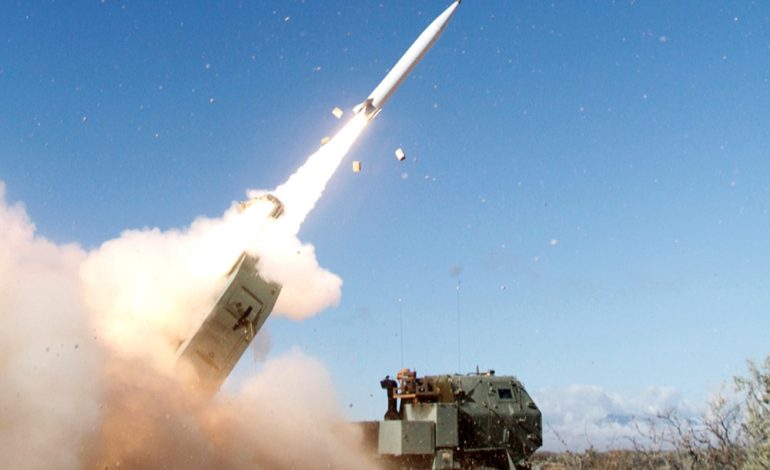
PrSM

New Delhi: Evidence gathered from three missile explosions over Lamerd in southern Iran indicates that the US Army’s new precision strike missile (PrSM) may have caused a much broader damage footprint than its reputation for pinpoint accuracy suggests. The February 28 strikes killed at least 21, including volleyball young female players and seven children, and wounded as many as 170 people in residential neighbourhoods and around a sports complex, according to Iranian reports assessed by independent investigators.
The London-based conflict-monitoring group Airwars said the missiles killed civilians at least 50 metres from their estimated detonation points and caused identifiable damage as far as 170 metres away. Its findings, based on geolocated videos, photographs, witness accounts and satellite imagery, were subsequently examined and independently corroborated in key respects by the Associated Press.
Airwars mapped three explosions across an area of about 550 metres wide, covering the Shahrak Isar and Tal-e Khandagh neighbourhoods and the Shahid Naimi sports hall. A learning centre approximately 170 metres from the sports-hall detonation showed both external and internal damage, representing the farthest documented effects identified in the Airwars investigation.
The missiles appear to have exploded between 15 and 20 metres above the ground, scattering dense metal fragments rather than producing the large craters associated with impact-fuzed warheads. Buildings, roads, electricity poles and vehicles were peppered with thousands of small impact marks, creating a fragmentation pattern that six weapons specialists consulted by AP said was consistent with the PrSM.
The US military has acknowledged employing PrSMs for the first time in combat during its campaign against Iran, but it has emphatically denied firing them at Lamerd. The Israeli military separately told AP that it had not conducted strikes as far south as Lamerd on the opening day of the war.
In a March 31 statement, the US Central Command (Centcom) said American forces had launched no attack on Lamerd or within 30 miles of the city on February 28. It argued that a missile visible in circulated footage appeared to be roughly twice the 13-foot, or nearly four-metre, length of a PrSM and resembled Iran’s longer Hoveyzeh cruise missile, according to the official Centcom account.
Weapons specialists examining the same imagery disputed that explanation, pointing to the missile’s compact body, control fins and lack of the wings and external engine arrangement associated with the Hoveyzeh. They also said an Iranian cruise missile was not known to carry a height-of-burst warhead capable of producing the distinctive, near-circular fragmentation field seen across Lamerd.
The intended target remains unexplained, as neither AP nor Airwars found evidence that military personnel or security officials were killed in the three explosions. An Islamic Revolutionary Guard Corps compound lies near the affected area, but available satellite images reportedly showed no damage to that installation.
The open-source evidence therefore makes the PrSM identification persuasive without settling attribution beyond doubt, particularly because investigators do not have access to US targeting data, launcher records or classified battle-damage assessments. It also cannot establish whether the missiles struck their programmed coordinates, malfunctioned, were directed using faulty intelligence or were intended for another target altogether.
What the evidence does establish is a serious weapon-selection question, because precision at the point of aim does not necessarily mean that a munition’s effects remain narrowly confined. A missile designed to spread high-velocity fragments across a substantial area may be militarily effective against dispersed equipment and troops, but its use close to homes, schools and sports facilities sharply increases the probability of civilian casualties.
The Lamerd controversy has emerged as Washington is rapidly expanding PrSM production after its combat debut and heavy expenditure during the Iran war. In June, the US Army raised the programme’s contract ceiling by $8.4 billion to a cumulative $13.34 billion for production and development through 2032, although the ceiling does not represent money already spent, according to an official US contract notice.
The expansion also reflects concerns about the depth of American long-range missile stocks, which were relatively small when PrSM entered service. Reuters reported in August, citing people familiar with classified inventory data, that the US had expended “virtually all” of its available PrSM and Army Tactical Missile System stocks during the prolonged campaign, although the Pentagon did not disclose the remaining numbers in its response to the report.
PrSM explained
The PrSM (precision strike missile) is a road-mobile, solid-propellant, surface-to-surface ballistic missile developed by Lockheed Martin to replace the MGM-140 army tactical missile system, commonly known as Atacms. It is intended to strike air-defence sites, missile launchers, command centres, radar installations, troop concentrations and other time-sensitive targets beyond the reach of conventional rocket artillery.
Lockheed Martin publishes an engagement envelope extending from about 60 kilometres to more than 499 kilometres for the baseline missile, while the US Army generally describes its effective reach as exceeding 400 kilometres. Its manufacturer has not publicly disclosed the missile’s launch weight, diameter, maximum speed, circular error probable or warhead weight, limiting the value of apparently precise figures circulating in unofficial accounts.
The missile’s compact diameter allows two rounds to fit inside each standard launcher pod, compared with one ATACMS. A wheeled M142 high-mobility artillery rocket system, or Himars, can consequently carry two PrSMs, while a twin-pod M270A2 multiple-launch rocket system (MLRS) can accommodate four.
This doubling of launcher capacity is as operationally important as the extended range because it permits a battery to attack more targets before exposing itself during reloading. The longer reach also allows launchers to remain farther behind the front and exploit road mobility to fire, relocate and complicate an adversary’s counter-strike effort.
During a February 2025 qualification test, two PrSM Increment 1 missiles launched from a Himars engaged a target array representing a Scud missile, a radar and rotary-wing aircraft. The US Army said the missiles performed as expected in range, flight time, accuracy and height of burst, which demonstrated the system’s intended use against both point targets and dispersed battlefield assets in the official test report.
The warhead implicated in Lamerd is designed to detonate shortly above the target and project tens of thousands of dense tungsten pellets in every direction. One published estimate cited by Airwars places the number at around 180,000, but neither the US Army nor Lockheed Martin has publicly confirmed the pellet count, warhead weight or official lethal radius.
Tungsten’s high density allows comparatively small fragments to retain considerable energy, puncture light structures and soft-skinned vehicles, and injure exposed personnel at substantial distances. That makes the warhead effective against parked aircraft, radar equipment, missile batteries and troop concentrations, but also explains why walls, vehicles and roads across Lamerd displayed extensive pockmarking without corresponding impact craters.
The distinction between accuracy and effect is central to understanding the controversy surrounding the weapon. A PrSM may land or detonate extremely close to its designated coordinates, yet still cause casualties well beyond that point because accuracy describes where the missile arrives, not how far its warhead throws lethal fragments.
Atacms, the weapon being replaced, has a maximum range of roughly 300 kilometres and carries a 500-pound-class blast-fragmentation warhead in its unitary configuration. PrSM reaches considerably farther and doubles the launcher load, although the secrecy surrounding its warhead weight and accuracy prevents a complete quantitative comparison, as the US Army’s Atacms-PrSM assessment makes clear.
Israel Aerospace Industries’ Lora occupies a broadly comparable long-range precision-strike category, with a declared range of 90 to 430 kilometres and a manufacturer-claimed accuracy of 10 metres circular error probable. Lora is substantially larger at 5.2 metres and 1,600 kilograms, uses GPS-aided inertial guidance, carries a high-explosive warhead and can be fired from land or ships, while four sealed missiles can be mounted on a standard 16-tonne truck, according to IAI’s published specifications.
India’s Pralay is another relevant comparison because it is a mobile, solid-propellant, quasi-ballistic missile designed for conventional battlefield strikes at ranges between 150 and 500 kilometres. The Indian missile can carry different warheads and uses modern navigation and integrated avionics, but recent government releases have not provided sufficient data on its accuracy, physical dimensions or fragmentation footprint to rank it directly against PrSM, as reflected in the Ministry of Defence’s Pralay documentation.
In doctrinal terms, Pralay and PrSM both give land forces the ability to attack high-value targets deep inside an adversary’s rear without relying on combat aircraft, while Lora offers a similar function with the added option of shipboard deployment. PrSM’s principal advantages are its seamless integration with the widely deployed Himars and M270 launcher fleet, its two-missile pod and an established production and combat-use pathway, rather than any publicly demonstrated superiority in accuracy.
The current Increment 1 is principally intended for stationary targets, but the PrSM family is being developed through successive upgrades. Increment 2 completed its first 350-kilometre flight test in March 2026 with a multimode seeker intended to attack moving ships and relocatable land targets, according to Lockheed Martin.
Later increments are intended to improve effectiveness against hardened targets and extend the missile’s reach far beyond the baseline model. Lockheed Martin’s proposed Increment 4 uses a booster-to-ramjet propulsion arrangement designed to exceed 1,000 kilometres while retaining compatibility with Himars and M270 launchers, although that version remains under development and is not the weapon associated with Lamerd, according to the company’s June test update.
PrSM consequently represents a major increase in the reach and volume of US Army missile fire, but Lamerd demonstrates why technical precision cannot be assessed separately from warhead behaviour and target surroundings. If the independent identification is correct, its combat debut has shown that a missile can strike accurately and still create a lethal footprint large enough to make its employment near populated areas exceptionally hazardous.