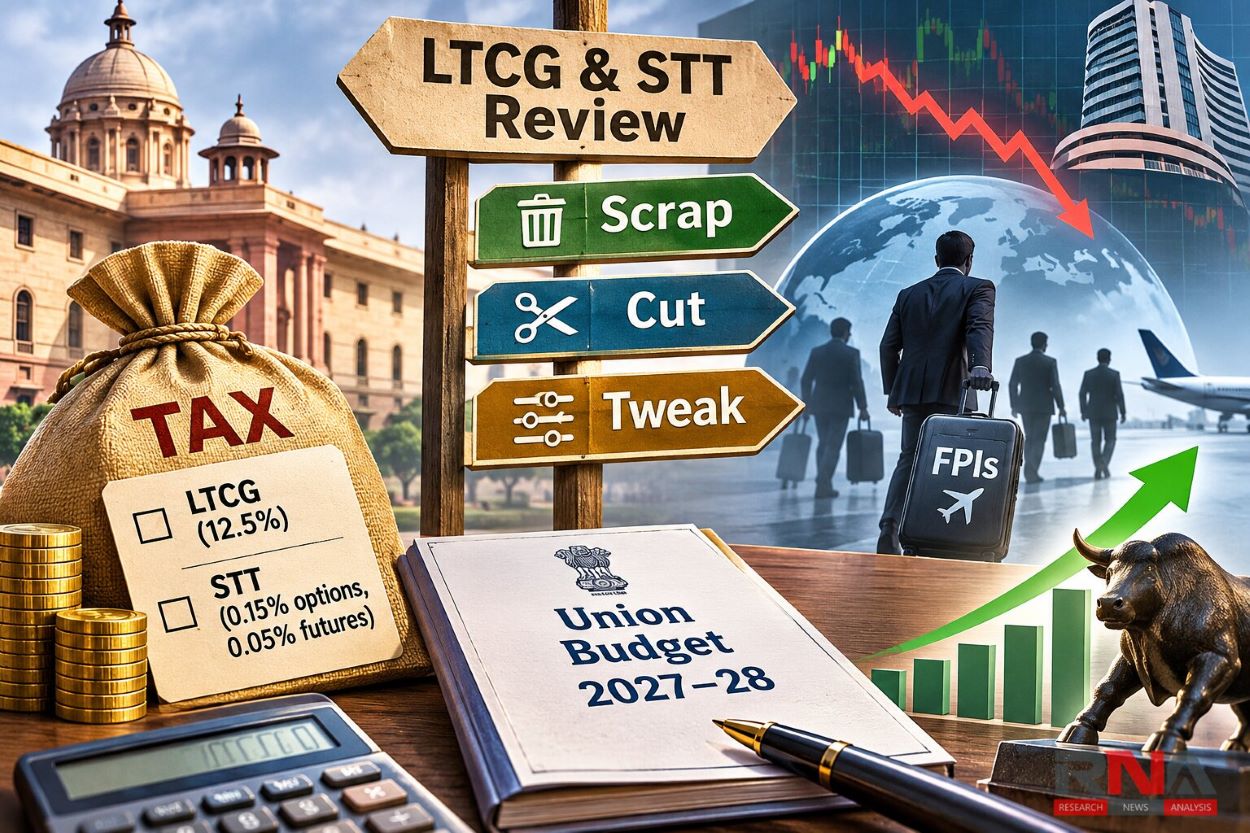




India weighs major capital gains tax overhaul to win back foreign investors after record market exodus
RNA Media illustration for representation.

New Delhi: The Centre is considering a substantial overhaul of taxes on stock market investments, including the possible abolition or reduction of long-term capital gains tax, as it seeks to restore foreign investor confidence following unprecedented withdrawals from Indian equities. The proposals, which also envisage changes to securities transaction tax, come amid concerns that India’s relatively high investment costs, weakening rupee and disappointing equity returns are driving overseas capital towards more attractive global markets.
The finance ministry has begun examining several options, ranging from eliminating long-term capital gains (LTCG) tax on listed shares to restricting exemptions to foreign portfolio investors (FPIs), according to an ET report. Another proposal involves reducing the prevailing tax rate without abolishing the levy altogether, potentially offering the government a compromise between encouraging investment and protecting its revenue.
The discussions have gained urgency as India prepares its Union Budget for 2027–28 against a backdrop of substantial foreign capital outflows and increased competition from other emerging economies. Officials have consulted institutional investors, financial market representatives and taxation specialists, although no decision has been announced and the government is understood to be assessing the financial implications of each proposal.
Regulators favour tax relief
India’s financial regulators have reportedly supported a major relaxation of capital gains taxation to improve the country’s competitiveness as an investment destination. The Securities and Exchange Board of India (Sebi) and the Reserve Bank of India are understood to favour removing the levy, although their precise recommendations have not been made public.
According to a recent Reuters report, Sebi has recommended exempting overseas equity investors from LTCG tax and providing targeted relief to domestic mutual fund investors. The latter proposal would allow qualifying investors to move investments held for more than a year into other mutual fund holdings without immediately incurring the existing capital gains liability.
Such changes could reduce the tax burden on long-term investments and encourage investors to retain capital within India’s financial markets rather than withdraw it altogether. However, the recommendations are understood to be part of confidential consultations ahead of the Budget and carry no binding obligation for the government.
The finance minister, Nirmala Sitharaman, has acknowledged growing concerns about the taxation of equity investments and indicated that the government would examine demands for reform. Speaking at a media event earlier this week, she recognized that changing economic conditions had strengthened the arguments for reconsidering the existing tax structure.
The government’s willingness to revisit the issue represents a shift from its position in July, when it informed Parliament that no proposal to abolish LTCG tax on equities was under consideration. The minister of state for finance, Pankaj Chaudhary, had then maintained that capital gains taxation was reviewed periodically as part of the annual Budget exercise.
Record foreign withdrawals expose India’s challenges
The debate follows an exceptionally difficult year for overseas investment in Indian stocks, with FPIs withdrawing approximately ₹2.95 lakh crore during the first 10 months of 2026. October alone recorded net foreign equity sales of ₹34,843 crore, following withdrawals of ₹35,861 crore in September, reflecting sustained pressure on investor sentiment.
The scale of the withdrawals is particularly significant when compared with 2025, when overseas investors sold Indian equities worth approximately ₹1.66 lakh crore over the entire year. Market analysts have attributed the accelerated selling to a combination of expensive valuations, currency depreciation, elevated global interest rates, high crude oil prices and uncertainty surrounding corporate earnings.
There are nevertheless indications that the selling pressure may be easing, with foreign investors returning as net buyers during the latter half of October. According to NSDL-based figures reported on November 5, overseas funds invested ₹13,112 crore during October 16–31, particularly in information technology and telecommunications shares, although this was insufficient to reverse the month’s overall withdrawals.
Another important concern is India’s relative underperformance against competing markets, particularly those benefiting from the global investment boom in artificial intelligence and advanced semiconductor manufacturing. Reuters reported that the Nifty 50 had declined approximately 4.8 per cent over two years, against a roughly 40 per cent gain in the MSCI emerging markets index, underscoring the challenge of retaining internationally mobile capital.
Why LTCG and transaction taxes matter
Under the existing framework, gains from listed equity investments held for more than 12 months generally attract LTCG tax at 12.5 per cent, subject to applicable exemptions and conditions. Profits from qualifying equity investments sold within a year are taxed at 20 per cent, reflecting the higher rate applicable to short-term capital gains.
The I-T department’s regulations reflect changes introduced in July 2024, when the government increased the long-term capital gains tax rate on listed equities from 10 per cent to 12.5 per cent. Although intended to rationalize capital gains taxation, the revised structure has attracted criticism from investors who argue that it diminishes India’s appeal relative to markets offering more favourable tax treatment.
Foreign investors face an additional complication because their returns are ultimately measured in their home currencies, frequently the US dollar, rather than in rupees. Consequently, an increase in the rupee value of an investment may translate into a much smaller dollar-denominated gain, or even a loss, when the Indian currency depreciates.
One proposal under examination would therefore permit FPIs to calculate their taxable capital gains in dollar terms instead of rupees, potentially reducing the mismatch between taxable profits and actual foreign-currency returns. Overseas investors have also sought simpler procedures for bringing money into India and repatriating investment proceeds, arguing that administrative efficiency is another important factor in international investment decisions.
Government faces a difficult revenue calculation
Any substantial reduction in capital gains taxation would carry financial implications for the Union government, which relies on such collections to support public expenditure. LTCG tax revenue amounted to approximately ₹1.29 lakh crore in the 2024–25 financial year, while securities transaction tax (STT) contributed another ₹57,522 crore, according to figures cited in the latest reports.
These revenue totals illustrate why abolishing the levy outright could prove politically and fiscally difficult, particularly when the government must finance infrastructure development, welfare programmes, subsidies and other expenditure commitments. The overall LTCG collection figure also covers taxable long-term gains beyond listed equities, meaning it should not be treated as the precise revenue that would be forfeited through an equity-specific exemption.
Some market participants have consequently suggested restructuring STT to compensate for at least part of the potential revenue loss from LTCG reform. One possibility involves marginally increasing transaction taxes on options trading, which accounts for a substantial share of derivatives activity, without imposing additional costs on ordinary equity purchases or futures transactions.
The proposal would require careful consideration because derivatives taxation has already increased under the Union Budget for 2026–27. According to the National Stock Exchange’s current tax schedule, STT on the sale of options rose from 0.10 per cent to 0.15 per cent of the premium on April 1, while the levy on futures sales increased from 0.02 per cent to 0.05 per cent.
The authorities must therefore balance potentially competing objectives – raising revenue, discouraging excessive short-term speculation and ensuring that taxation does not undermine market liquidity. Higher charges on speculative derivatives transactions might support regulatory efforts to contain risky trading, but additional increases could also affect legitimate hedging activity and institutional participation.
Equal treatment of investors remains a concern
Another contentious question is whether foreign investors should receive tax concessions unavailable to Indian investors, including retail shareholders and domestic institutions. Several participants in the consultations have reportedly opposed an FPI-exclusive exemption, warning that preferential treatment could create disparities within the country’s investment framework.
An alternative would extend LTCG relief to all qualifying equity investors, thereby preserving broadly comparable treatment between domestic and overseas capital. Such a policy could encourage longer holding periods and support domestic financial savings, although its larger potential revenue cost would make the decision considerably more complicated.
Ultimately, reducing investment taxes alone may not be sufficient to reverse foreign withdrawals if concerns over valuations, corporate profitability, currency stability and global economic conditions persist. The government’s challenge will be to devise a taxation framework that improves India’s competitiveness without compromising fiscal priorities, with the forthcoming Union Budget providing the next major opportunity for a policy decision.