India watching global security shifts, Rajnath Singh calls for stronger defence self-reliance
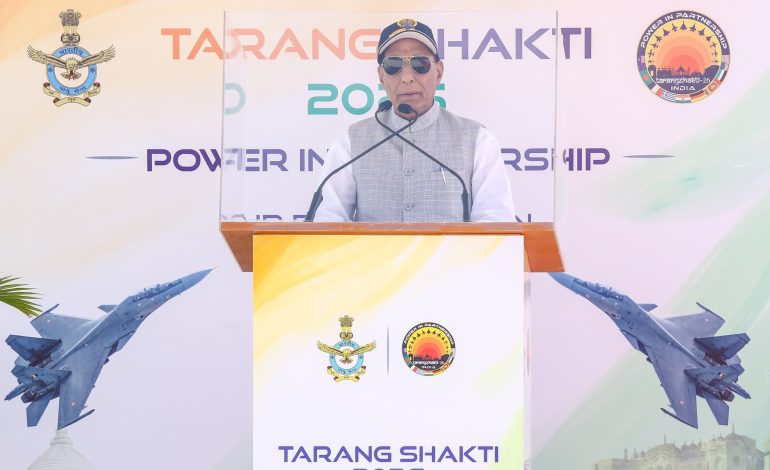
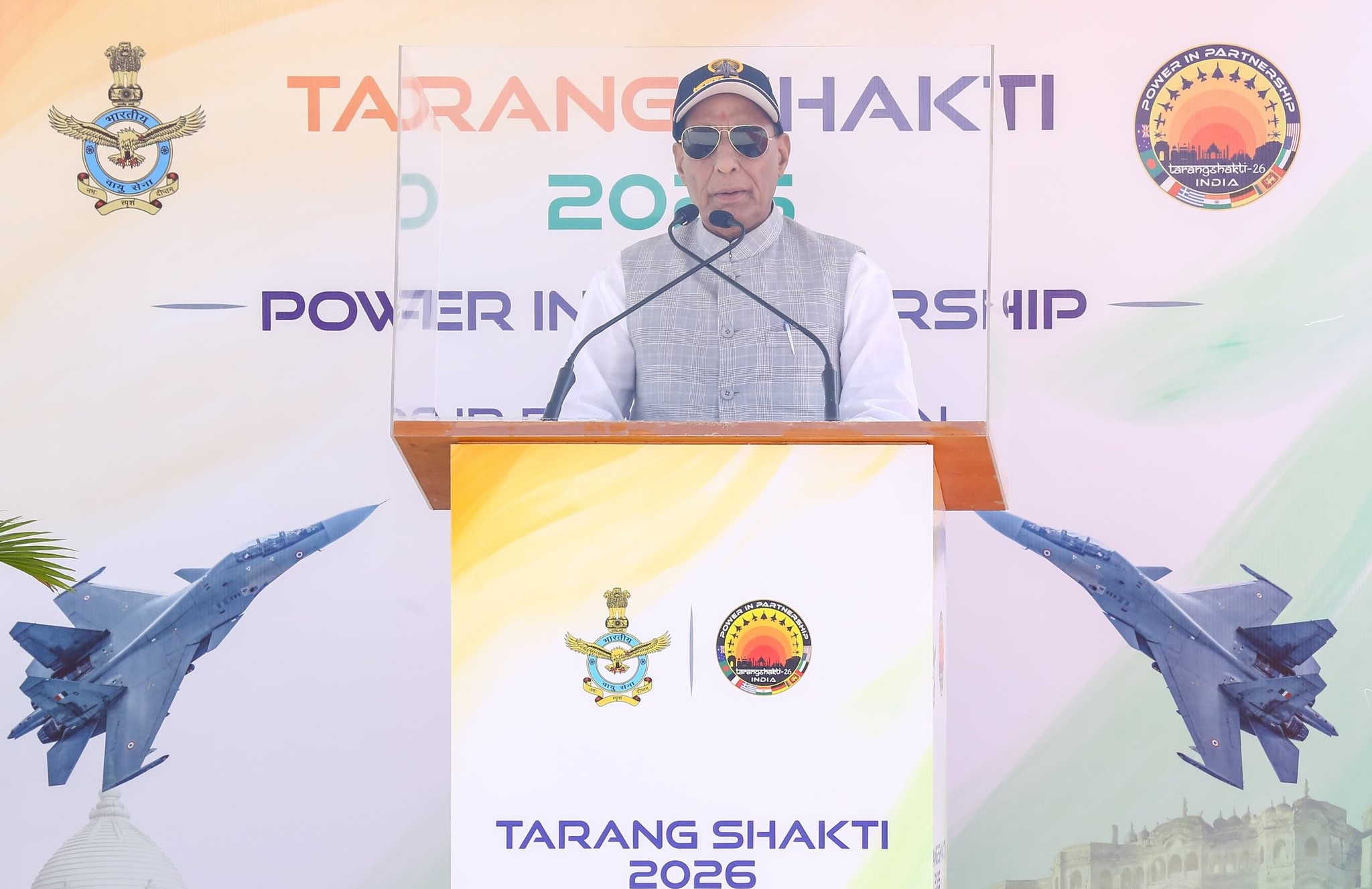
Rajnath Singh during his address at Tarang Shakti 2026 at the Jodhpur airbase. (Photo: X/@rajnathsingh)

New Delhi: India is closely tracking security developments in its neighbourhood and beyond as changes in warfare and an unsettled international order reshape its strategic environment, the defence minister, Rajnath Singh, said on Saturday. Addressing Exercise Tarang Shakti 2026 at Air Force Station Jodhpur, he linked military preparedness to stronger domestic technological capabilities and closer cooperation with trusted international partners.
Speaking after an aerial display, Singh said the established global order was changing rapidly, while the contours of its successor remained uncertain. Against that backdrop, he said, India’s armed forces were undergoing changes in their organization, equipment and strategic approach, with defence self-reliance providing the foundation for that transformation.
His remarks placed Atmanirbhar Bharat (self-reliant India) in defence within the wider challenge of maintaining national security during international uncertainty. He described the policy as building the ability to design, develop, manufacture, maintain and upgrade essential military technologies while remaining engaged with the world.
Singh argued that the capacity to manufacture weapons and develop critical technologies was essential for sustaining a prolonged conflict. His emphasis extended beyond acquiring equipment to ensuring that the country could support its military capabilities through periods of disruption.
The minister also highlighted how artificial intelligence, drones and electronic warfare were changing the pace and character of combat. Unmanned systems were altering the scale of operations, while AI was influencing battlefield decision-making and electronic warfare was increasing the importance of control over the electromagnetic spectrum.
Military effectiveness would increasingly depend on how quickly forces detected threats, understood developments and responded, he said. He identified information, precision, speed and coordination as central to future operations, with warfare now extending into space, cyberspace and the information domain alongside land, sea and air.
Singh also warned that critical trade routes, sea lanes and vulnerable chokepoints were being weaponized. He pointed to the growing battlefield influence of non-state actors and the ability of long-range precision weapons to expand the area over which military operations could unfold.
Turning to domestic capabilities, he cited the Tejas LCA, the Dhruv, Rudra and Prachand helicopters, the light utility helicopter, the Akash air defence system and active electronically scanned array radars. He also identified the Advanced Medium Combat Aircraft programme and advanced aero-engine development and co-production as priorities for building more sophisticated aerospace capabilities.
Singh said India’s ambitions included contributing to dependable international defence supply chains, with opportunities for joint research, development, production, maintenance and training. “The defence relationships of the future will be about technology and trust, not just about platforms,” he said, arguing that domestic strength should develop alongside reliable partnerships.
According to the defence ministry’s account of Tarang Shakti, the exercise’s second edition is being hosted by the Indian Air Force from September 26 to October 12. It brings together participating air forces from Australia, Bangladesh, France, Germany, Sri Lanka, the United Arab Emirates and the United States, alongside observers from 32 countries.
Building on the inaugural edition in 2024, the exercise combines combat, transport, surveillance and air-to-air refuelling capabilities to support joint mission planning and operational learning. Indigenous aircraft, including Tejas LCA and the Prachand light combat helicopter, are also participating, placing Indian platforms alongside those of foreign contingents.
Singh urged the Air Force to incorporate the exercise’s lessons into training, tactics, doctrine and future capability development. He said its lasting value would lie in the ability of forces using different aircraft and procedures to communicate, coordinate and operate effectively together, as well as in the professional relationships developed during the deployment.