
India offers to help rebuild Nepal school swept away after principal saves hundreds
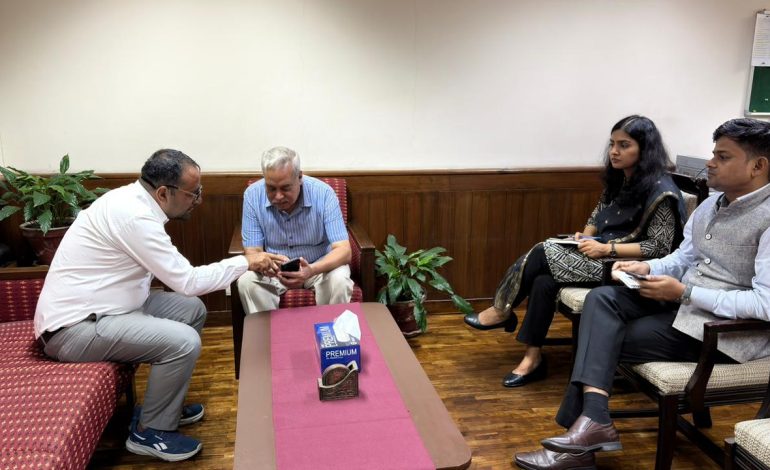

New Delhi: India has offered to support the reconstruction of Tribhuvan Trishuli Secondary School in Nepal’s Nuwakot district after the institution was swept away by the catastrophic flash flood that struck the Himalayan country on August 26. The assurance followed a meeting on Tuesday between the Indian ambassador to Nepal, Naveen Srivastava, and the school’s principal, Rajendra Dawadi, whose swift evacuation protected more than 900 pupils on the campus and hundreds of others travelling to school, as RNA Media had reported.
In a social-media post, the Indian mission said Srivastava had recognized Dawadi’s timely intervention and assured him that India would support the school’s eventual reconstruction. The wording amounted to an offer of assistance rather than a declaration that New Delhi would finance or execute the entire project.
Accounts of the number of children saved have varied because the school had about 1,600 enrolled pupils, but only around 900 were on the premises when the first warning arrived. Dawadi had also instructed buses carrying other students to turn back, while the Indian mission credited his actions with protecting more than 1,600 schoolchildren.
The warning came at about 9.20am when the school accountant rushed into a classroom after receiving a telephone call from a relative in Rasuwa, where the flood had struck earlier. With barely 14 minutes available, Dawadi stopped classes, ordered the bell to be sounded and directed teachers to move the pupils towards higher ground.
Parents, teachers and students used buses and motorcycles during the evacuation, while many children ran uphill as the wall of water, mud and debris approached Bidur. The last school bus crossed a nearby bridge shortly before an older bridge collapsed, and the pupils watched from higher ground as the river engulfed their classrooms.
The school was left completely destroyed, with its former site effectively becoming part of the riverbed, while two staff members remained unaccounted for. Dawadi, who had once studied at the institution before returning as a teacher and later becoming its principal, has appealed for the school to be rebuilt at a safer location away from the river.
India’s association with Tribhuvan Trishuli Secondary School goes back to its establishment in 1951, when its original facilities were designed by K.I. Singh, an Indian engineer associated with the Trishuli hydroelectric project. An Indian embassy record said a new school building, constructed with an Indian grant of Nepali rupees 25 million – about ₹1.56 crore – was inaugurated on August 2, 2022.
The project was implemented under the India-Nepal Development Cooperation programme as a high-impact community development project, with the new infrastructure intended to improve facilities for more than 1,300 pupils. The school’s enrolment subsequently increased to about 1,600, making the loss of the campus a major disruption to education across the flood-affected Trishuli valley.
Teachers are considering rented premises, government buildings or a temporary learning centre so that classes can resume, but damaged bridges and roads have divided the school community. Dawadi has said that any permanent campus must be located on higher ground and that restoring connectivity across the Trishuli river will be essential for pupils living on opposite banks.
The school’s destruction forms part of a wider disaster caused by a glacier collapse on August 26, which sent ice, rock, mud and water through Nepal’s border region with China. By September 1, the confirmed death toll in Nepal, as RNA Media reported, had crossed 1,000, about 4,000 people remained missing and more than 11,000 had been rescued.
Specialized teams from India, Nepal and China have been working at damaged hydropower projects and other difficult locations where hundreds of workers were stranded or feared trapped. Against that larger emergency, the survival of the Tribhuvan Trishuli pupils has underscored how credible local warnings and immediate evacuation can prevent mass casualties.