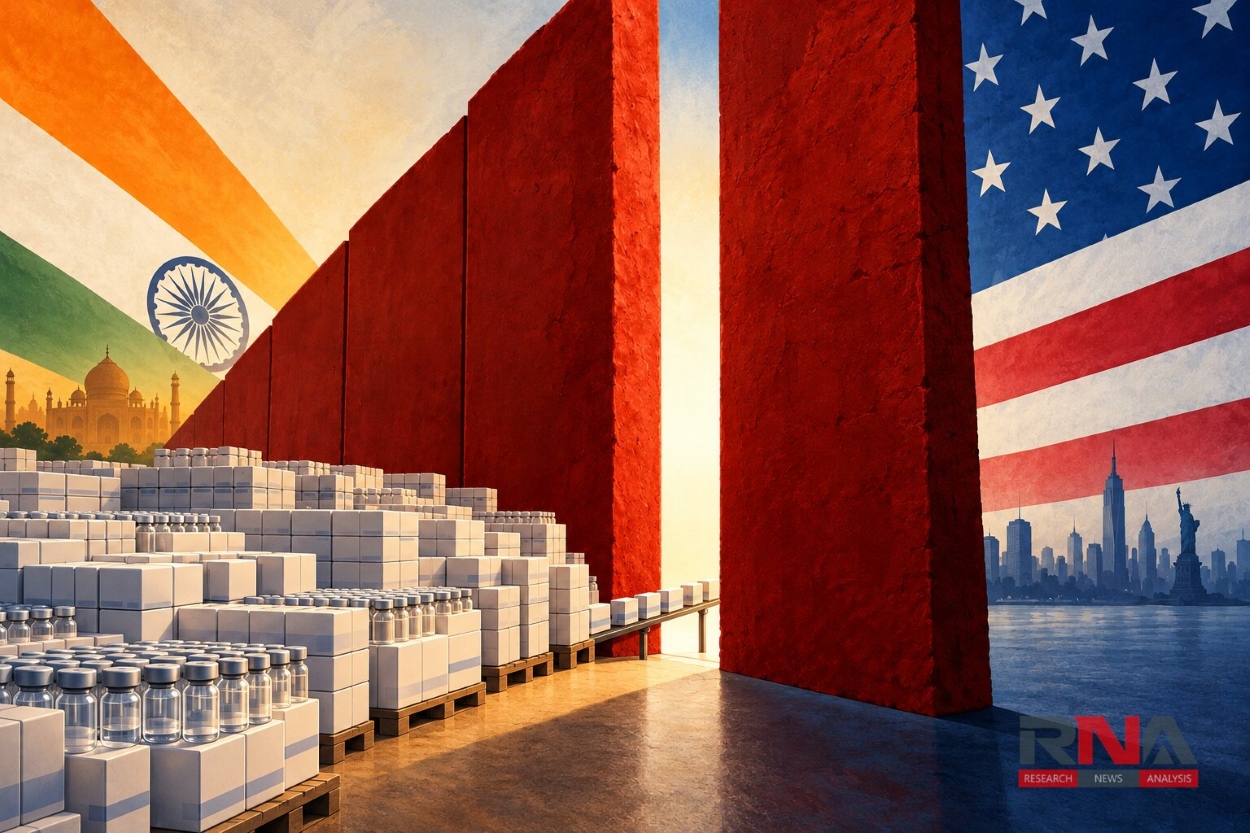




India in US ‘shadow transhipment’ report. How Chinese goods allegedly bypass tariffs
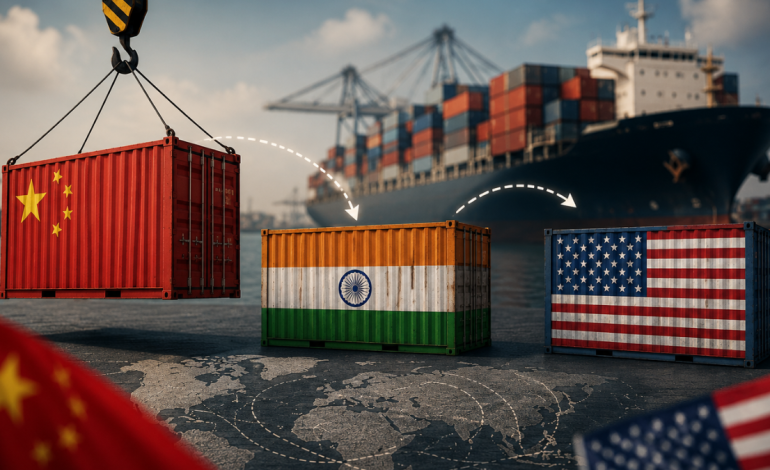
RNA illustration for representation.

New Delhi: India has been placed in the top category of a new United States report examining the global network through which Chinese-origin goods are allegedly rerouted to America to avoid higher tariffs. The White House report lists India alongside major trading hubs such as the European Union, Canada, Mexico, Japan and South Korea, while marking India, Mexico and Vietnam as the three leading destinations for Chinese goods that were transhipped to the US in 2025.
The report, titled “The Great Trans-shipment Scam”, estimates that around $67 billion worth of Chinese-origin goods moved through the three countries before reaching the US last year. However, being placed in the top category does not mean that all trade through India or the other countries is illegal; the classification reflects the scale and complexity of their trade networks and the potential risk of transhipment.
How are Chinese goods allegedly getting around US tariffs?
According to the White House report, Chinese exporters began increasingly using third countries after the Trump administration imposed Section 301 tariffs on Chinese goods in 2018. Instead of sending some products directly from China to the US, exporters could route them through another country first.
But simply changing the shipping route does not legally change a product’s origin.
The US report alleges that some Chinese goods were subjected to only limited activity in the third country – such as repackaging, relabelling, minor processing, reinvoicing or changes in shipping documentation. The goods could then be presented as originating from that country even though most of their Chinese content remained unchanged.
That is the distinction between legitimate trade and alleged tariff evasion.
A Chinese component or product can legitimately become part of a product manufactured in India if sufficient manufacturing takes place in India. But if a finished Chinese product is merely repacked or given minor processing in India and then declared as Indian-origin, US authorities can regard the transaction as an attempt to circumvent tariffs.
Why does changing the route make a difference?
The customs authority looks at the country of origin of the good as well as what occurred while producing the good. If there was significant processing or transformation of the good in a different country, the country of origin may change as per the trade rules. Just transporting the good does not do that
If Chinese-origin goods can be made to appear as products of a lower-tariff country without undergoing substantial transformation, the importer could potentially avoid paying the higher China-specific duty.
In other words, the alleged scheme is not simply about moving Chinese goods through India. It is about using the Indian leg of the supply chain to make the goods appear, on paper or through their processing history, to have a different origin.
Why has India been highlighted?
The report highlighted India as a “Tier-1 Diversified Scale Leader”, alongside some of the world’s largest and most diversified trading economies. The White House says India, Mexico and Vietnam were the leading destinations for Chinese-origin goods that were subsequently transhipped to the US in 2025. The three accounted for an estimated $67 billion in such goods.
The report also points specifically to the Pune-Gujarat-Chennai industrial belt, alleging that Chinese-origin pumps and compressors entering these supply chains can compete with American manufacturers.
The significance of the example is not that goods manufactured in India are automatically considered Chinese. Rather, the US allegation is that some Chinese-origin products can enter Indian supply chains and subsequently reach the US in a way that obscures their original Chinese content.
How does the US plan to catch such shipments?
The Trump administration has announced an AI-enabled system called “Detective Border”, which is intended to help US customs and border protection identify shipments that may have been rerouted to evade tariffs.
The system is expected to examine information such as shipping records, previous routes taken by similar goods, product classifications, corporate ownership, and whether a company claiming to manufacture a product actually has the capacity to produce it.
It could also use anomaly detection and computer vision to flag shipments that appear inconsistent with normal trade patterns.
This is important because a transhipment investigation often cannot be resolved simply by looking at the final shipping label. Customs officials may need to establish where the product was made, what processing actually took place, who owned the companies involved, how the shipment moved and whether the declared manufacturing activity was genuine.
How big does the US say the problem is?
The White House report gives a wide range for the estimated value of potentially illegal transhipment – from about $40 billion to $303 billion a year. The large gap reflects differences in the methodologies and definitions used to estimate transhipment, meaning the figures should not be treated as a precise measurement of proven illegal trade.
The report nevertheless argues that the scale is large enough to undermine US tariff policy and hurt American manufacturers.
For India, the immediate significance is that Washington is treating the country as one of the world’s major trade hubs where transhipment risks require greater scrutiny. The report does not establish that India’s overall trade with the US or China is illicit, but it could lead to closer checks of specific products, exporters and supply chains.
The broader US concern is straightforward. If Chinese goods remain Chinese-made but reach the American market through another country to escape China-specific tariffs, Washington wants to ensure that the tariff cannot simply be bypassed by changing the route.