


India, Germany edge closer to ₹90,000 crore submarine deal, Berlin’s envoy to New Delhi says
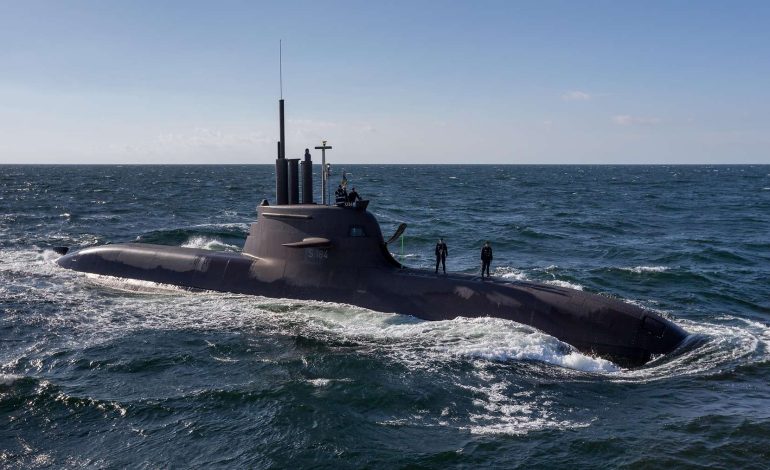
A German Type 212A air-independent propulsion diesel-electric attack submarine built by Howaldtswerke-Deutsche Werft, now part of Thyssenkrupp Marine Systems. (Bundeswehr photo for representation.)

New Delhi: India and Germany are set to sign a long-delayed submarine construction agreement worth close to ₹90,000 crore within the next month, the German ambassador to India, Philipp Ackermann, said on Thursday. Speaking on the sidelines of an industry event organized by the Indo-German Chamber of Commerce in New Delhi, Ackermann said he was “very hopeful and confident” that the accord would be signed soon.
The agreement covers six next-generation conventional submarines to be built in India under Project-75I (P-75I), the Indian Navy’s programme to replace its ageing diesel-electric fleet with boats fitted with air-independent propulsion (AIP), which is a technology that allows a conventional submarine to stay submerged for roughly two weeks instead of a few days. Germany’s ThyssenKrupp Marine Systems will partner Mumbai-based Mazagon Dock Shipbuilders to build the vessels domestically.
The project has been in the making since 2018, when the estimated cost stood at around ₹43,000 crore. Years of technical evaluation, shifting requirements and prolonged negotiation have since pushed the figure to somewhere between ₹70,000 crore and ₹90,000 crore, depending on the final scope of technology transfer and localization agreed upon.
Navantia’s exit left TKMS as sole bidder
Thyssenkrupp was not always the only contender. Spain’s Navantia, bidding alongside Larsen & Toubro, competed for the contract for several years before being disqualified in January 2025 for want of a sea-proven air-independent propulsion system. That left the Thyssenkrupp-Mazagon Dock combination as the sole compliant bidder, a status confirmed by Mazagon Dock in official filings to the stock exchanges.
By March 2026, the contract negotiation committee had completed its deliberations between the government and the winning consortium, with the proposal forwarded for approval by the competent authority – the final procedural step before a formal contract can be signed. Ackermann’s remarks suggest that approval is now close at hand.
Unlike Thyssenkrupp’s proven Type 214 boats already in service elsewhere, the submarines proposed for the Indian Navy will reportedly be built to an entirely new design, featuring angular hull lines intended to reduce sonar signature rather than the rounded profile typical of conventional submarines. That represents both an opportunity and a risk: it gives India a more advanced platform, but one without the operational track record of an established design.
Indigenization is central to the programme’s stated purpose. The first submarine is expected to carry around 45 per cent Indian-made content, rising progressively to about 60 per cent by the sixth vessel, covering critical components such as heavyweight torpedoes and towed sonar systems. Thyssenkrupp has already begun lining up Indian sub-vendors, including a memorandum of understanding with Hyderabad-based VEM Technologies for weapons technology, and discussions with Mumbai’s CFF Fluid Control.
The submarine deal has taken on significance beyond its commercial value. Germany’s defence minister, Boris Pistorius, has previously described India as Germany’s most important strategic partner in the Indo-Pacific, and had himself expressed confidence – during a visit to Mumbai in 2023 – that a preliminary agreement would follow shortly. Ackermann, in earlier remarks, characterised the broader defence relationship as one that has moved beyond symbolic gestures into what he called industrial substance, encompassing joint exercises as well as production cooperation.
For India, the programme forms part of a wider effort to reduce dependence on a single supplier for critical naval platforms, a consideration that has gained urgency given Russia’s prolonged war in Ukraine and Moscow’s historically dominant role in supplying Indian military hardware. The Indian Navy currently operates six Kalvari-class submarines, built under the earlier Project 75 with French assistance, and has long argued that its underwater fleet strength falls well short of operational requirements.
Once signed, the contract is expected to mark the effective conclusion of a procurement process that has run for the better part of a decade, though delivery of the first submarine – under the terms of the original tender – is not expected until roughly seven years after the contract is inked. Whether that timeline holds will depend on how smoothly the transition from a wholly new design to series production proceeds, a transition that has tripped up submarine programmes in India before.