
India approves first dengue vaccine, but Qdenga’s private-market launch is expected in 2027
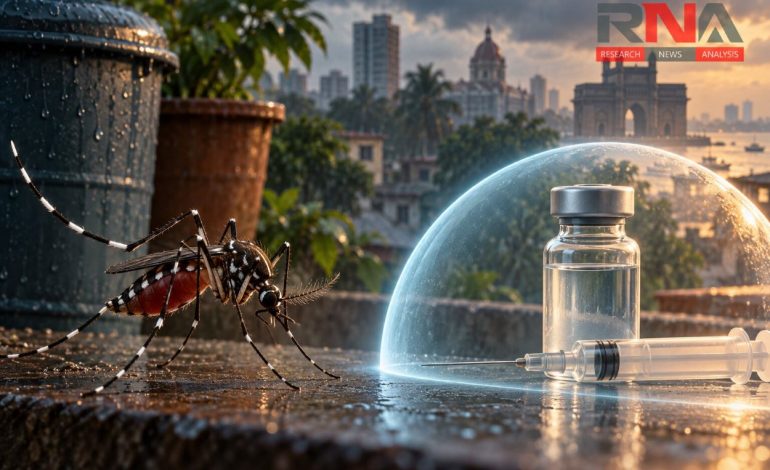
RNA Media illustration for representation.

New Delhi: India has approved its first dengue vaccine, authorizing Takeda’s Qdenga for people aged four to 60 after reviewing clinical evidence that included a study in Indian participants. The approval opens a new route to dengue prevention, although the vaccine is expected to reach India’s private market only in the first half of 2027.
The Central Drugs Standard Control Organisation (CDSCO) granted marketing authorization in July 2026 for the two-dose vaccine, which is manufactured in Germany and will be imported into India. On Friday, Takeda and Dr Reddy’s Laboratories announced an agreement under which Dr Reddy’s will promote and distribute it through private healthcare providers, subject to the remaining local procedures.
That timetable matters for patients: regulatory approval does not mean the vaccine is available for appointments. Takeda retains the rights to supply India’s public market, while any inclusion in a government immunisation programme would require a separate policy decision.
Qdenga is designed to protect against dengue disease caused by four types of the virus, known as DENV-1, DENV-2, DENV-3 and DENV-4. It contains weakened viruses built around a DENV-2 backbone and is given as an injection under the skin in two 0.5ml doses, three months apart.
The Indian health ministry said its assessment covered the vaccine’s quality, safety and efficacy, drawing on an international clinical programme and a phase III safety and immune-response study involving Indian participants aged four to 60. The ministry also said that, at the time of its July announcement, Qdenga had been approved in 42 countries and more than 24 million doses had been distributed globally.
Those worldwide figures have since moved on: the companies said in September that the vaccine had been approved in 43 countries, including India, and that more than 32 million doses had been distributed. Distribution totals indicate the scale of use, but they do not by themselves measure how well the vaccine prevents illness in a particular population.
Takeda has reported 80.2 per cent efficacy against laboratory-confirmed dengue during the first year after the second dose in a late-stage trial, and 90.4 per cent efficacy against dengue-related hospitalisation over 18 months. Those results describe outcomes in the trial over specified periods; they should not be read as a guarantee of protection for every recipient or against every virus type.
One practical distinction is that Qdenga can be administered without first testing whether a person has had dengue. That differs from the older dengue vaccine Dengvaxia, which is restricted to people with evidence of a previous infection because of safety concerns for some recipients who had never had the disease; Dengvaxia is not approved in India.
India’s authorisation also has a wider age range than the World Health Organization’s recommendation for public vaccination programmes. The WHO recommends Qdenga for children aged six to 16 in settings with high dengue transmission, while India’s regulator has licensed it for individuals aged four to 60; a licence establishes who may receive a product, whereas a public-health recommendation identifies where its routine use is supported by the available evidence.
The disease burden explains the interest in another preventive measure. India recorded 232,425 reported dengue cases and 233 deaths in 2024, according to figures cited by Reuters, while the WHO recorded a global total of 14.4 million cases and 11,201 deaths that year.
Dengue spreads through infected mosquitoes, and a person who has recovered from one infection can become ill again after exposure to a different virus type. The WHO says a previous infection can increase the risk of severe dengue, making prevention especially consequential in places where transmission is sustained.
India must now determine how broadly the vaccine can be supplied and who should receive priority if it enters public programmes. Even after vaccination begins, controlling mosquito breeding, preventing bites, detecting infections promptly and treating severe cases will remain essential parts of the country’s dengue response.