

Hormuz flashpoint: Iranian warship reportedly turns Indian tanker back as Tehran seeks ban on military vessels
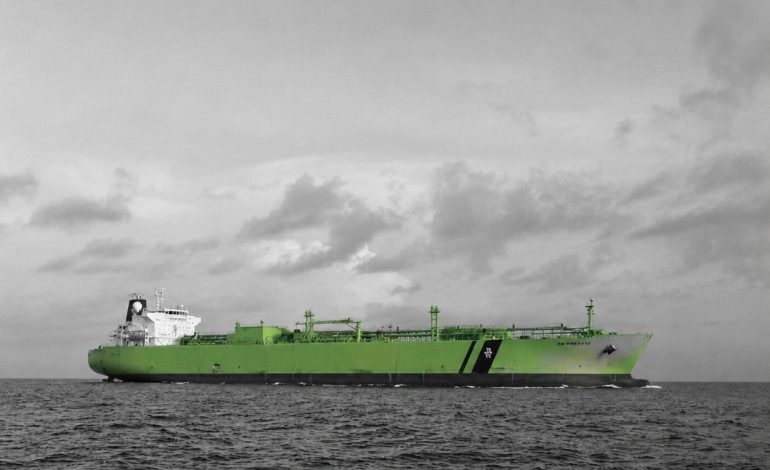
Oil tanker Haana. (Photo courtesy: VesselFinder)

New Delhi: An Iranian warship reportedly forced the Indian-flagged oil tanker Haana to abandon an attempted passage through the southern Strait of Hormuz, even as Tehran and Muscat negotiate a temporary maritime arrangement that Iran says would exclude all military vessels. The two developments demonstrate how the Islamic Republic is using its control over the strategic waterway as leverage in negotiations over regional security, sanctions and maritime trade.
Iran’s deputy foreign minister for legal and international affairs, Kazem Gharibabadi, said commercial vessels entering the Persian Gulf would travel entirely through Iranian waters under the proposed arrangement with Oman. Outbound ships would use a route running partly through Iranian waters and partly through Oman’s territorial waters, according to details reported by Associated Press.
Gharibabadi said no military vessel would be permitted to use the Strait of Hormuz if the understanding became binding, potentially restricting access for US and allied warships operating from bases in the Persian Gulf. He described the proposed routes as temporary and said Iran and Oman would have to negotiate a permanent maritime traffic arrangement within 30 to 60 days.
The announcement, however, did not amount to confirmation of a finalized agreement between the two countries. A senior Iranian source told Reuters that negotiations were continuing, contradicting claims from Iran’s Islamic Revolutionary Guard Corps (IRGC) that the two sides had already settled how the waterway and any revenue generated from it would be shared.
Brigadier General Hossein Mohebbi, an IRGC spokesman, said Tehran and Muscat had reached results acceptable to both sides after about a month of negotiations. He accused the US of obstructing the talks and maintained that the strait would not fully reopen unless Washington accepted Tehran’s conditions under a short-lived memorandum of understanding reached in June.
Those conditions reportedly include an end to the US blockade of Iranian ports, the removal of sanctions and compensation for damage caused during the war. Washington has opposed any arrangement that would allow Iran to charge vessels for passage or give Tehran an internationally recognized supervisory role over one of the world’s most important maritime chokepoints.
A complete ban on military vessels would also be legally contentious because the UN Convention on the Law of the Sea provides a right of transit passage to ships and aircraft through straits used for international navigation. Such a restriction would have wider strategic consequences for the US and its partners because their warships routinely use Hormuz to reach bases and naval facilities across the Persian Gulf.
The negotiations come nearly six months after the US-Israeli war against Iran began on February 28, disrupting energy shipments and sharply reducing traffic through the strait. Although major military exchanges have slowed, Washington and Tehran remain divided over sanctions, Iran’s missile and nuclear programmes, the US military presence in the region and control of Hormuz.
Visible oil flows through the strait had fallen to about five million barrels a day by August 24, compared with roughly 20 million barrels before the conflict, according to ship-tracking data cited by Reuters. The International Maritime Organization had confirmed 70 maritime security incidents and 19 seafarer deaths across Hormuz and the wider region by August 26.
Energy exporters have consequently devised costly workarounds to keep supplies moving, including transfers between vessels outside the strait. Saudi Aramco has offered cargoes for loading near Sohar in Oman and Fujairah in the United Arab Emirates, with at least four million barrels of Saudi crude transferred for delivery to China during August, Reuters reported.
Qatar has meanwhile renewed its attempt to bridge the gap between Tehran and Washington. The prime minister and foreign minister of Qatar, Sheikh Mohammed bin Abdulrahman al-Thani, was due in Tehran on August 27 for discussions on de-escalation, freedom of navigation and a possible return to conditions prevailing before the war.
Indian tanker challenged in Oman corridor
Against this unsettled background, Iran’s semi-official Fars News Agency reported that Haana attempted to enter the southern passage through Hormuz, which Iranian media described as the “Oman corridor”. A large Iranian warship warned the tanker against proceeding, after which the vessel turned back, according to several media report. According to VesselFinder, the oil tanker was on the way to the port of Ras Laffan in Qatar and was expected to arrive there on Thursday.
There were no reports of gunfire, damage, injuries or an attempt to board the tanker. Neither the Indian government nor the vessel’s operator had publicly issued a detailed account at the time of writing.
Fars described the incident as a major confrontation and claimed that no ships had used the southern route during the preceding 24 hours. That assertion was difficult to reconcile with Kpler tracking data, which recorded 10 visible commodity-vessel transits through Hormuz on August 26, although some ships may have sailed with their identification transponders switched off.
The incident followed Tehran’s publication of a blacklist naming 45 vessels accused of violating its maritime rules in the strait. Iran has threatened to fine or detain the listed ships, confiscate their cargoes and penalize vessels involved in ship-to-ship transfers with them, prompting at least three Indian refiners to consider avoiding the blacklisted tankers, Reuters reported.
The HAANA episode is particularly significant for New Delhi because about 40 per cent of India’s crude imports passed through Hormuz before the war disrupted established supply routes. India, the world’s third-largest oil consumer, has since expanded purchases from Russia, Africa and Latin America and sought additional liquefied petroleum gas supplies from the US, Algeria and other producers.
The confrontation nevertheless underlines the limits of commercial rerouting when Iran retains the military capability to challenge vessels even in the southern approaches nearer Oman. For India and other major Asian energy importers, the proposed Iran-Oman arrangement could improve predictability only if it establishes verifiable rules, preserves commercial freedom of navigation and commands broader international acceptance.