

China’s ‘Arctic Express’ redraws trade map as US watches from sidelines and India eyes Northern Sea Route
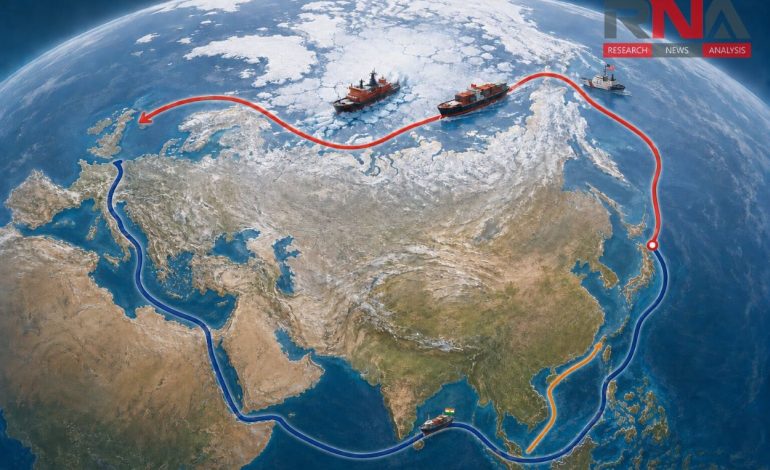
RNA Media illustration for representation.

New Delhi: China has converted an experimental Arctic voyage into the first scheduled seasonal container service between Asia and Europe, opening a faster maritime corridor that largely avoids the world’s most vulnerable southern chokepoints. The move gives Beijing and Moscow an early commercial advantage in the emerging Arctic economy, exposes Washington’s limited role in the new route and offers India a narrower but potentially valuable opening.
The Chinese container carrier Sea Legend sent the Dubai Tower from Ningbo-Zhoushan port on Saturday for a voyage to Felixstowe in Britain through Russia’s Northern Sea Route. The 1,740-TEU vessel is expected to arrive on September 5 after a journey of about 21 days, compared with roughly 40 days on conventional services using the Suez Canal or the longer diversion around the Cape of Good Hope.
Sea Legend plans eight weekly departures between August 15 and October 3, using seven ships under what it calls the China-Europe Arctic Express. After Felixstowe, cargo will be distributed to European ports including Rotterdam, Hamburg, Wilhelmshaven and Gdynia, according to International Transport Journal.
The service follows Sea Legend’s pilot voyage in September 2025, when the Istanbul Bridge completed the passage from Ningbo-Zhoushan to Felixstowe in about 20 days. That journey demonstrated that the Arctic could support more than one-off energy shipments, although scheduled container operations introduce a far tougher test of punctuality, insurance, cargo volumes and vessel availability.
The roughly 5,500-kilometre Northern Sea Route runs from waters near the Bering Strait along Russia’s Siberian coast to the Barents Sea, connecting the Pacific and Atlantic oceans. Russia’s state nuclear corporation, Rosatom, administers navigation permits and provides icebreaker assistance, giving Moscow decisive control over the corridor’s commercial infrastructure.
China has described its broader Arctic strategy as the Polar Silk Road, treating the route as a northern extension of the Belt and Road Initiative. The Chinese president, Xi Jinping, first publicly called for joint China-Russia development of Arctic shipping corridors in 2017, and western sanctions imposed on Moscow have since made Russia more dependent on Chinese cargo, capital and technology.
The timing is significant because insecurity in the Red Sea has forced several major carriers to divert around southern Africa, adding days, fuel costs and uncertainty to Asia-Europe voyages. Although the Northern Sea Route does not substitute for the Strait of Hormuz in transporting Gulf energy, it demonstrates how governments and shipping companies are seeking alternatives to routes exposed to conflict, blockades and political pressure.
Russia is simultaneously accelerating Arctic energy exports, with seven tankers carrying about six million barrels of crude towards Asian markets by August 11. That was already close to half the quantity shipped through the route during the entire 2025 navigation season, according to Reuters.
China is also unlikely to remain the only Asian operator testing the corridor. South Korea’s PanStar plans an 18-day trial voyage from Busan to Felixstowe, followed by calls at Rotterdam, Hamburg and Gdansk, as Japan, India and other trading economies assess whether Arctic shipping can become commercially dependable.
How Arctic could alter global trade – and where US and India fit
The immediate effect on global commerce will be incremental rather than revolutionary because the Northern Sea Route remains far too small, seasonal and unpredictable to replace Suez. Its importance lies in creating a supplementary corridor for selected high-value, time-sensitive cargoes and in forcing shipping companies, ports and insurers to price an Arctic alternative into long-term planning.
The scale difference remains enormous, though. About 37 million tonnes of cargo moved along the Northern Sea Route in 2025, of which only around 3.2 million tonnes was through-transit traffic between its Pacific and Atlantic ends. The Suez Canal handled about 1.57 billion tonnes in 2023 before the Red Sea crisis, showing why the Arctic corridor should be seen as a strategic hedge rather than a replacement for established maritime arteries.
Only 103 complete Northern Sea Route transits were recorded in 2025, including 15 container-ship voyages, according to the Centre for High North Logistics figures cited by Seatrade Maritime. Modern container networks depend on thousands of annual sailings, large vessels, frequent port calls and dependable arrival windows – conditions that the Arctic cannot yet provide.
The Dubai Tower’s capacity is also modest compared with the 20,000-TEU-plus ships deployed on established Asia-Europe services. This makes the Arctic Express better suited initially to premium cargoes such as electric vehicles, batteries, solar equipment, electronics and seasonal consumer goods, where faster delivery can justify higher insurance and operating costs.
If regular sailings prove reliable, the route could reduce working-capital costs by allowing exporters to receive payment sooner and importers to carry smaller inventories. It could also increase the commercial importance of Ningbo, Felixstowe and Russian Arctic transshipment points, shifting a limited share of logistics activity away from Singapore, West Asian ports and the Mediterranean.
Russia would gain revenue and influence through navigation permits, icebreaker services, port access, energy exports and control over infrastructure along much of the passage. China, despite having no Arctic coastline, would acquire an alternative gateway to Europe and reduce its exposure to the Strait of Malacca, Bab el-Mandeb and Suez Canal.
The claim in the original Sputnik report that the United States has been left “watching from the sidelines” is broadly valid in a commercial sense, but it requires qualification. No American carrier is operating a comparable scheduled Arctic container service, and Washington cannot independently shape tariffs, permits or icebreaker support on a corridor administered by Russia and increasingly used by Chinese shipping interests.
American sanctions against Russia have also discouraged US and many European companies from investing in the route, insuring its vessels or using Russian port services. Beijing faces fewer political constraints and has been prepared to combine its cargo base with Russia’s geography, icebreakers and Arctic infrastructure, giving the two countries an early-mover advantage.
The United States has meanwhile concentrated more on security, surveillance and territorial access than on building a commercial Arctic shipping network. Its Arctic position rests on Alaska, the Bering Strait approaches, military and space-monitoring facilities, and alliances with Canada and the Nordic countries rather than on ownership of a competing trade corridor.
Washington also suffers from a long-standing shortage of icebreakers and supporting infrastructure in Alaska. An October 2025 presidential memorandum acknowledged that the US Coast Guard’s fleet of icebreakers and Arctic-capable vessels was insufficient for current requirements and authorized the construction of up to four Arctic Security Cutters abroad as a temporary response.
The United States is therefore not absent from the Arctic, nor is it condemned to permanent irrelevance. Its ability to monitor the Bering Strait, work with Nato allies, expand Alaska’s ports and deploy new cutters could strengthen its strategic position, but those measures will not immediately provide the commercial ecosystem that Russia and China are already testing.
America is consequently on the sidelines of this particular shipping experiment, not of the wider Arctic contest. It can observe, regulate access to its own waters and strengthen allied deterrence, but it cannot easily prevent Russia and China from developing a commercial route running principally along Russia’s northern coast.
The environmental and financial constraints could still erode the Sino-Russian advantage. Drifting ice, fog, shallow passages, inadequate repair and rescue facilities, high insurance premiums, sanctions exposure and a shortage of ice-class ships make scheduled operations far more difficult than a shorter line on a map suggests.
An accident would be especially serious because oil and fuel are difficult to recover from ice-covered, remote waters, and black-carbon emissions can accelerate melting by darkening snow and ice. The International Maritime Organization’s Polar Code imposes specialized requirements for ship design, equipment, operations, environmental protection and crew training, adding costs that conventional routes do not face.
India’s opportunity emerges at the intersection of these commercial and geopolitical changes, but it differs substantially from China’s. As RNA Media reported earlier, Russia’s president, Vladimir Putin, has identified India alongside China as a prospective partner in developing the Northern Sea Route.
The Ministry of External Affairs confirmed on August 14 that discussions with Russia were continuing because connectivity formed an important part of the wider bilateral relationship. India and Russia had already agreed during Putin’s December 2025 visit to deepen cooperation on the Northern Sea Route, the Chennai-Vladivostok Eastern Maritime Corridor and the International North-South Transport Corridor.
The two countries also signed a memorandum on training Indian specialists for vessels operating in polar waters. Their joint statement identified energy, mining, critical materials, manpower, maritime transport, agriculture, pharmaceuticals and diamonds as possible areas for Indian participation in Russia’s Far East and Arctic zone.
The joint secretary in the ministry of ports, shipping and waterways, S Venkatesapathy, subsequently said India intended to send a pilot vessel through the Northern Sea Route in 2027. Such a voyage would allow Indian authorities and companies to measure actual fuel consumption, insurance costs, icebreaker fees, cargo-handling requirements and transit reliability instead of relying on promotional estimates.
India should, however, avoid treating the Northern Sea Route as a general shortcut for its exports to Europe. An Indian vessel sailing from Chennai or another eastern port would first have to travel north-east through Southeast Asian waters and the Bering Strait before turning west across the Arctic, making Suez considerably more direct for most India-Europe cargo.
The more realistic model is to connect Indian ports with Vladivostok through the Eastern Maritime Corridor and use Russian railways, inland waterways and Arctic ports to reach energy and mineral production centres. This could support imports of oil, LNG, coal, fertilizers, timber and critical minerals, while creating opportunities for Indian engineering, pharmaceutical, food-processing and digital-service companies in Russia’s Far East.
India could also gain through polar-seafarer training, ice-class shipbuilding, repair services, port management, satellite navigation, weather forecasting and Arctic scientific research. Indian shipyards and technology companies would have to meet demanding classification and certification standards, but the requirement for specialized vessels and shore infrastructure creates a market extending beyond the carriage of cargo.
A viable strategy would link Chennai, Kamarajar and Visakhapatnam with Russian Far Eastern ports as consolidation and transshipment nodes rather than immediately attempting a direct Indian service to northern Europe. India could then participate in selected Northern Sea Route sailings carrying Russian cargo, test eastbound export loads and build operational expertise without committing large capital to an immature corridor.
Balanced cargo will be essential because ships cannot operate economically if they sail full in one direction and return largely empty. India must therefore use negotiations with Moscow to secure space for Indian exports and industrial participation instead of allowing the corridor merely to widen an already substantial bilateral trade imbalance.
New Delhi must also examine sanctions, insurance, payments, vessel ownership and environmental liability before Indian companies enter long-term contracts. Excessive dependence on Russian icebreakers or Chinese-operated services could replace one vulnerability with another, making commercial diversification and transparent pricing critical.
The Northern Sea Route will not overturn global shipping immediately, but China’s scheduled service marks the point at which the Arctic begins moving from strategic possibility to commercial experiment. For India, the advantage lies not in copying China’s route to Europe, but in using the opening selectively to strengthen access to Russia’s Far East and Arctic resources, acquire polar capabilities and secure a place in the logistics system before its rules become harder to influence.