
BRICS grain exchange gathers pace as Russia unveils digital trade blueprint before New Delhi summit
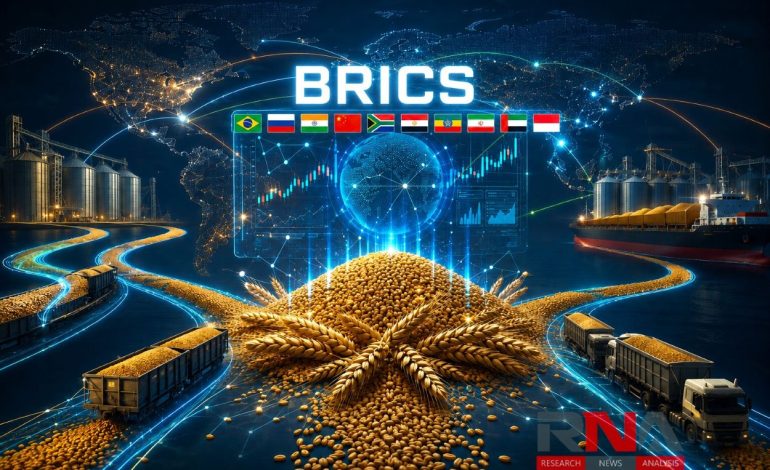
RNA Media illustration for representation.

New Delhi: Russia’s proposal for a BRICS grain exchange is moving from political endorsement towards a technical blueprint, with member governments examining a digital marketplace that could connect agricultural producers directly with buyers. Moscow presented the proposed structure at the BRICS trade ministers’ meeting in Jaipur on August 7 and the initiative is expected to figure at the leaders’ summit in New Delhi on September 12 and 13.
According to Russia’s Interfax, the Russian economic development ministry described the proposed exchange as a unified digital trading platform through which buyers and producers could transact without depending on external exchanges or multiple intermediaries. Moscow argues that the system would allow prices to reflect supply and demand within BRICS more accurately, giving participating countries greater control over agricultural commodity flows.
The deputy economic development minister of Russia, Vladimir Ilyichev, said reducing the number of intermediaries could improve prices for both farmers and purchasers because every additional participant in a supply chain adds a margin. The proposal rests on the premise that direct settlement would allow producers to retain more of the final price and enable buyers to pay less.
Lower brokerage costs, however, would be only one part of the equation because grain prices also incorporate storage, transport, inspection, insurance, financing and currency risks. Whether individual farmers would benefit directly would depend on the exchange’s membership rules and whether smaller producers could participate without relying on large exporters, traders or aggregators.
The proposal originated with Russia’s Union of Grain Exporters and Producers towards the end of 2023 and received the backing of the president, Vladimir Putin, in the spring of 2024. BRICS leaders formally welcomed the initiative in the Kazan Declaration of October 23, 2024, with the possibility of later expanding the platform beyond grain into other agricultural commodities.
The initiative was subsequently supported by BRICS agriculture ministers in 2025, and India hosted a special dialogue on the proposed exchange during the group’s agriculture ministers’ meeting in Indore, in June. India said the dialogue had imparted fresh momentum to the discussions, although no binding decision or operational timetable was announced.
Russia’s grain exporters’ union estimates that eventual trading in agricultural and related products through the platform could exceed $1 trillion. The projection should not be mistaken for an immediate forecast for grain contracts alone, as the union has not publicly provided a timetable or detailed assumptions underpinning the figure.
The economic weight behind the proposal is nevertheless considerable because BRICS includes major grain exporters such as Russia and Brazil and some of the world’s largest food markets, including China and India. A 2024 assessment by the Council on Foreign Relations estimated that the then-expanded grouping accounted for about 44 per cent of global grain production and consumption and nearly a quarter of worldwide grain exports.
At present, international prices for wheat, maize, soybeans and other crops are heavily influenced by futures contracts traded on established exchanges in the United States and Europe, particularly the Chicago-based CME Group and Euronext. These markets do not control all physical grain transactions, but their liquid contracts provide widely used benchmarks through which traders, farmers and food companies manage price risks.
The proposed BRICS platform seeks to create alternative price indicators based on production, consumption and trade within the grouping. Its success would depend on attracting sufficient volumes because a price benchmark acquires global authority through liquidity, transparent transactions and reliable physical delivery rather than political endorsement alone.
The project also carries a geopolitical dimension for Russia, which has sought trading and payment arrangements less exposed to Western financial restrictions. The Kazan Declaration linked the exchange to ensuring uninterrupted movement of food and agricultural inputs, supporting Moscow’s argument that essential commodity trade should remain insulated from unilateral economic measures.
However, the documents released so far do not identify the currency or currencies in which contracts would be priced and settled. Any attempt to use national currencies would require arrangements for conversion, clearing and trade imbalances, particularly between large exporters and countries that consistently import more than they sell.
India’s approach is likely to be shaped by its concern for domestic food security as much as by the promise of a larger agricultural marketplace. At Jaipur, the commerce and industry minister, Piyush Goyal, emphasized protecting farmers and preserving policy space for food and livelihood security within a multilateral trading system centred on the World Trade Organization.
A BRICS exchange could offer Indian exporters additional buyers and more regionally representative price information, particularly for rice, pulses, oilseeds and other agricultural products. New Delhi would nevertheless have to reconcile such commitments with minimum support prices, public procurement, food stocks and periodic export controls used to contain domestic inflation.
The members must also agree on standardized grain grades, delivery locations, warehousing, inspections, dispute settlement, financial guarantees and regulatory oversight. Publicly available proposals have yet to specify the headquarters, governing law, clearing institution, settlement mechanism or launch date for the exchange.
Recent disruptions to Russian and Ukrainian export infrastructure in the Black Sea have reinforced concerns about the vulnerability of global food supply chains. A new exchange could improve price discovery and diversify trading arrangements, but it could not by itself remove the physical risks posed by war, blocked ports, sanctions-related complications or inadequate shipping and insurance capacity.
The New Delhi summit will therefore test whether BRICS leaders can turn broad support into an agreed work programme covering technology, governance, finance and market access. Until those questions are resolved and significant trading volumes are committed, the grain exchange will remain a strategically important proposal rather than a functioning rival to established global commodity markets.