
BrahMos vs Tomahawk: How India’s supersonic missile stacks up against America’s long-range workhorse
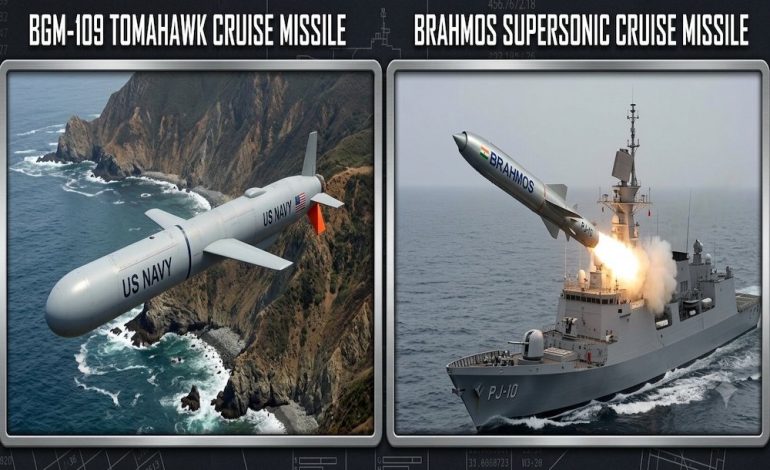
Illustration for representation.

Cruise missiles occupy a strange middle ground in modern warfare – too precise to be dismissed as area weapons, yet too vulnerable to jamming and interception to match the certainty of a ballistic strike. Two names dominate any conversation on this class of weapon: India-Russia’s BrahMos and America’s Tomahawk. Both are staples of their respective militaries strike doctrine, both have been fired in anger in the past two years, and both are frequently namechecked in the same breath by defence commentators.
However, the two missiles were built to solve almost opposite problems, and understanding that difference explains far more about Indian and American military thinking than a simple specifications chart ever could.
Two different design philosophies
The Tomahawk, formally the BGM-109, traces its origins to the late 1970s and entered US Navy service in 1983. It was conceived as a subsonic, low-flying, terrain-hugging missile that could sneak past enemy radar over hundreds of kilometres and strike with metre-level precision, all while keeping American pilots out of harm’s way. Stealth through low observability, not speed, is the Tomahawk’s core survival strategy.
BrahMos, by contrast, is a child of the post-Cold War era, developed jointly from 1998 by India’s Defence Research and Development Organisation (DRDO) and Russia’s NPO Mashinostroyeniya through the BrahMos Aerospace joint venture, in which India holds a 50.5 per cent stake. Its design logic is the reverse of the Tomahawk’s: rather than avoiding detection, BrahMos aims to outrun any reasonable response once it is detected. It is, at its core, a supersonic anti-ship weapon that has since been adapted for land-attack roles across the Army, Navy and Air Force.
Speed and propulsion
This is where the two missiles diverge most sharply. Tomahawk is a subsonic weapon, cruising at roughly Mach 0.74, or about 880 kilometres an hour, powered by a Williams International turbofan engine after an initial solid-rocket boost off the launcher. It compensates for this modest speed with terrain-following flight profiles and stealth shaping to stay below enemy radar coverage for the length of its journey.
BrahMos flies at Mach 2.8 to Mach 3, or roughly 3,400 to 3,700 kilometres an hour, making it the fastest operationally deployed cruise missile in the world today. It achieves this through a two-stage propulsion system – a solid-propellant booster for initial acceleration, which then separates, followed by a liquid-fuelled ramjet that sustains supersonic speed through the cruise phase.
That velocity translates into vastly higher kinetic energy on impact than a subsonic weapon of similar size can generate, and it drastically compresses the time an adversary’s air defence network has to detect, track and intercept the missile.
Range: America’s long game vs India’s growing reach
Range has traditionally been Tomahawk’s trump card. Its baseline variants are credited with a reach of around 1,600 kilometres, and the newest Block V standard, alongside extended-range upgrades, is reported by the US Navy and industry sources to push beyond 2,500 kilometres in some configurations.
BrahMos was long constrained by India’s obligations under the Missile Technology Control Regime (MTCR), which capped export and, for some years, even domestic variants at 290 kilometres. Since India joined the MTCR as a full member in 2016, that ceiling has been progressively lifted.
The BrahMos-ER (extended range) family is now credited with reaching 450 kilometres in front-line service, with trials reportedly pushing toward 800 to 900 kilometres. A future BrahMos-II hypersonic variant, aimed at speeds of Mach 7 to 8 using scramjet propulsion derived from Russia’s 3M22 Zircon technology, is targeting a range near 1,500 kilometres, though it remains years away from operational service.
Guidance and accuracy
Both missiles are, by the standards of unguided munitions, extraordinarily precise, though they get there by somewhat different routes.
Tomahawk relies on a layered guidance suite: inertial navigation, GPS, terrain contour matching (TERCOM) for mid-course correction, and digital scene-matching area correlation (DSMAC) for terminal guidance, comparing real-time imagery against preloaded maps. This combination gives it a circular error probable – the industry’s standard measure of accuracy – of under 10 metres. The Block V standard adds a two-way satellite datalink, letting commanders redirect the missile mid-flight to any of up to 15 pre-planned alternate targets, or retask it entirely.
BrahMos uses inertial navigation with multi-constellation satellite correction (GPS, Russia’s GLONASS and India’s own NavIC), transitioning to active radar homing in the terminal phase for a fire-and-forget engagement. Manufacturers and independent analysts credit it with a circular error probable of about one metre, aided by fibre-optic gyroscope technology and onboard target-recognition software.
Notably, BrahMos was originally optimised as an anti-ship weapon capable of executing steep terminal dives and sea-skimming approaches as low as five metres above the waves, a profile since adapted for land-attack variants as well.
Warheads and lethality
Tomahawk typically carries a 450-kilogramme unitary warhead, or a submunitions dispenser for area targets, depending on mission requirements. Its nuclear-armed variant, the TLAM-N, was retired from US service in 2013, leaving today’s operational Tomahawks purely conventional.
BrahMos carries a smaller conventional warhead of 200 to 300 kilogrammes, semi-armour-piercing in design, and retains a nuclear-capable option within its declared envelope, reflecting India’s broader deterrence posture. What BrahMos gives up in payload weight relative to Tomahawk, it partly recovers through sheer velocity: analysts have calculated that its cruise-phase kinetic energy runs many times higher than a Tomahawk’s, owing to the physics of speed squared.
Stealth vs speed
Tomahawk’s low radar cross-section, radar-absorbent coatings and low-altitude, terrain-hugging flight are all built around the idea of not being seen. BrahMos takes the opposite approach: it accepts a higher radar signature in exchange for a flight profile so fast that even a detected missile leaves an adversary’s air-defence crew only seconds to react before impact.
Neither approach is objectively superior; each is optimised for a different threat environment. Against modern, layered air-defence networks with long-range early warning, a slower, stealthier missile can still be tracked and, in principle, intercepted given enough warning time. Against a supersonic threat, even a radar lock does not guarantee a successful engagement, because the intercept window is so brief.
Launch platforms
Tomahawk is fired from more than 140 US Navy surface ships and submarines via the Mark 41 vertical launch system or torpedo tubes, and, more recently, from ground-based launchers such as the US Army’s Typhon Mid-Range Capability system. The United Kingdom’s Astute and Trafalgar-class submarines also carry it, and Australia, Japan and the Netherlands have all moved to acquire or field the missile in recent years.
BrahMos was designed from the outset for what its makers call “universal” launch – an identical missile configuration adaptable to land-based transporter erector launchers, naval vertical launch modules, submarine torpedo tubes and, since 2017, air-launched delivery from the Indian Air Force’s Su-30MKI fleet. That last integration, achieved indigenously at a fraction of the cost Russia had originally quoted, gave India one of the very few air forces in the world capable of firing a supersonic cruise missile from a fighter jet.
Cost and combat record
Tomahawk’s Block V unit cost runs between roughly $1.3 million and $2.2 million depending on production lot and configuration, making it one of the more cost-effective long-range strike weapons in the American arsenal, even as production rates have struggled to keep pace with demand. BrahMos is estimated at $2.5 million to $4.85 million per missile, reflecting its more complex propulsion and guidance package.
On combat record, Tomahawk has few peers. Since its 1991 Gulf War debut, it has been used operationally more than 2,300 times, including strikes on Syria, Yemen’s Houthi positions, Iranian nuclear-linked sites in June 2025, and the large-scale Operation Epic Fury campaign against Iran that began in late February 2026.
BrahMos, though newer to actual combat, had its own validating moment during Operation Sindoor in May 2025, when the Indian Air Force fired BrahMos missiles from Su-30MKI jets against Pakistani airbases, alongside French-origin SCALP missiles from the Rafale fleet, striking targets including the Nur Khan, Jacobabad and Sargodha airfields.
Reports at the time credited the strikes with achieving high accuracy, with none of the BrahMos missiles fired reported to have been intercepted by Pakistan’s Chinese-supplied air-defence network – a result that has since fed directly into a wave of export interest from South East Asian and Gulf buyers.
So, which missile wins?
BrahMos and Tomahawk are not really rivals competing for the same job; they are answers to two different strategic questions. Tomahawk was built to strike deep, static, heavily defended targets from a safe stand-off distance, prioritising range, stealth and reprogrammable flexibility over speed.
BrahMos was built to deny an adversary reaction time altogether, prioritizing velocity and kinetic force over reach and radar evasion. For India, whose immediate strategic requirement has centred on high-value, time-sensitive targets close to its borders and coastline, BrahMos’s supersonic profile has proved a natural fit. For the United States, with a global footprint and the need to strike targets thousands of kilometres from its carrier groups, Tomahawk’s range and endurance remain difficult to substitute.
As India’s own BrahMos-ER and BrahMos II programmes mature, and as the missile finds new export customers across South East Asia, the gap between the two systems’ reach is narrowing – even as their underlying philosophies remain as distinct as they were at launch.
| Parameter | BrahMos | Tomahawk |
| Origin | India-Russia joint venture (BrahMos Aerospace) | United States (Raytheon/RTX) |
| First service | 2005 (naval); 2007 (land) | 1983 |
| Speed | Mach 2.8–3.0 (supersonic) | Mach 0.74 (subsonic) |
| Range | 290km (export); 450–900km (extended range, in testing/induction) | ~1,600km (baseline); 2,500km+ (Block V, reported) |
| Propulsion | Solid booster + liquid-fuel ramjet | Turbofan engine + solid rocket booster |
| Guidance | INS, multi-GNSS, terminal active radar homing | INS, GPS, TERCOM, DSMAC |
| Accuracy (CEP) | ~1 metre | Under 10 metres |
| Warhead | 200–300kg, conventional/nuclear-capable | 450kg, conventional only (nuclear variant retired 2013) |
| Launch platforms | Land TEL, ships, submarines, Su-30MKI | Ships, submarines, ground launchers (Typhon) |
| Unit cost | $2.5–4.85 million (estimated) | $1.3–2.2 million (estimated) |
| Combat record | Operation Sindoor, May 2025 | Gulf War (1991) onward; Operation Epic Fury, 2026 |