


Amit Shah sets 2029 deadline for ‘drug-free India’, unveils four-pillar campaign against narcotics
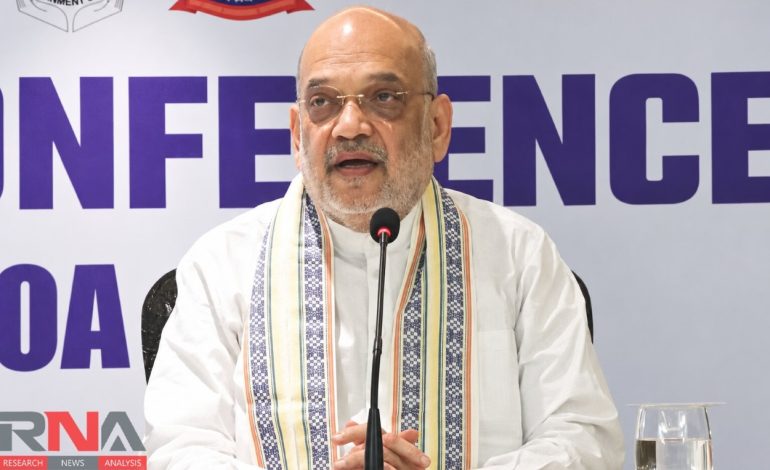
This screenshot from a video posted by Amit Shah on X shows him addressing a news conference in Panaji, on September 6, 2026.

New Delhi: The Union home minister, Amit Shah, announced on Sunday a three-year roadmap to make India “drug-free” by July 2029, describing narcotics trafficking as a threat to national security and the country’s young population. He said the government intended to dismantle drug networks with the same determination that, according to him, had brought the decades-old Naxalite insurgency close to an end.
Addressing a news conference in Panaji in the presence of the Goa chief minister, Pramod Sawant, Shah said the campaign would operate in mission mode, with ministries assigned measurable targets and their performance reviewed every quarter. The programme covers the period from July 2026 to July 2029 and comprises 25 components and more than 200 time-bound action points, according to the home ministry.
The roadmap rests on four pillars – intelligence-led enforcement and operations, control over precursor chemicals and synthetic drugs, reduction of demand and harm, and stronger capacity and inter-agency coordination. Its scope indicates that the Centre is seeking to combine policing and border interdiction with financial investigations, preventive work, treatment and rehabilitation rather than treating narcotics solely as a law-and-order problem.
Shah said India’s location between two major narcotics-producing regions – the so-called Golden Crescent to its northwest and Golden Triangle to its east – left it exposed to several international trafficking routes. Drug proceeds could finance terrorism and organized crime, he said, making the campaign as much an internal-security operation as a public-health intervention.
Under the plan, dossiers will be prepared on suspected drug kingpins, while investigators will examine both the source and the intended destination of seized consignments. Even a small retail seizure will be traced backwards through the supply chain, while the recovery of a large consignment at a border or port will trigger an inquiry into the distributors and consumers for whom it was intended.
The government also plans to intensify financial investigations in cases involving commercial quantities of narcotics and pursue traffickers using the dark web, encrypted communications, cryptocurrencies and anonymous delivery systems. Dedicated dark-net and cryptocurrency cells are being developed within state anti-narcotics task forces to track the technological and financial infrastructure supporting illicit networks.
The Border Security Force, Central Industrial Security Force, Indian Coast Guard, Customs and Directorate of Revenue Intelligence will undertake risk-based profiling and strengthen screening at land borders, airports, seaports and cargo terminals. The Central Bureau of Investigation, Ministry of External Affairs and Interpol will assist in bringing fugitives back to India, while financial agencies and banks will follow suspected money trails.
Shah said the government had replaced what he characterized as a fragmented pre-2014 approach with a nationally coordinated system built around the four-tier Narcotics Coordination Centre, or NCORD. State anti-narcotics task forces, a joint coordination committee, the Manas helpline and the Nidaan database of narcotics offenders have also been integrated into the enforcement framework.
The database is being combined with information from the Crime and Criminal Tracking Network and Systems to map trafficking hotspots, seizure patterns and methods used by smugglers. The government has held 10 apex-level, seven executive, 277 state-level and 16,798 district-level NCORD meetings, while signing agreements with 46 countries on narcotics-related cooperation, Shah said.
Citing official figures, Shah said agencies had seized 11.9 million kilograms of drugs valued at ₹1.89 lakh crore between 2014 and 2026, compared with 2.6 million kilograms worth ₹40,000 crore during the preceding decade. He added that 4.868 million kilograms of narcotics had been destroyed since 2014, against 336,000 kilograms between 2004 and 2014.
Although the figures point to a substantial expansion in enforcement activity, seizure volumes alone do not establish whether drug availability or consumption has declined, as they can also reflect changes in trafficking, detection capabilities and reporting. The success of the 2029 mission will therefore depend on verifiable reductions in supply and addiction, alongside prosecutions that reach financiers and cartel leaders rather than stopping with couriers and small distributors.
On demand reduction, the Centre plans to use the National Cadet Corps, National Service Scheme and My Bharat network to train lakhs of volunteers as anti-drug campaigners, particularly across educational institutions. The social justice and health departments and prison administrations will work together to increase the number of drug-deaddiction centres threefold to 1,751, supported by about 10,000 volunteers.
The government says the Nasha Mukt Bharat Abhiyaan has reached 25 crore people with its anti-drug pledge and helped 5.7 lakh people overcome addiction through treatment and rehabilitation. Shah said the broader objective was to protect India’s young population so that it could contribute to the country’s development goals for 2047.
Every state is expected to establish a fully equipped anti-narcotics task force by March 2027, for which the Centre will provide financial assistance, while forensic reporting timelines are to be reduced to 30 days. Shah said the campaign would remain uncompromising towards traffickers but adopt a rehabilitative approach towards people suffering from substance dependence.
Drawing a parallel with the government’s campaign against left-wing extremism, Shah said Naxalism had been eliminated and narcotics networks would be dealt with similarly. The comparison underlined the government’s intention to place the anti-drug drive among its principal internal-security priorities, although meeting the 2029 goal will require sustained cooperation among central agencies, states, foreign governments, educational institutions and public-health services.