


India Begins Fencing Bangladesh Border, To Launch ‘Smart Border’ System By 2027
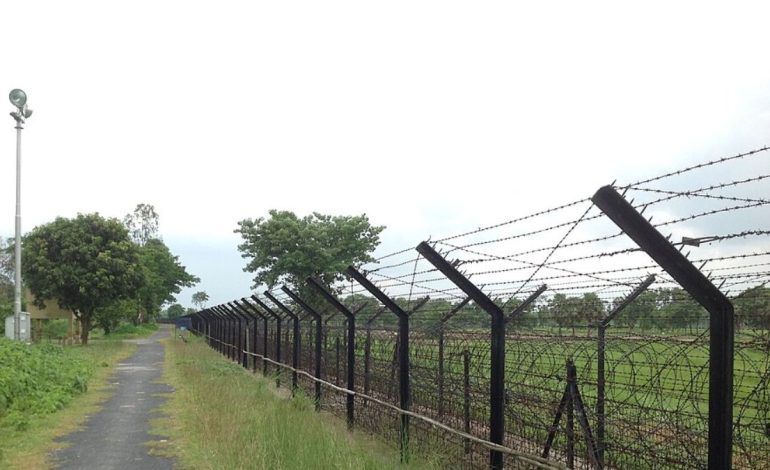
India has begun fencing work along sections of the Bangladesh border as the government prepares to roll out a technology driven “smart border” system aimed at strengthening surveillance, preventing infiltration and enhancing national security. Image courtesy: Wikimedia Commons.

India has begun fencing work along the Bangladesh border in the Phansidewa area of Siliguri subdivision after the West Bengal government handed over 27 kilometres of land to the Border Security Force (BSF).
The fencing work marks a key step toward strengthening border security in the region that had been pending for years. The fencing work is being pursued to prevent infiltration of Bangladeshi nationals and illegal trade.
Visuals from the border town showed fencing work underway, with officials initiating groundwork following the long-pending land transfer. The move is expected to bolster surveillance and improve security infrastructure along the sensitive international border.
The development comes days after West Bengal Chief Minister Suvendu Adhikari announced in Howrah that the state government was ready to transfer 27 kilometres of land for fencing along the India-Bangladesh border, along with additional land for Border Outposts (BOPs) and BSF infrastructure.
Adhikari said the decision followed renewed coordination with central agencies after earlier delays in land allocation, which had affected border security.
The Chief Minister added that the decision taken in the first Cabinet meeting had set the transfer process in motion, with the land to be handed over to the Ministry of Home Affairs within 45 days, after which BSF fencing work would be completed.
On Friday (May 22, 2026), Indian Home Minister Amit Shah said in New Delhi that the government would launch a “smart border” project in a year to make the 6,000-km borders with both Pakistan and Bangladesh impenetrable.
He said the smart border project would defeat the “conspiracy” to change the demography of border areas adjoining Pakistan and Bangladesh.
Delivering the annual Rustamji Memorial Lecture hosted by the BSF, Shah reiterated the Indian government’s resolve to locate every infiltrator from within the country and to deport them.
The lecture was in memory of K. F. Rustamji, the first Director General of the BSF, which was raised in 1965.
“I want to assure BSF troops that we will launch this smart border project in the 60th year of its raising and we will make the Pakistan and Bangladesh borders impenetrable,” Shah said.
The Indian government had decided to create a “strong security grid” along its western and eastern fronts in the next year.
The “smart border” would be aided by technology, drones, radars, and smart cameras to help create an unbreachable border, he said.
The Indian Home Minister urged the BSF troops to defeat the conspiracy to artificially change the Indian demography.
He said Indian states such as Tripura, West Bengal, and Assam believed there should be no infiltration from across the border with Bangladesh.
His ministry would hold a meeting with the Chief Ministers from these states soon to draw up a plan to prevent infiltration from the neighbouring country.
The smart borders project is envisaged as an intelligent, multi-layered “electronic wall” that is virtually impenetrable to infiltration, smuggling, and other threats.
At its core, the smart border builds upon and significantly expands the existing Comprehensive Integrated Border Management System (CIBMS).
Instead of relying solely on physical fencing and manual patrolling, the new system would fuse advanced sensors, artificial intelligence, real-time data analytics, and rapid-response capabilities to create a 24×7 automated surveillance grid.
The smart border would be a strong security grid that drastically reduces blind spots, especially in riverine, hilly, marshy, and densely vegetated stretches where traditional methods often fall short.
One of the foundational pillars of the smart border is an extensive network of high-resolution smart cameras and electro-optic systems.
These include day-and-night CCTV, thermal-imaging cameras capable of detecting human body heat even in complete darkness, fog, or thick foliage, and infrared night-vision devices.
Many of these cameras are equipped with artificial intelligence that can automatically distinguish among humans, animals, vehicles, and drones and instantly flag suspicious activity.
Complementing the cameras would be advanced ground surveillance radars and battlefield radars that can detect movement several kilometres away, including low-flying drones used for smuggling or reconnaissance.
These systems work alongside perimeter intrusion detection systems, fibre-optic sensors buried along fences, seismic sensors that detect footsteps or vehicle vibrations, laser beams, and underground monitors designed to detect tunnelling attempts.
Together they form a virtual, invisible fence that triggers alerts the moment any breach is attempted.
Drones, both fixed-wing and rotary, would play a crucial role in covering difficult terrain. Equipped with high-definition and thermal cameras, these drones would provide real-time video feeds to command centres, conduct autonomous patrols, and offer rapid aerial verification whenever ground sensors detect activity.
BSF units are already training with drone fleets, and their deployment is expected to scale up significantly under the new project.