




Isro’s talent exodus exposes a deeper funding and morale crisis

RNA illustration for representation.

For an organization built on decades of quiet, incremental confidence, the Indian Space Research Organisation (Isro) has run into a problem no failed launch could have caused – its own people are leaving. As RNA Media reported, the Department of Space (DoS) issued an internal memorandum on Tuesday to Isro’s major centres stripping local directors of the power to approve voluntary retirement scheme (VRS) and resignation requests from Group A scientific and technical staff attached to critical missions.
Every such case must now be forwarded to New Delhi for a final decision, which effectively centralizes a function that had been delegated to the field since 2020.
The order is a direct response to what insiders describe as a steady, accelerating exodus. More than 100 scientists and engineers, including senior figures on the Gaganyaan human spaceflight programme, have resigned or sought early retirement in recent months, and the Department has warned that these departures are “severely impacting” project implementation.
Memo that undoes years of delegation
The memorandum went to the UR Rao Satellite Centre (URSC) in Bengaluru, the Vikram Sarabhai Space Centre (VSSC) in Thiruvananthapuram, the Satish Dhawan Space Centre and other key units, describing a “spate of requests” for exit from personnel associated with Gaganyaan and other flagship projects. It instructs centre directors to stop treating such requests as routine and to send every case – regardless of the scientist’s seniority – to headquarters with a detailed recommendation, reversing a 2020 decision that had allowed centre heads to clear resignations and VRS applications up to the Scientist/Engineer-SG level on their own authority.
The numbers behind the order are striking. Media estimates suggest around 80 personnel have left URSC and at least 20 from VSSC, broadly consistent with wider reports of 100 to 120 exits in this latest wave. Those departing are not junior staff testing the water; they include the LVM3/GSLV Mk-III project director at VSSC, Victor Joseph, along with specialists who worked on the SpaDeX docking experiment and simulation teams behind Chandrayaan-3.
The exodus is concentrated precisely where institutional memory matters most – a worrying signal for safety-critical undertakings such as Gaganyaan and the planned Bharatiya Antariksh Station.
Doing more with fewer hands, flat purse
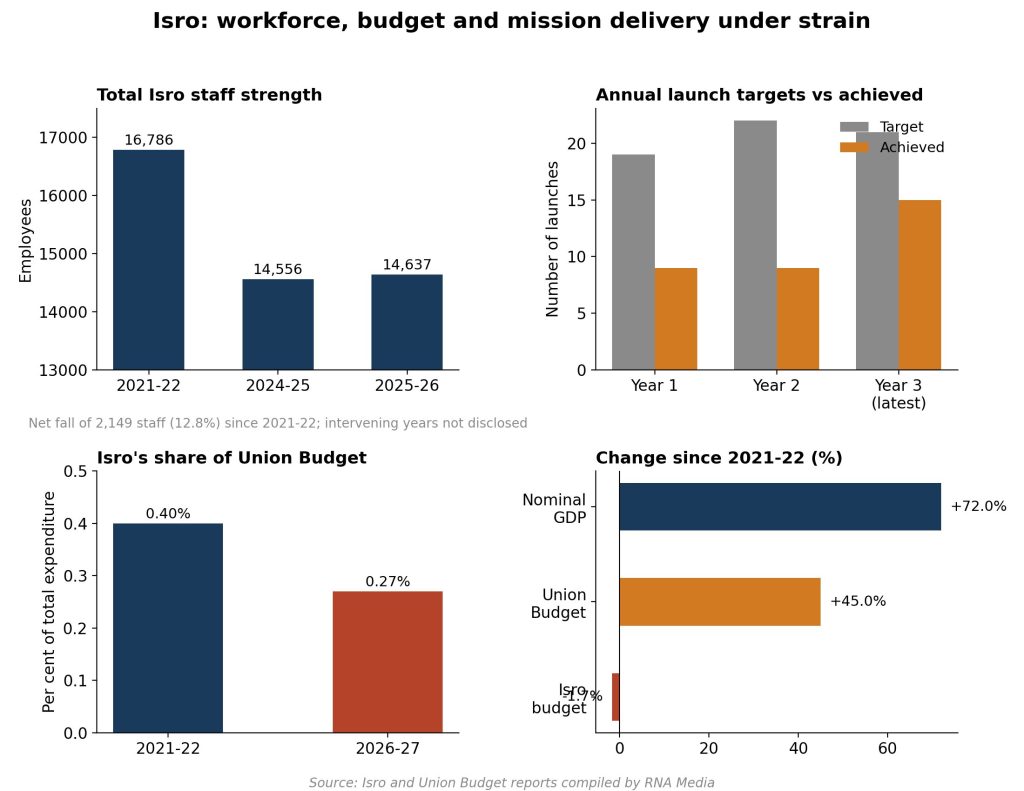
Isro’s own annual reports tell a story of contraction even as ambitions grow. Total staff strength fell from 16,786 in 2021-22 to 14,637 in 2025-26 – a net loss of 2,149 people, or 12.8%, over four years. The single sharpest drop came in 2024-25, when headcount fell by 1,120 to 14,556, before a modest recovery of 81 positions the following year hinted at a tentative resumption of hiring.
Mission ambitions have not shrunk to match. Annual launch targets have climbed into the high teens and twenties, yet actual launches have consistently undershot them: targets of 19, 22 and 21 in three successive years produced only 9, 9 and 15 actual liftoffs, an achievement rate below 50% in the weaker years. That gap points to resource and manpower constraints as much as to technical setbacks.
Money has not kept pace either. Isro’s budget estimate slipped from ₹13,949 crore in 2021-22 to ₹13,705.63 crore in 2026-27 – a 1.7% decline in nominal terms, before any adjustment for inflation. Over the same stretch, India’s nominal GDP grew by roughly 72%, from about ₹236 lakh crore to ₹407 lakh crore, and total Union Budget expenditure rose by about 45%. Consequently, Isro’s share of the Union Budget has fallen from around 0.40% to about 0.27%, which is a one-third reduction in space spending as a proportion of government expenditure even as the agency takes on human spaceflight and a domestic space station.
Budget utilization, too, was as low as 76.9% in 2022-23 before improving to 92.8% by 2025-26, suggesting internal bottlenecks compounded the effect of flat funding. The accompanying charts set out these trends visually.
Seen from inside the organization, this combination – more missions, fewer people, a static budget – translates into rising workload with little room to modernize infrastructure or expand research. It is precisely the environment in which a booming private space sector looks most attractive.
The pay gap
Compensation differentials sit at the heart of most exit decisions, even where money is not the sole motivation. Isro scientists remain civil servants bound by central government pay scales, while private aerospace firms and global technology companies routinely offer two to three times the salary for comparable expertise, along with equity and bonuses unavailable in government service.
An older interview with the former Isro chairperson, S Somanath, has resurfaced amid the current wave, in which he recalled nearly 60% of IIT students walking out [YouTube] of a campus recruitment presentation once they learned the maximum pay Isro could offer. Only a small fraction of IIT graduates ultimately choose the organization, Somanath noted, a reflection of how difficult it has become to compete against private packages running into tens of lakhs, or more, annually.
Former DRDO and Isro scientists interviewed in the current cycle describe government salaries as “a major challenge” against private and overseas benchmarks, particularly for mid-career and senior specialists. The opening of India’s private space sector since 2020, formalized by the Indian Space Policy of 2023, has fuelled the rise of more than 400 space-related startups, many of them actively recruiting experienced Isro hands into roles that pair higher pay with a more entrepreneurial working style.
Workload, risk-aversion and search for meaning
Pay is only part of the story. Graduates of the Indian Institute of Space Science and Technology (IIST), several of whom are contractually bound to serve Isro after completing their degrees, describe postings at the Satish Dhawan Space Centre in Sriharikota as gruelling, with no fixed hours during launch campaigns and a correspondingly high attrition rate. Long hours and repeated mission crunches take a toll on personal life, and some who left mid-career have compared the organization’s culture to that of a factory, built around maintaining launch cadence rather than exploration.
A more particular grievance concerns risk-aversion. Several former engineers describe an institutional reluctance to attempt anything beyond flight-proven designs, a caution they trace partly to the fallout from the Devas-Antrix case and punitive responses to past mission failures. The common refrain among young staff weighing an exit, according to one former engineer, is that “there is nothing more to learn” – not because the work lacks challenge, but because the scope for pursuing genuinely new architectures is narrow.
Many who leave go not to industry but to doctoral programmes abroad, in search of research freedom rather than a bigger salary, which amounts to a second, quieter drain on talent that a purely pay-focused response would fail to address.
Structural frustrations compound these pressures. As engineers gain seniority, their work shifts towards administration, often at the expense of hands-on design. Individual scientists, aside from a handful of senior leaders, remain largely anonymous compared with the visibility available in startups or academia, and promotion within Isro continues to follow rule-bound, time-based cycles that leave little room to reward exceptional performers differently from their peers.
Agencies such as Nasa and the European Space Agency have moved towards more flexible rotations and cross-appointments to address similar tensions; Isro’s structures have been slower to evolve in that direction.
Constraint can’t be strategy
The DoS memorandum protects ongoing missions from sudden departures, but it does nothing to address why scientists want to leave in the first place, and some analysts have described its effect as turning Isro into a “golden cage” – prestigious, but increasingly restrictive for those inside it. There is a further risk that younger staff, watching senior colleagues face tighter exit controls, read the move as evidence of institutional anxiety about retention, which could push them to plan their own departures earlier rather than later.
Isro’s chairman, V Narayanan, has publicly downplayed the operational impact, saying the organization can absorb departures by reassigning responsibilities and training successors. That may hold true in the short term, but it does not touch the deeper question of morale among those who remain, who may find themselves carrying a heavier load without any corresponding improvement in pay or autonomy.
There is also a mission-assurance dimension worth weighing: engineers retained against their preference may become more risk-averse rather than less, and less inclined to flag problems if doing so invites administrative friction. Retention built on constraint rather than positive incentive tends not to survive contact with a labour market as buoyant as India’s current space sector.
What reform should look like
The exit restrictions may buy Isro a little time, but a durable fix will need financial, organizational and cultural changes together, not a single administrative order. Revisiting pay structures for scientists on flagship missions – through special allowances or performance-linked components – would begin to narrow, even if not close, the gap with private employers.
Equally useful would be a formal research track within the Department of Space, allowing scientists to spend part of their time on exploratory work, academic collaborations or sabbaticals without derailing their promotion prospects, along the lines of the rotation schemes used by Nasa and ESA. Streamlining internal approvals for novel designs, creating protected space for higher-risk projects, and building more transparent recognition systems – authorship credit, public profiles, leadership pathways – would address the “factory” perception that so many departing engineers describe.
None of this is likely to work, however, unless scientists are treated as partners in shaping these reforms rather than as assets to be administratively secured in place. A retention policy designed without the people it is meant to retain risks reinforcing the very sense of powerlessness that is driving many of Isro’s best minds towards the door.