
2,010 Incidents in Sixteen Days: The August 2024 Violence That Shook Bangladesh’s Minority Communities
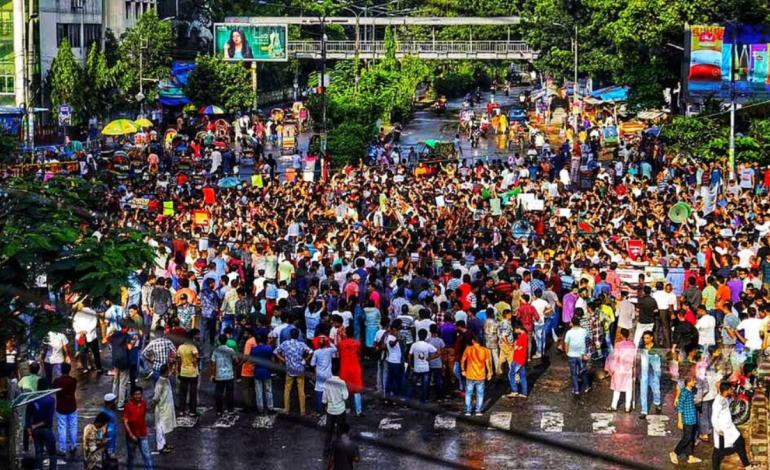
Representational Image. Image courtesy: Wikimedia

Shefali Sarkar was at home in Bidyadharpur, Rajshahi, on the afternoon of 5 August 2024, when word spread through the neighbourhood that Sheikh Hasina had fled. Within hours, the men in her community dispersed into fields and relatives’ houses, anywhere that was not home. The mobs that came were primarily targeting men. Shefali stayed. She watched her house being vandalised. “I thought this was it,” she told Al Jazeera, still shaken months later. “I thought we were going to die.”
What happened to Shefali’s family happened, in some form, across Bangladesh that August. The Bangladesh Hindu Buddhist Christian Unity Council documented 2,010 incidents of communal violence between 4 and 20 August 2024—a sixteen-day period in which the social contract for minorities visibly collapsed.
What the Numbers Say
The 2,010 figure comes from the Unity Council’s monitoring across the country, and covers attacks on lives, homes, businesses, and places of worship across at least 45 of Bangladesh’s 64 districts. Prothom Alo’s own correspondents, investigating independently across all 64 districts and 67 upazilas, documented 1,068 attacks on minority-owned homes and business establishments between 5 and 20 August, a partially overlapping but separately compiled count that nonetheless confirms the geographic reach of the violence. Of the homes and businesses destroyed, the majority were in Khulna division, where approximately 295 structures were wrecked.
Rangpur saw 219, Mymensingh 183, Rajshahi 155, with further destruction recorded in Dhaka, Barishal, Chattogram, and Sylhet. Sixty-nine temples were attacked in this period; Christian churches were also targeted; Ahmadiyya mosques and homes were vandalised; indigenous communities in the Chittagong Hill Tracts were attacked by Bengali Muslim settlers.
These numbers represent different organisations’ attempts to count the same catastrophe from different vantage points. They agree on the essential reality–this was not localised unrest. It was a nationwide pattern, compressed into days, radiating simultaneously across the country.
How It Happened So Fast
The temporal concentration of the violence is striking and requires explanation. The Unity Council noted that the vast majority of the 2,010 incidents occurred in the period immediately surrounding 5 August, the day Hasina fled. That clustering and the simultaneous, rather than sequential, geographic spread are consistent with networks that were ready to move, rather than with crowds that spontaneously formed and then spread. Bangladesh’s Home Minister acknowledged at the time that some of the attacks appeared to be coordinated. Rights groups and Christian Solidarity International documented the role of Islamist networks, including elements linked to Jamaat-e-Islami, in exploiting the security vacuum.
The OHCHR’s subsequent report described the violence against Hindus as motivated by a combination of “religious and ethnic discrimination, revenge against Awami League supporters, and local communal disputes over land and interpersonal issues.”
That combination matters. Some perpetrators were motivated by genuine communal hostility. Others were settling political scores, casting Hindus as Awami League proxies. Others were seizing the opportunity for land and asset theft under the cover of political chaos. The result, for the victims, was the same regardless of which motivation had sent the mob to their door.
The Victims
For the people who lived through it, August 2024 was not experienced as a statistic. It was the loss of a business that had taken a generation to build. It was an idol smashed in a temple that a family had maintained for a century. It was a decision, made in fear, to send the children to relatives in India and not bring them back.
The Human Rights Support Society separately documented 65 attacks in August 2024 alone, recording 228 Hindu homes attacked, 240 businesses destroyed, and 15 temples damaged, a partial local tally that illustrates how even one organisation’s incomplete count fills in the human texture behind the Unity Council’s aggregate numbers.
Nine people are confirmed to have died in the violence, five of whom were Hindu. An investigation by Netra News found that none of the deaths bore clear signs of being purely religiously motivated, with most involving a mix of political retribution, mob violence, and criminal homicide.
That finding is contested by rights groups who argue it sets an impossibly high evidentiary bar; what is not contested is that Hindus were disproportionately targeted, that their identity made them visible to mobs looking for targets, and that many perpetrators understood themselves to be attacking Awami League proxies, which, in the context of Bangladesh’s political culture, means attacking the community perceived to have supported the ousted government, which means attacking Hindus.
The Government’s Response
The Yunus government, under pressure from India and the international community, acknowledged that attacks on minorities had occurred and deployed security forces for subsequent festivals like Durga Puja. But its classification of the violence has been a persistent point of friction with minority groups. The government’s position, consistently maintained through 2024 and 2025, has been that most incidents involving minorities were political or criminal rather than communal in character, and that rights groups’ figures are inflated.
A Netra News investigation found no definitive evidence of religious motivation in the deaths. The government has cited lower figures from organisations such as Ain o Salish Kendra, whose methodology yields smaller counts than the Unity Council’s media-monitoring approach.
This classification dispute is not merely academic. If the violence was political, people attacking Awami League supporters who happened to be Hindu, then it fits within a general law-and-order framework and requires no special response addressing the minority dimension.
If it was communal, people attacking Hindus because they are Hindu, or because being Hindu makes them presumptive enemies of the new order, then something more structural is being said about Bangladesh’s direction of travel, and something more structural is required in response.
The families who fled in August 2024 and have not come back know which description fits their experience. They are not waiting for the methodological debate to be resolved.
What August 2024 Established
For Bangladesh’s minorities, August 2024 has become a temporal marker, shorthand, like “Ramu 2012” or “post-poll 2001,” for a moment when the state’s protection failed, and the vulnerability of being a minority in Bangladesh was made brutally legible. The combination of political upheaval, opportunistic Islamist mobilisation, and a state that was either unable or unwilling to intervene rapidly enough produced violence on a scale that cannot be explained away by political motivation alone.
For anyone watching from outside, the August 2024 events also established something about the mechanics of minority persecution in Bangladesh: that regime change, however it comes about, creates a window in which violence against minorities is effectively decriminalised, and that prepared networks will use that window. Understanding that dynamic, and building protections against it that do not depend on the goodwill of whichever government happens to be in power, is what minority protection in Bangladesh actually requires.