


From the Bridge of INS Vikramaditya to the Top of the Indian Navy—What You Need to Know About Admiral Krishna Swaminathan
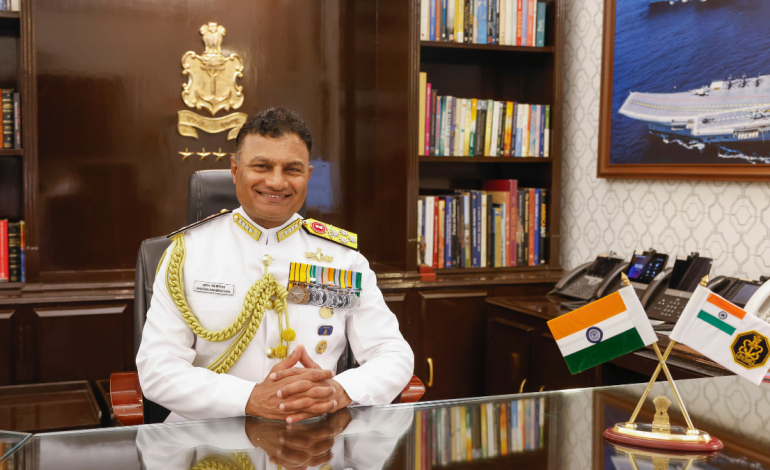
Admiral Krishna Swaminathan. Image Credit: Indian Navy

On a Sunday morning steeped in ceremony and solemnity, Admiral Krishna Swaminathan stepped forward to lead the Indian Navy into a new chapter by becoming the 27th Chief of the Naval Staff.
Accorded a Guard of Honour during a ceremony at South Block in New Delhi, Admiral Swaminathan assumed charge as India’s new Chief of the Naval Staff on May 31, 2026, amid a fast-evolving regional maritime security scenario.
Admiral Swaminathan was commissioned into the Indian Navy on 1 July 1987. His career has spanned nearly four decades—from the cockpit of fast attack missile vessels to the bridge of India’s most prized aircraft carrier. Born in Bangalore, Karnataka, he is married to Laila Swaminathan. His formative military education began at Sainik School, Bijapur, before he went on to the National Defence Academy, Khadakwasla.
A specialist in Communication and Electronic Warfare, Admiral Swaminathan built his career at the intersection of technology and tactics. His sea commands some of India’s finest warships such as the guided missile vessels INS Vidyut and INS Vinash, the guided missile corvette INS Kulish, the guided missile destroyer INS Mysore, as well as the aircraft carrier INS Vikramaditya.
As a Rear Admiral, he served as Chief Staff Officer (Training) at the Southern Naval Command in Kochi, then went on to lead Flag Officer Sea Training and command the Western Fleet, known as the Sword Arm of the Indian Navy.
He also served as Flag Officer Offshore Defence Advisory Group and as Advisor, Offshore Security and Defence to the Government of India.
As a Vice Admiral, he held some of the most demanding posts in naval headquarters, such as the Chief of Staff of the Western Naval Command, Controller Personnel Services, Chief of Personnel, and Vice Chief of the Naval Staff.
Immediately before his elevation as CNS, Admiral Swaminathan served as Flag Officer Commanding-in-Chief of the Western Naval Command—the Navy’s most operationally critical formation—overseeing India’s maritime frontier along the Arabian Sea and the key sea lanes that carry a large share of the country’s trade and energy imports.
Educational Background
Admiral Swaminathan holds a BSc from Jawaharlal Nehru University, an MSc in Telecommunications from Cochin University of Science and Technology, an MA in Defence Studies from King’s College, London, an MPhil in Strategic Studies from Mumbai University, and a PhD in International Studies, also from Mumbai University.
He has studied at the Joint Services Command and Staff College in Shrivenham, UK; the College of Naval Warfare in Karanja; and the United States Naval War College in Newport, Rhode Island.
The Ceremony: A Passing of the Baton
The outgoing Chief of Naval Staff, Admiral Dinesh Kumar Tripathi, bid farewell after 41 years of distinguished service—leaving behind a Navy that had made its presence felt in some of the most critical global situations of recent years.
Reflecting on the Navy’s recent deployments, Admiral Tripathi said, “Over the past few years, whenever the nation called, the Navy delivered. We saw it during Operation Sindoor, which still continues, and we are seeing it now during Operation Urja Suraksha amid the turmoil in West Asia… What we have demonstrated as a service is that we are there to protect and promote India’s national maritime interests anytime, anywhere, anyhow.”
Praising his successor warmly, Admiral Tripathi added, “Today, as I hand over the baton of the Indian Navy to Admiral Krishna Swaminathan, I do it with satisfaction knowing that Admiral Swaminathan, a thorough professional and outstanding leader with proven quality and capacity, will take our Navy to greater heights.”
In His Own Words
After the ceremony, Admiral Swaminathan laid a wreath at the National War Memorial, paying homage to those who gave their lives in the service of the nation. Then, addressing the media, he spoke with characteristic directness and quiet resolve. “I assume command today as the 27th Chief of the Naval Staff with a deep sense of humility, responsibility, pride, and gratitude. Being selected by the top leadership of the country for this job has been the highest honour and privilege of my life. The Indian Navy stands vigilant to protect national interests wherever they are and is very actively deployed in a regional security environment that continues to remain challenging, complex, unpredictable, and uncertain.”
He declared that it would be his highest priority to ensure that the Indian Navy maintains the highest level of operational readiness and combat effectiveness for protecting the nation’s security and economic interests. He also emphasised the importance of ‘JAI’—Jointness, Atmanirbharata (self-reliance), and Indigenisation as guiding principles for the Navy’s path ahead.