



Yemeni government forces claim Mount Numan capture from Houthis as battle for strategic highlands intensifies
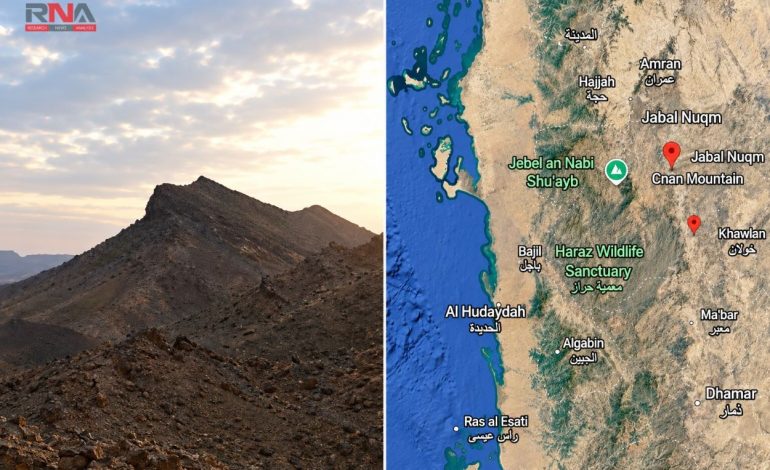
Mount Numan and area showing the highland region in Yemen and the Bab al-Mandab.

New Delhi: Forces loyal to Yemen’s internationally recognized government have announced the capture of Mount Numan’s summit and the Dar al-Kafir area in an overnight operation against Houthi positions. The reported advance comes amid fighting across the southwestern highlands, where both sides are contesting elevated ground overlooking routes between Taiz, Lahij and the Red Sea coast.
According to the forces’ statement, troops infiltrated the targeted area overnight and encircled the positions before advancing during the morning. Houthi fighters retreated, leaving casualties, weapons and ammunition behind, it said, without specifying the number killed or wounded or providing an inventory of the equipment recovered.
The account did not give government losses or establish the extent of territory secured beyond the named positions. The operation’s details could not be independently verified, and the material available for this report contained no Houthi response addressing the specific claim.
The announcement described the mountain as overlooking al-Waziiyah and al-Madaribah, placing the operation on the Lahij front. However, other reporting locates Mount Numan in the Jabal Habashi sector of Taiz, making the precise geographical description a point requiring clarification rather than an established feature of the latest account.
Reports of government control over the mountain also predate this announcement, complicating efforts to establish whether it describes a fresh capture or the consolidation of earlier gains. On September 20, Asharq Al-Awsat reported that government troops had retaken Mount Numan, citing military and local sources who placed it west of Jabal Habashi.
Those sources said the advance reconnected the Bani Bakari and al-Kadhah fronts and helped secure the Bani Bakari–al-Ashrouh–al-Bireen road. They also described the summit as a position from which government troops could threaten nearby Houthi deployments, explaining its tactical value in a battle increasingly focused on mountain roads and supply routes.
On September 21, Taiz Time carried a military official’s assertion that Mount Numan remained under government control and that troops stationed there were using artillery against surrounding Houthi positions. The same account described exchanges of territory elsewhere, indicating that possession of individual heights did not amount to a settled front line.
The wider campaign helps explain why these relatively small territorial claims matter beyond the immediate battlefield. Reuters reported on September 21 that Houthi forces were seeking control of the Kahboub Mountains in Taiz and Lahij, following their advance along Yemen’s Red Sea coast earlier this month.
Five Yemeni military sources told Reuters that the heights separate the coast from government-held territory in the south. Fighting around al-Waziiyah and Ras al-Ara therefore forms part of a struggle over access between coastal positions, inland routes and the approaches towards Aden.
For government forces, maintaining those connections is also important to Taiz’s links with the south. Asharq Al-Awsat reported that Houthi pressure on the surrounding heights threatened the route connecting Taiz with al-Turbah, Lahij and Aden, a vital passage for civilian movement and military supplies.
The evidence consequently points to a contest over connected defensive positions and transport corridors, rather than a single summit determining the outcome of the campaign. Nothing in the latest statement establishes that government forces have recovered the coast or reversed the Houthis’ wider territorial gains.
The maritime stakes arise from the region’s proximity to Bab al-Mandab, the narrow passage connecting the Red Sea with the Gulf of Aden and the Arabian Sea. Together with the Suez Canal farther north, it forms a major shipping route linking Asian markets with Europe, making insecurity around southwestern Yemen an international commercial concern.
For Indian traders using this route, disruption can mean longer journeys and higher transport costs when vessels divert around Africa. The US Energy Information Administration has documented such diversions following attacks in the Red Sea, although an inland territorial gain alone does not establish that navigation has become safer.
The renewed fighting also threatens gains from earlier diplomacy, particularly the UN-brokered truce that began on April 2, 2022. The UN said that arrangement reduced violence and civilian casualties, increased fuel deliveries and enabled discussions on reopening roads in Taiz and other provinces.
The immediate humanitarian consequences now extend well beyond the contested mountain positions. In a September 22 warning, the UN refugee agency said fighting had displaced more than 130,000 people since the beginning of the month, while its Yemen operation had received only 18 per cent of its required funding before the latest escalation created additional needs.