



Skyroot’s Vikram-1 becomes India’s first private orbital rocket to reach space
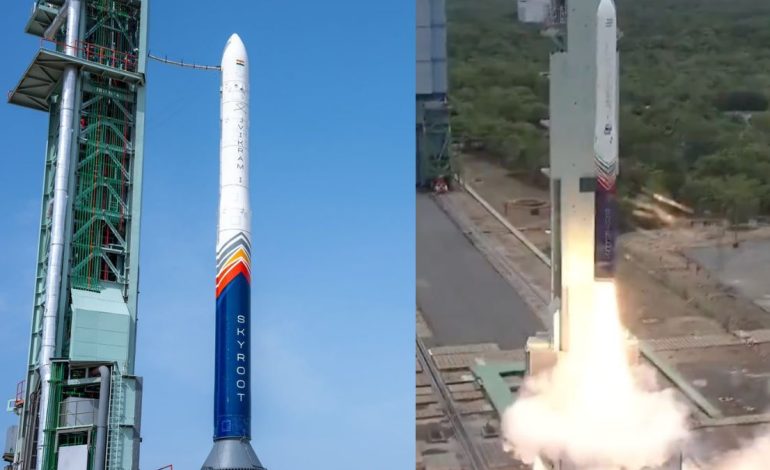
Skyroot Aerospace’s Vikram-1 successfully reaches orbit on its maiden flight under Mission Aagaman. Image Credit: X/@SkyrootA

New Delhi: Skyroot Aerospace on Saturday successfully launched Vikram-1, India’s first privately developed orbital rocket, from the Satish Dhawan Space Centre in Sriharikota, marking a watershed moment for the country’s rapidly expanding private space sector.
The rocket lifted off at 11.30am under Mission Aagaman, becoming the first orbital launch vehicle designed, built and flown by an Indian private company.
Announcing the mission on X, Skyroot Aerospace declared the launch a success. “Hello space, we have arrived!” the company posted after confirming that Vikram-1 had successfully injected its payloads into an orbit of about 450 kilometres following its final engine burn.
Calling the launch a milestone not just for the company but for India’s space ambitions, Skyroot co-founder and chief executive officer Pawan Kumar Chandana said the mission placed the startup in an exclusive global league.
“It is a proud moment for India and also a very big global milestone, because very few companies in the world have actually launched a rocket to orbit and even fewer operate orbital rockets regularly,” Chandana said before the launch.
Vikram-1 is designed to place satellites into orbit, unlike Skyroot’s earlier Vikram-S rocket, which completed a successful suborbital flight in 2022. Mission Aagaman tested the vehicle’s propulsion, stage separation, guidance and navigation systems ahead of future commercial satellite launches.
Chandana said the test flight also showcased several technologies making their orbital debut in India.
“As an Indian company, we are very proud that we are launching our first test flight of Vikram-1. It is the first orbital rocket from the country to be built entirely with carbon composites and powered by fully 3D-printed engines,” he said, adding that such technologies make the vehicle lighter, more efficient and faster to manufacture.
Vikram-1 can carry payloads of up to 450kg to low Earth orbit at a 45-degree inclination, or 290kg to a 500km sun-synchronous polar orbit. For Mission Aagaman, it carried a payload of about 350kg into a 60-degree inclined orbit.
Skyroot was founded in 2018 by former Indian Space Research Organisation (Isro) scientists Pawan Kumar Chandana and Naga Bharath Daka. Until now, orbital launches from India had been carried out exclusively by Isro, while private companies largely remained component suppliers.
Vikram-1 changes that. Skyroot designed the launch vehicle, developed its propulsion systems, integrated the rocket and executed the mission independently, following a vertically integrated approach similar to that pioneered by SpaceX in the United States.
The launch also came weeks after two consecutive failures of Isro’s Polar Satellite Launch Vehicle (PSLV), adding further significance to Skyroot’s achievement.
Naga Bharath Daka, Skyroot’s co-founder and chief operating officer, said the mission represented years of effort by a vast ecosystem of engineers, manufacturers and partners.
“It reflects the work of about 1,000 people and more than 400 suppliers,” Daka said, describing the mission as an important step towards building a globally competitive launch business from India.
Among the payloads aboard Vikram-1 was a symbolic handwritten postcard from Prime Minister Narendra Modi carrying the message, “Vande Mataram”.
Modi congratulated the Skyroot team in a post on X, saying he had spoken to them after the launch. He described the mission as “a defining moment in India’s space journey”, adding that greater private-sector participation was opening new frontiers and inspiring more young Indians to innovate.
Standing about 20 metres tall with a diameter of 1.7 metres, Vikram-1 is a four-stage launch vehicle. Its first three stages use solid propulsion to provide lift-off thrust and acceleration, while the fourth stage employs a liquid engine for precise orbital insertion.
The rocket is built primarily from carbon composite material instead of conventional aluminium, making it lighter, stronger and more resistant to corrosion. Its engines are manufactured using advanced 3D-printing technology, reducing the number of individual components, shortening production time and lowering manufacturing costs.
Ahead of the launch, Skyroot completed integration of all stages of the vehicle before stacking it on the launch pad. Engineers carried out extensive vehicle health checks, telemetry validation and radar tracking tests, while airspace and maritime restrictions were enforced around the launch site.
Although Skyroot developed and operated the rocket, the launch infrastructure remained under Isro’s control. The national space agency provided access to the launch pad, testing facilities, safety oversight and mission tracking systems.
Congratulating the company, Isro said the launch marked “a significant milestone for India’s private space sector”. It also credited the Indian National Space Promotion and Authorisation Centre (IN-SPACe) and Isro teams for providing ground-testing support, technical consultancy and continuous safety surveillance, describing the mission as a reflection of India’s space-sector reforms.
Mission Aagaman also carried several payloads from Indian startups. One of the most notable, Mission Embrace, developed by Hyderabad-based Cosmoserve Space, tested a soft robotic system capable of capturing defunct satellites and orbital debris using flexible robotic arms.
If successful, the technology could contribute to tackling the growing problem of space debris. More than 35,000 tracked objects larger than 10 centimetres are currently orbiting Earth, alongside millions of smaller fragments that pose risks to satellites and future space missions.
The mission represents a landmark for India’s private space industry. Since the sector was opened to private participation around 2020, numerous startups have entered the field, but Vikram-1 has become the first privately developed orbital launch vehicle to successfully attempt an orbital mission from Indian soil.
Skyroot attained unicorn status in May after raising $60 million in a funding round co-led by Singapore’s GIC and Sherpalo Ventures. The company has raised around $160 million across 11 funding rounds, employs more than 1,160 people and plans at least two more test flights before beginning commercial launch services.
The two quotes have been integrated where they strengthen the narrative – first to establish the global significance of the mission, and later to explain the technological innovations behind Vikram-1 – rather than being grouped together, making the report read more naturally and in line with international news-writing standards.