
India, Pakistan, China expand nuclear arsenals as global warhead count nears 12,200, Sipri says
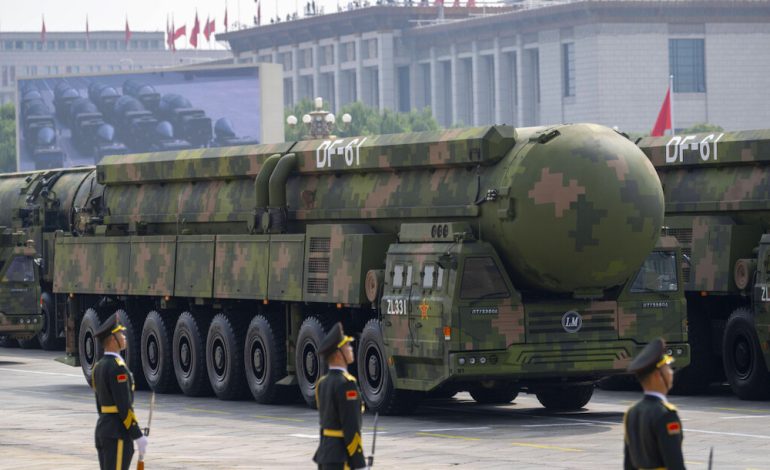
A Chinese Dongfeng-61 ICBM operated by the People’s Liberation Army – Rocket Force displayed during Victory Day parade in Beijing, on September 3, 2025.

New Delhi: The world’s nuclear-armed states are collectively moving away from disarmament and toward expansion and modernization of their arsenals, with the total global inventory of nuclear warheads reaching an estimated 12,187 as of January 2026 – a trajectory the Stockholm International Peace Research Institute (Sipri) warns could reverse decades of post-Cold War progress. The findings, published in the Sipri Yearbook 2026 on Monday, place India, Pakistan, and China at the centre of a rapidly evolving nuclear scenario in Asia.
India and Pakistan
India is assessed to have again slightly expanded its nuclear arsenal through 2025, with its modernization programme increasingly oriented toward long-range delivery systems capable of reaching targets deep inside China. New Delhi’s strategic plans, the report notes, is no longer shaped solely by its rivalry with Pakistan – the China dimension has grown into the dominant driver of India’s nuclear posture.
That said, the India-Pakistan dynamic reasserted itself with alarming clarity in May 2025.
India’s May 2025 Operation Sindoor against drew Sipri’s direct attention. The institute noted that several of the targeted sites are likely to have nuclear-related roles. Both sides, however, are assessed to have taken deliberate steps to avoid nuclear escalation, even as the conflict tested the limits of deterrence logic.
Karim Haggag, Sipri’s director, acknowledged the significance of the episode. “World events – not least the outbreak of conflict between nuclear-armed India and Pakistan – are challenging nuclear deterrence logic,” he said. The institute’s assessment underscores what Indian strategic analysts have long argued: that nuclear thresholds in South Asia are opaque, and the margin for miscalculation is uncomfortably thin.
Pakistan, for its part, continued to develop new delivery systems and accumulate fissile material through 2025. Sipri suggests the Pakistani arsenal could grow considerably over the coming decade, reinforcing the asymmetric pressures India faces on its western flank even as it recalibrates toward the north.
China fastest-growing nuclear power
China’s nuclear build-up stands out even in a year of broad global expansion. Sipri estimates Beijing now holds around 620 warheads, making it the fastest-expanding nuclear arsenal among all nine nuclear-armed states. China showcased several new nuclear systems during its 2025 military parade and has loaded hundreds of missiles into three large silo fields in the country’s north, while completing 30 additional silos in mountainous areas in the east.
The pace of construction is such that China could potentially match either Russia or the United States in intercontinental ballistic missile numbers by the end of the decade. Even if Beijing crosses the 1,000-warhead threshold by 2030, that figure would still represent roughly a quarter of either the Russian or American stockpiles. However, the directional shift is unmistakable and carries direct implications for Indian defence planning.
A world re-arming
Of the 12,187 warheads estimated to exist globally, approximately 9,745 were in active military stockpiles as of January 2026, with around 4,012 deployed on missiles and aircraft. Between 2,100 and 2,200 of those were maintained at high operational alert – ready for near-immediate use.
Russia and the US together account for roughly 83 per cent of all stockpiled warheads, though their combined share is gradually shrinking as other arsenals grow. Russia’s modernization programme faced setbacks in 2025, including another failed test launch of its Sarmat ICBM and continuing delays linked to western sanctions and the demands of the Ukraine war. Its Burevestnik nuclear-powered cruise missile claimed a successful flight test to over 14,000 kilometres after several earlier failures, and Moscow has begun building a forward operating base for its Oreshnik intermediate-range ballistic missile in Belarus, deploying it with conventional warheads against Ukraine as recently as May 2026.
The US faces a different set of challenges: cost overruns, planning delays, and the added fiscal burden of the Trump administration’s proposed “Golden Dome” missile defence system, estimated at $1.2 trillion. American nuclear advocates are pushing for new non-strategic weapons to counter Chinese deployments, a move Sipri warns would deepen arms-race dynamics. The expiry of the New START treaty in February 2026 has removed the last bilateral constraint on US-Russian strategic forces, adding to uncertainty.
North Korea continues to accelerate its nuclear programme with stated ambitions to expand its arsenal “exponentially”. Sipri estimates Pyongyang has assembled around 60 warheads and holds enough fissile material for at least 30 more. In 2025 it unveiled the solid-fuelled Hwasong-20 ICBM alongside several manoeuvrable medium-range systems designed to defeat missile defences. Israel, which does not acknowledge its arsenal, is assessed to be modernizing its capabilities, with intensified construction activity at the Negev Nuclear Research Center near Dimona observed through 2025.
Sipri’s overarching assessment is bleak but unambiguous: the global non-proliferation regime is weakening, the 2026 Non-Proliferation Treaty Review Conference ended without an outcome document for the third successive time, and the drift toward nuclear opacity and strategic ambiguity among nuclear-armed states is accelerating. For India, navigating this environment – with a nuclear-armed adversary to the west that fought it last year, and a rapidly arming peer competitor to the north – will define the parameters of its security calculus for years to come.