

India, Japan sign maritime pact and explore joint warship development as Koizumi makes first India visit
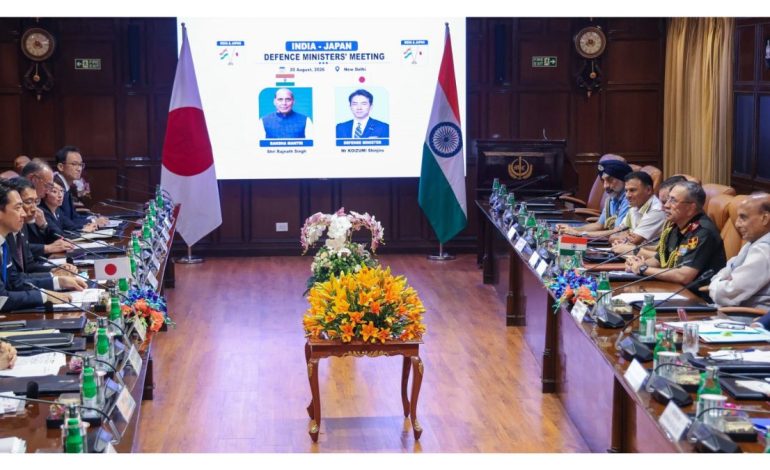
India-Japan Defence Ministers meeting, 2026. Image: X/@rajnathsingh

New Delhi: India and Japan signed a Memorandum of Arrangement on Maritime Security Cooperation on Thursday, agreeing to deepen coordination between their navies and explore jointly developing warships, as Japan’s defence minister, Shinjiro Koizumi, made his first visit to India since taking office.
Koizumi’s visit began a day earlier in Mumbai, on August 19, where he visited the Indian Navy’s Western Naval Command. He was received with a guard of honour and laid a wreath at the Gaurav Stambh memorial at the Naval Dockyard. He also toured INS Chennai, one of the Navy’s indigenously built guided-missile destroyers, and met the chief of the naval staff, Admiral Krishna Swaminathan, and the Western Naval Command’s flag officer commanding-in-chief, Vice Admiral Sanjay Mahajan Vatsayan, who briefed him on naval operations. Japan’s ambassador to India, Keiichi Ono, described the visit as involving “fruitful discussions on advancing maritime cooperation.”
Koizumi flew to New Delhi the next day. Singh welcomed him at the Manekshaw Centre with a guard of honour, before the two travelled to the National War Memorial to lay a wreath.
Singh, in a post on X, greeted Koizumi in Japanese: “Konichiwa Koizumi San!”
The two ministers then held talks on deepening operational maritime security cooperation and signed a Memorandum of Arrangement (MoA) on Maritime Security Cooperation between India’s Ministry of Defence and Japan’s Ministry of Defence. The two sides “concurred on deepening operational cooperation in the field of maritime security practically and effectively” and “affirmed their commitment to strengthening maritime security cooperation,” the two countries said in a statement.
The MoA creates a framework for closer cooperation between the Indian Navy and Japan’s Maritime Self-Defence Force, including information-sharing on maritime domain awareness (MDA), and enhanced cooperation on search and rescue (SAR) and humanitarian assistance and disaster relief (HADR), according to the statement.
The agreement also covers protecting shared sea lanes through more mutual ship visits, joint exercises, personnel exchanges, and shared access to ports and repair facilities. Both sides said they wanted to move “swiftly to realise concrete maritime security cooperation that serves the strategic and operational needs.”
Against this backdrop, the two countries floated something larger: exploring joint development of naval warships, pairing Japan’s ship design and technology with India’s manufacturing base. The joint statement’s language was careful here. It said that it was an agreement to “explore the possibility” of joint development, not a signed contract for a specific vessel. The two sides also agreed to work together on mine-countermeasure capabilities.
Separately, it was reported that talks are under way to co-produce Japan’s Mogami-class stealth frigate in Indian shipyards under the Make in India programme. This has not been officially confirmed; the joint statement says only that the two sides will explore the possibility of joint development in naval shipbuilding and design.
The two sides also agreed to work towards reciprocal access to ship-repair facilities, with an arrangement expected soon. Singh tied this to a broader shift he said the relationship needed to make: “To stay ahead of evolving global uncertainties, we must broaden our collaboration into emerging domains and industrial manufacturing under the ‘Make in India’ initiative.”
Military exercises came up too. Both sides agreed to expand the army exercise Dharma Guardian and the naval exercise JAIMEX, and to continue coordinating on the air exercise Veer Guardian 26. They also agreed to increase exchanges between their special operations forces. Once India’s integrated theatre commands are in place, the two countries said they would look to work with those structures as well.
On technology, the ministers reviewed the UNICORN integrated communications antenna system, which both governments call their flagship defence technology transfer project, and reaffirmed their commitment to completing it. They also agreed to deepen research cooperation between India’s Defence Research and Development Organization (DRDO) and Japan’s Acquisition, Technology and Logistics Agency (ATLA). A Defence Industry Forum will be convened to take this work forward.
The talks then widened to the broader Indo-Pacific picture. Both ministers spoke against unilateral attempts to change the status quo through force or coercion, and reaffirmed the importance of open sea lanes and airspace. Singh said India’s “maritime lifelines are facing growing vulnerabilities,” and that “efforts to ensure freedom of navigation, overflight and unimpeded lawful commerce are not just an economic necessity but a strategic imperative.” He described the alignment between India’s MAHASAGAR vision and Japan’s Free and Open Indo-Pacific initiative as “more important now than ever before.”
Summing up the day, Singh called the talks a “milestone for Indo-Pacific stability.” He said the discussions had centred on “strengthening maritime security cooperation, promoting defence technology cooperation under the ‘Make in India’ initiative, and further deepening our strategic trust relationship.”
The visit builds on commitments made weeks earlier. Japan’s prime minister, Sanae Takaichi, travelled to India in July for the 16th Annual Summit with Prime Minister Narendra Modi. During that visit, the two countries agreed to deepen defence and security cooperation, and signed agreements worth more than $10bn across artificial intelligence, defence and clean energy.