


HAL signs long-term deal with Safran for LEAP engine forgings, expanding aerospace supply-chain role
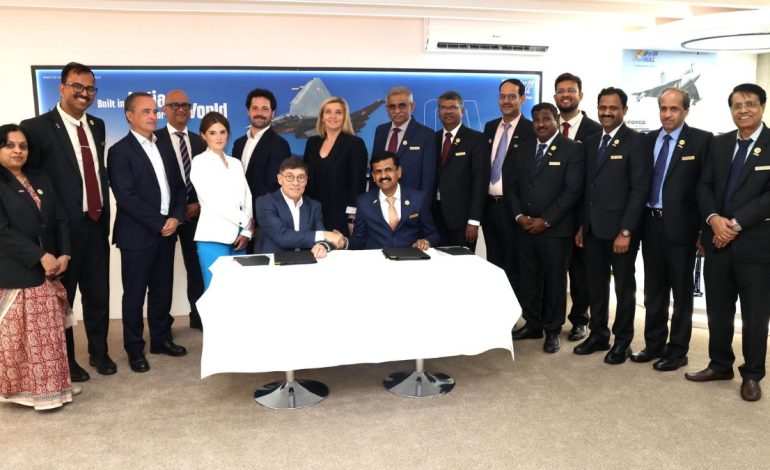
HAL and Safran Aircraft Engines sign a long-term agreement to manufacture critical turbine ring forgings for the CFM LEAP engine programme. Image Credit: X/ @HALHQBLR

New Delhi: Hindustan Aeronautics Limited (HAL) and Safran Aircraft Engines signed a long-term agreement at the Farnborough International Airshow 2026 on Wednesday. The deal covers the production and supply of turbine ring forgings for the CFM LEAP engine.
The agreement was signed by Praveen B, general manager of HAL’s Foundry and Forge Division, and Dominique Dupuy, Safran’s senior vice-president for purchasing.
Under the deal, HAL will manufacture near-net-shape ring forgings using superalloys at its Ring Rolling facility in Bengaluru. These components go into the rotating section of the engine, where they must withstand extremely high temperatures. HAL said the components are critical to engine performance and reliability.
HAL’s chairman and managing director, Ravi K, said the agreement reflected growing confidence among global aerospace manufacturers in HAL’s capabilities. He said it would help HAL expand its presence in the international civil aerospace market.
This is not HAL’s first agreement with Safran on LEAP parts. The two companies signed an initial memorandum of understanding in October 2023. This was followed by a contract for forged parts in February 2025.
Cooperation expanded again in June 2025 to include a different type of high-strength metal part. The new deal builds on this existing partnership, rather than marking HAL’s first entry into the programme.
CFM LEAP engines are made by CFM International, a joint venture between GE Aerospace and Safran. Different versions of the engine power the Airbus A320neo, the Boeing 737 Max, and China’s Comac C919 aircraft – three of the most widely flown passenger jets in the world. HAL is not building complete engines. It is supplying specific forged parts that go into Safran’s broader production process.
The deal supports India’s Make in India initiative, which aims to build more high-value components domestically instead of simply assembling parts made elsewhere.
HAL and Safran also run a separate joint venture, SAFHAL Helicopter Engines, which is developing a new engine called Aravalli. This engine is meant for India’s future Indian multi-role helicopter and its naval version. Unlike the LEAP deal, this involves jointly designing an engine from scratch, a deeper level of cooperation.
Separately at the airshow, Bharat Forge signed an agreement with FLYING WHALES, a French-Canadian company, to develop heavy-lift airships in India for defence use. The aircraft in question is called the LCA60T – a large cargo airship, not to be confused with India’s light combat aircraft, Tejas, which uses the same “LCA” initials. The LCA60T is designed to carry up to 60 tonnes of cargo and can take off and land vertically.
The companies said they intend to build manufacturing capability for these airships in India. The agreement is only a memorandum of understanding at this stage, not a confirmed production or purchase order.
Officials linked the idea to India’s difficult military supply routes, including high-altitude areas such as Ladakh, where airstrips are limited.