

China presses ahead with Motuo dam construction on Yarlung Tsangpo near Arunachal Pradesh border
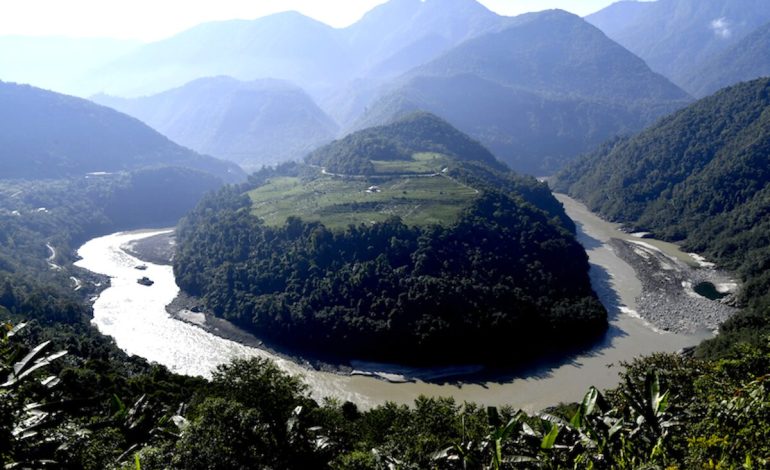
Yarlung Tsangpo river’s “great bend” in China’s Tibet Autonomous Region, close to India’s Arunachal Pradesh, where the megadam is being built. (Photo courtesy: China News Service)

New Delhi: China is pressing ahead with the construction of the controversial Motuo dam, according to various credible reports. The project, which is barely a few dozen kilometres from India-China line of actual control (LAC) in Arunachal Pradesh, is now well into its construction phase.
The project has been monitored through intelligence inputs, renewing concerns in India over its possible impact on the Brahmaputra river system, which supports millions of people in Arunachal Pradesh and Assam.
Officially termed the Medog (Motuo) hydropower station, the dam entered its construction phase on July 19, 2025, when the Chinese premier, Li Qiang, presided over a groundbreaking ceremony in Nyingchi city in the Tibet Autonomous Region. Beijing had approved the project, in the lower reaches of the Yarlung Tsangpo, in December 2024, to be built in Medog county of Tibet, near the disputed boundary with India.
Construction is being overseen by the state-owned China Yajiang Group, with most of the power generated to be distributed elsewhere in the country.
The complex comprises five cascade dams, with a projected installed capacity of approximately 60 gigawatts and annual generation of up to 300 billion kilowatt-hours – enough to supply more than 300 million people – with commercial operations planned for 2033. The site is the river’s “great bend”, where the level drops by approximately 2,000 metres, generating conditions for massive power output. A portion of the flow will be diverted through four 20-kilometre tunnels bored through the Namcha Barwa mountain. Li called the dam “the project of the century.”
The stakes for India lie in geography. The river rises in Tibet, enters India as the Siang before becoming the Brahmaputra in Assam, and finally reaches Bangladesh as the Jamuna before emptying into the Bay of Bengal. Tens of millions downstream depend on its flow for agriculture, fishing and flood-plain ecology, and the dam’s proximity to the contested boundary has sharpened New Delhi’s unease.
India has formally conveyed its concerns to Beijing. In February 2025, the Ministry of External Affairs spokesman, Randhir Jaiswal, told a weekly media briefing that the Chinese side had been urged to ensure the interests of downstream states are not harmed, adding, “we will continue to monitor and take necessary measures to protect our interests.”
In Arunachal Pradesh, the chief minister, Pema Khandu, has been among the most vocal critics. Khandu has warned that the Siang and Brahmaputra rivers could “dry up considerably” once the dam is completed, calling it an existential threat that China “could even use … as a sort of water bomb”. The deputy chief minister, Chowna Mein, has gone further, cautioning that a sudden release of excess water could submerge the entire Siang region, the Brahmaputra valley, and even Guwahati’s Saraighat bridge.
The alarm is not universal. The chief minister of Assam, Himanta Biswa Sarma, has said he sees no reason for concern, broadly endorsing New Delhi’s official position that China’s run-of-the-river project will not significantly alter total downstream flow.
Beijing, for its part, has repeatedly sought to allay such fears. In January this year, a spokeswoman for China’s foreign ministry, Mao Ning, said the project will not “negatively affect the lower reaches” and that China would continue cooperating with downstream countries on disaster prevention. The chargé d’affaires at the Chinese embassy in India, Wang Lei, separately wrote that critics characterizing the dam as a “Chinese weapon” were mistaken.
India’s principal countermeasure is the Upper Siang project in Arunachal Pradesh. The roughly 11.2-gigawatt hydropower scheme is being pursued as a strategic and water-security response to the Chinese dam, though it remains delayed amid stiff local opposition, prompting the Centre to roll out a ₹350-crore special development and livelihood programme, alongside the Arunachal Pradesh government, to build local trust ahead of a pre-feasibility study.
Diplomatically, channels have stayed open even as concerns persist: the external affairs minister, S Jaishankar, conveyed India’s concerns over the dam to his Chinese counterpart, Wang Yi, underlining the need for utmost transparency, even as the two sides agreed to reopen border trade and keep communication going on renewing arrangements for sharing hydrological data during emergencies.
Set against this backdrop, the Motuo project sits at the intersection of energy ambition and hydro-geopolitics. Much of the Brahmaputra’s actual volume is generated by rainfall and tributaries after the river enters Indian territory. This limits Beijing’s theoretical ability to choke off the flow entirely; the more credible risks lie instead in sudden discharges during dam-filling or maintenance, sediment disruption affecting the river’s delta-building function, and the great bend’s location on an active Himalayan fault line prone to landslides and earthquakes.
With both capitals now racing to build their own infrastructure on a shared and ecologically fragile river system, the absence of a binding bilateral water-sharing treaty – as opposed to the limited, renewable memorandums currently in place – remains the gap analysts most consistently flag as the real long-term vulnerability.