
Bashar al-Assad, ousted Syria president, sentenced to death in absentia as new regime puts former on trial
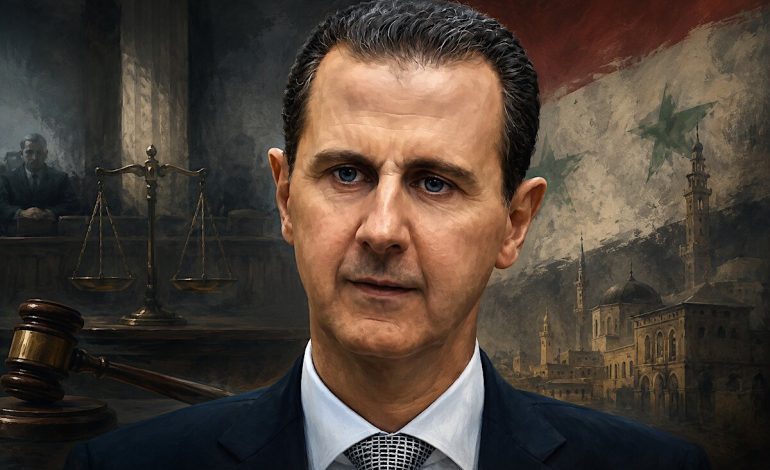
Bashar al-Assad. (RNA Media illustration)

New Delhi: A Syrian court under the Ahmed al-Sharaa regime on Tuesday sentenced the country’s ousted president, Bashar al-Assad, to death in absentia for crimes against humanity and war crimes committed during the long civil war, marking the most consequential judicial action against the former ruler since his government collapsed. His younger brother, Maher al-Assad, was also sentenced to death in absentia, while their cousin and former security chief Atef Najib received the same punishment after standing trial in Damascus.
The verdict, delivered by the fourth criminal court at the Justice Palace in Damascus on Tuesday represents a landmark moment in Syria’s attempts to prosecute senior figures associated with more than five decades of Assad family rule. Bashar and Maher are believed to be in Russia, where they fled after opposition forces swept into Damascus and toppled the government in December 2024.
Najib, a former brigadier general who headed the political security branch in the southern province of Daraa when Syria’s uprising began in 2011, appeared in court in a prisoner’s uniform as the sentence was pronounced. He was arrested by Syria’s new authorities in Latakia province in January 2025 and became one of the most senior officials of the former government to be taken into custody after Assad’s fall.
Najib’s actions in Daraa occupy a particularly important place in the history of the Syrian conflict because the detention and alleged torture of schoolboys accused of painting anti-government graffiti helped trigger the protests that erupted there in March 2011. The government’s violent response to those demonstrations fuelled unrest across the country, eventually transforming the uprising into a devastating civil war.
Syrian prosecutors had sought the conviction of Najib, Bashar, Maher and other defendants on charges including murder, torture, arbitrary detention and misappropriation of public funds. Lawyers representing civil plaintiffs had also sought convictions for crimes against humanity and war crimes, citing allegations of systematic torture, killings, deprivation of liberty and the deaths of children.
The court proceedings began in April and form part of a wider effort by Syria’s post-Assad authorities to prosecute officials accused of abuses committed under the former government. According to Sana, the case against Najib included accusations that he participated in suppressing peaceful demonstrations with live ammunition and bore responsibility for killings and torture in detention centres.
The verdict against Bashar al-Assad is largely symbolic for now because he remains outside Syrian jurisdiction and Russia has provided him refuge since his overthrow. Nevertheless, the judgment gives Syria’s transitional justice process its highest-profile conviction yet and could strengthen future attempts by Damascus to pursue international legal or extradition measures against former regime figures abroad.
Assad had ruled Syria since 2000, succeeding his father, Hafez al-Assad, whose family had dominated the country for more than half a century before the government’s collapse. The conflict that followed the 2011 uprising killed about half a million people, displaced millions inside and outside Syria and drew regional and global powers into one of the Middle East’s most destructive wars.
Assad has also faced legal action outside Syria over alleged atrocities committed during his presidency. France’s highest court ruled in July 2025 that a 2023 arrest warrant concerning alleged chemical attacks was invalid because Assad enjoyed the personal immunity of a serving head of state when it was issued, but stressed that a fresh warrant for war crimes or crimes against humanity could be sought after his removal from office.
For Syria’s new authorities, under the new president, Ahmed al-Sharaa – also known by his nom de guerre Abu Mohammad al-Julani, the convictions are therefore about more than the fate of three former officials as they form part of an attempt to establish judicial accountability for abuses committed during a conflict that fractured the country and displaced an entire generation. Whether that process develops into a credible and comprehensive system of transitional justice will depend on the independence of the courts, due process for defendants and the authorities’ willingness to investigate abuses regardless of who committed them.