
‘You can fool all people some of the time’: Iran’s Araghchi mocks US aircraft losses as US Congress report lists 81 lost
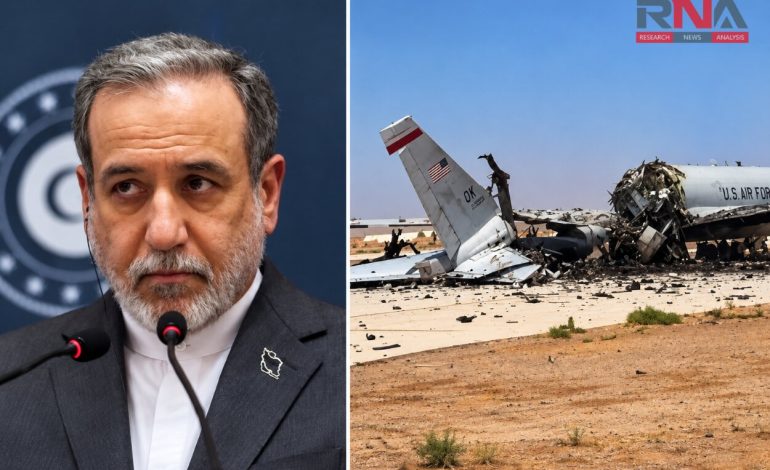
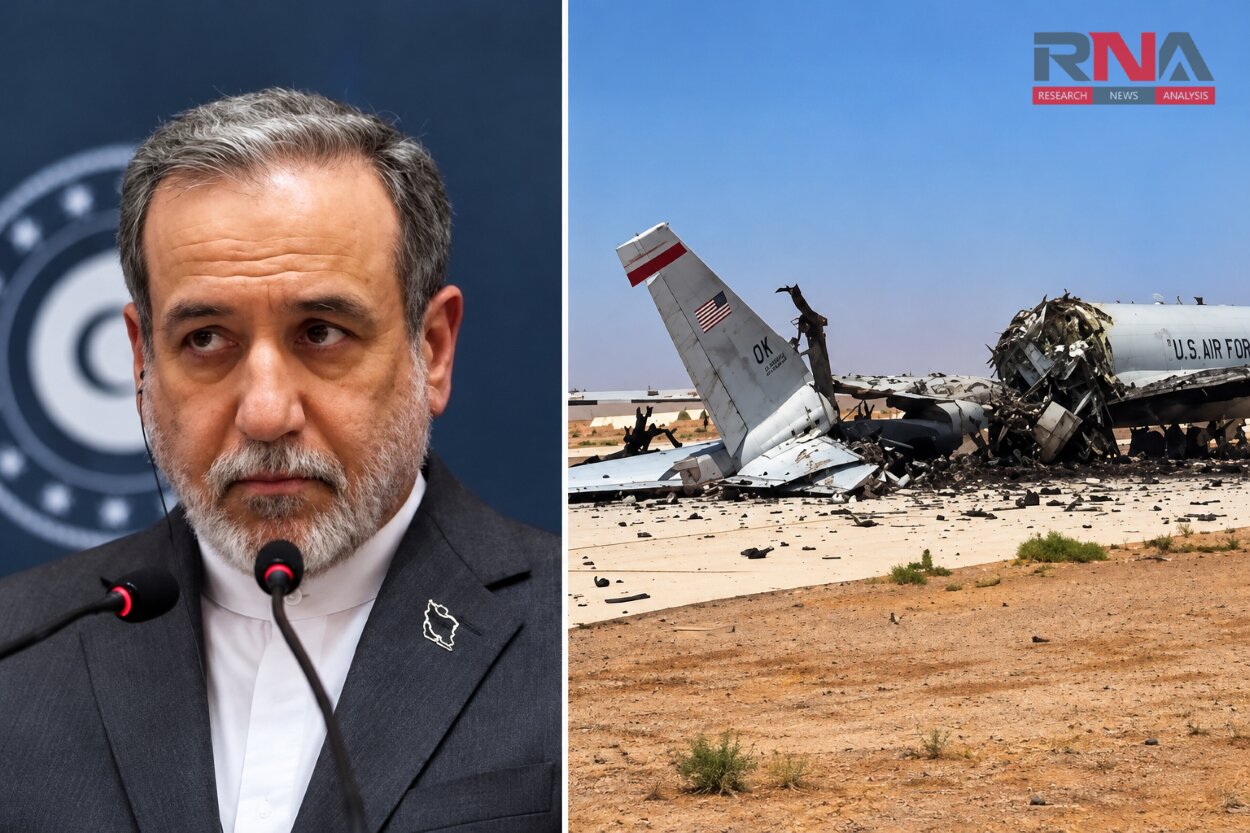
This combination photo shows Abbas Araghchi and a US AEW&C aircraft destroyed by an Iran missile attack.

New Delhi: The foreign minister of Iran, Abbas Araghchi, on October 8, 2026, claimed that American aircraft losses in operations against his country exceeded the 81 aircraft listed in an updated US congressional assessment. The figure includes aircraft reportedly destroyed or damaged, however, and cannot be read as a count of aircraft shot down by Iranian forces.
In a post on X, Araghchi contrasted the Congressional Research Service’s earlier tally of 42 aircraft in May with its latest figure of 81. Describing the aircraft as having been “taken out” by Iran’s armed forces, he asserted that the “real toll is far higher”, without providing a separate total or supporting inventory.
Araghchi also alleged that US Central Command, or Centcom, had prevented a serving US senator from inspecting military bases that the command maintained were in good condition. His post did not identify the senator or the bases, and the allegation does not independently establish additional aircraft losses.
The CRS assessment, updated on Monday, draws on military statements, media reporting and findings from the Pentagon’s inspector general. It cautions that classified information, continuing combat and uncertainty over attribution could alter the tally, while some damaged aircraft have returned to service.
That distinction matters because the compilation covers several different circumstances: enemy action, friendly fire, accidents and aircraft deliberately destroyed by American personnel during rescue operations. Combining those incidents into a single figure illustrates the campaign’s material toll but does not establish that Iran destroyed all 81 aircraft.
Uncrewed aircraft account for most of the reported losses, with 45 MQ-9 Reaper drones making up more than half the total. The list also includes three MQ-1 drones and an MQ-4C Triton surveillance aircraft that crashed in a mishap, further demonstrating why the overall tally should not be treated as a shootdown count.
Among manned combat aircraft, 12 F-15E Strike Eagles were listed as destroyed or damaged, including three lost to friendly fire over Kuwait and another lost over Iran. Eight others sustained light damage in an Iranian strike on Muwaffaq Salti Air Base in Jordan and subsequently returned to service.
The assessment also records damage to an F-35A Lightning II and losses or damage involving two A-10 Thunderbolt II aircraft. Army Times says one A-10 crashed after taking enemy fire during a rescue mission, while the other was severely damaged in the strike on the Jordanian base.
Support aircraft feature prominently, including seven KC-135 aerial refuelling tankers, an E-3 Sentry airborne early warning and control aircraft, and two MC-130J special operations transports. The MC-130Js were deliberately destroyed during operations to recover the crew of a downed F-15E, rather than being shot down by Iranian forces.
The deadliest tanker incident occurred on March 12, 2026, when a KC-135 crashed in western Iraq, killing all six crew members aboard, while another tanker involved in the incident made an emergency landing. Centcom said the loss was caused by neither hostile nor friendly fire.
The financial estimates also require careful interpretation: the US Congressional Budget Office’s September assessment put equipment replacement costs through August 1 at $1.9 billion, potentially rising to $3.3 billion depending on the Pentagon’s funding approach. Those figures cover equipment beyond aircraft, including a destroyed missile-defence radar, and are not a valuation of the latest 81-aircraft tally alone.
Replacing losses presents practical difficulties because several affected aircraft types, including the F-15E, A-10, KC-135 and E-3, are no longer in production. The budget office noted that successor aircraft already feature in regular procurement plans, meaning the additional funding required depends partly on how replacements are acquired.
Beyond replacement costs, CRS identifies questions over whether losses of scarce, ageing platforms could create capability gaps elsewhere and whether production lines can replenish aircraft quickly enough. It also asks whether the incidents warrant changes to equipment, tactics or basing arrangements – issues that extend beyond the dispute over the headline number.
The campaign began with coordinated US-Israeli operations on February 28 this year and continued through periods of reduced fighting and renewed strikes. Asked about the updated assessment on Wednesday, Centcom told Stars and Stripes it had “nothing further to provide”; that response preceded Araghchi’s latest allegation and was not a direct rebuttal of it.