US-Iran talks in Switzerland yield 60-day roadmap as negotiators seek to consolidate fragile West Asia peace
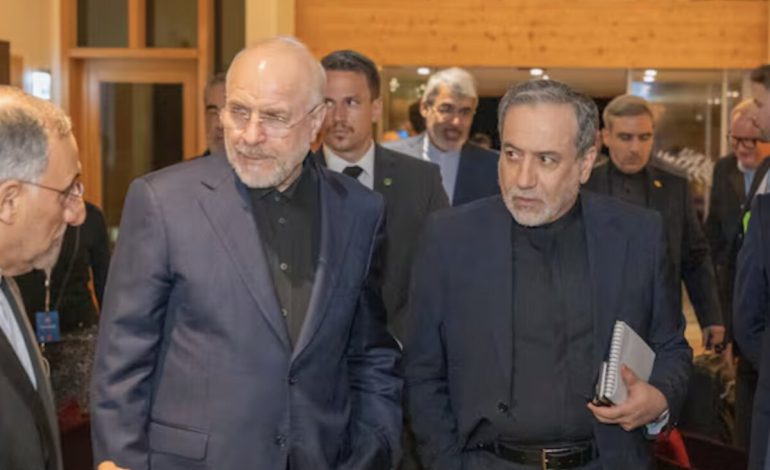
Iran’s negotiators are led by the country’s speaker of parliament, Mohammad Baqer Ghalibaf (2L), and foreign minister, Abbas Araghchi (R). (Photo via X)

New Delhi: The United States and Iran have concluded the opening round of high-level negotiations in Switzerland with an agreement on a 60-day roadmap aimed at transforming a fragile ceasefire into a broader political settlement. This marks the most significant direct engagement between the two adversaries in years.
The talks, mediated by Pakistan and Qatar, are intended to address the aftermath of the recent West Asia war, Iran’s nuclear programme, sanctions relief, regional security arrangements, and mechanisms to prevent renewed hostilities.
The discussions were held at the Burgenstock resort overlooking Lake Lucerne and brought together senior officials from both sides, including the US vice-president, JD Vance, and the Iranian foreign minister, Abbas Araghchi, along with representatives of the mediating countries. The meeting followed the signing earlier this month of an interim memorandum of understanding (MoU) designed to halt the conflict and create a framework for a negotiated settlement.
A joint statement issued by Pakistan and Qatar described the talks as “positive” and “constructive” and confirmed that both sides had agreed on a roadmap towards a final agreement within 60 days. The statement also announced the establishment of a high-level committee to supervise negotiations and facilitate further technical discussions on key issues, including nuclear verification, sanctions, dispute resolution, and regional security.
The negotiations are being viewed as the first major test of whether the ceasefire reached after months of escalating tensions can evolve into a durable political arrangement. The recent conflict brought the region to the brink of a wider war involving Iran, Israel, Hezbollah, and US forces, while also raising concerns over disruptions to global energy supplies through the Strait of Hormuz.
Progress despite tensions
The opening session was marked by uncertainty after earlier plans for talks had been postponed and amid renewed tensions triggered by developments in Lebanon and public remarks from the US president, Donald Trump. Swiss authorities had initially scheduled negotiations for June 19 before logistical and political complications forced a delay.
Despite the rocky start, negotiators ultimately met over the weekend and reported progress. Araghchi later described the discussions as a step forward and said efforts were under way to secure a broader settlement that could reduce regional tensions. According to reports carried by international media, he also referred to the negotiations as making “progress” towards ending the conflict linked to Lebanon and improving broader regional stability.
Vance, speaking before the talks, said Washington hoped to “turn over a new leaf” in relations with Tehran and establish a process that could reduce the risk of future confrontation. The White House has presented the negotiations as an opportunity to address longstanding disputes through diplomacy while retaining pressure mechanisms should talks fail.
Nuclear programme remains central
Although the current negotiations encompass several regional disputes, the future of Iran’s nuclear programme remains the core issue. Under the framework agreed by the two sides, technical experts are expected to begin work immediately on inspection mechanisms, verification procedures, uranium enrichment limits, and other safeguards intended to ensure that Iran’s nuclear activities remain exclusively civilian.
The director general of the International Atomic Energy Agency, Rafael Mariano Grossi, welcomed the launch of the process and indicated that the agency stood ready to assist.
“We believe the fact that the indispensable role of the IAEA is recognized is a sound point of departure,” Grossi told journalists in Geneva on Thursday. He added that the agency would now work with both governments to formulate “the concrete steps that will have to be taken” regarding verification and implementation.
Iran has consistently maintained that its nuclear programme is intended for peaceful purposes and that uranium enrichment is a sovereign right under the Nuclear Non-Proliferation Treaty. Tehran has indicated that sanctions relief and recognition of its civilian nuclear activities will be essential elements of any final agreement.
Sanctions relief
One of the most closely watched aspects of the negotiations concerns the possibility of phased sanctions relief for Iran. International media reports suggest negotiators are examining arrangements that could permit limited Iranian oil exports and provide access to some frozen Iranian assets as confidence-building measures during the negotiation period.
While details remain under discussion and no final decisions have been announced publicly, the issue is expected to be central to the technical talks scheduled over the coming days.
The prospect of progress in diplomacy has already had a noticeable impact on regional financial markets. Gulf investors reacted positively after reports emerged that the two sides had agreed on a roadmap rather than ending talks in deadlock.
Regional security concerns
Beyond the nuclear file, negotiators are attempting to address several flashpoints that could derail the peace process.
The continuing conflict involving Hezbollah and Israel in Lebanon remains a major concern. According to reports from the mediators, the talks produced agreement on mechanisms intended to reduce the risk of escalation and establish channels for communication among the parties involved.
Another sensitive issue is the Strait of Hormuz, through which a significant portion of global oil exports passes. Recent Iranian statements regarding restrictions in the waterway and subsequent US objections heightened fears of disruptions to maritime traffic. Negotiators are now working on communication arrangements intended to reduce misunderstandings and ensure safe commercial navigation.
Challenges ahead
Despite the positive tone emerging from Switzerland, diplomats and analysts caution that the most difficult phase of negotiations lies ahead.
The roadmap provides only a framework. Negotiators must still resolve contentious questions relating to enrichment levels, inspection regimes, sanctions removal, regional armed groups, dispute-settlement mechanisms, and guarantees against future military action. Many of these issues have derailed previous rounds of US–Iran diplomacy.
Iranian officials have also stressed that Tehran will not compromise on what it describes as its “red lines”. Mohammad Baqer Ghalibaf, the speaker of Iran’s parliament and identified by Iranian media as the chief negotiator in the process, said on June 19 that Iran remained committed to defending its national interests and would not accept excessive demands. The remarks were reported by Iran’s official news agency and cited by western media.
For Washington, the challenge will be balancing diplomatic engagement with domestic political pressures and security concerns from regional partners. For Tehran, the immediate priority is securing tangible economic relief while preserving what it considers its sovereign rights.
For now, however, both sides appear committed to continuing discussions. Technical negotiations are expected to continue throughout the week in Switzerland, with mediators hoping the momentum generated at Burgenstock can be translated into a comprehensive settlement within the agreed 60-day period. Whether that ambition can be realized will determine not only the future of US-Iran relations but also the stability of a region that has endured years of conflict and recurring crises.