


US bars BYD vehicles from its Kadena airbase in Japan over data-security fears
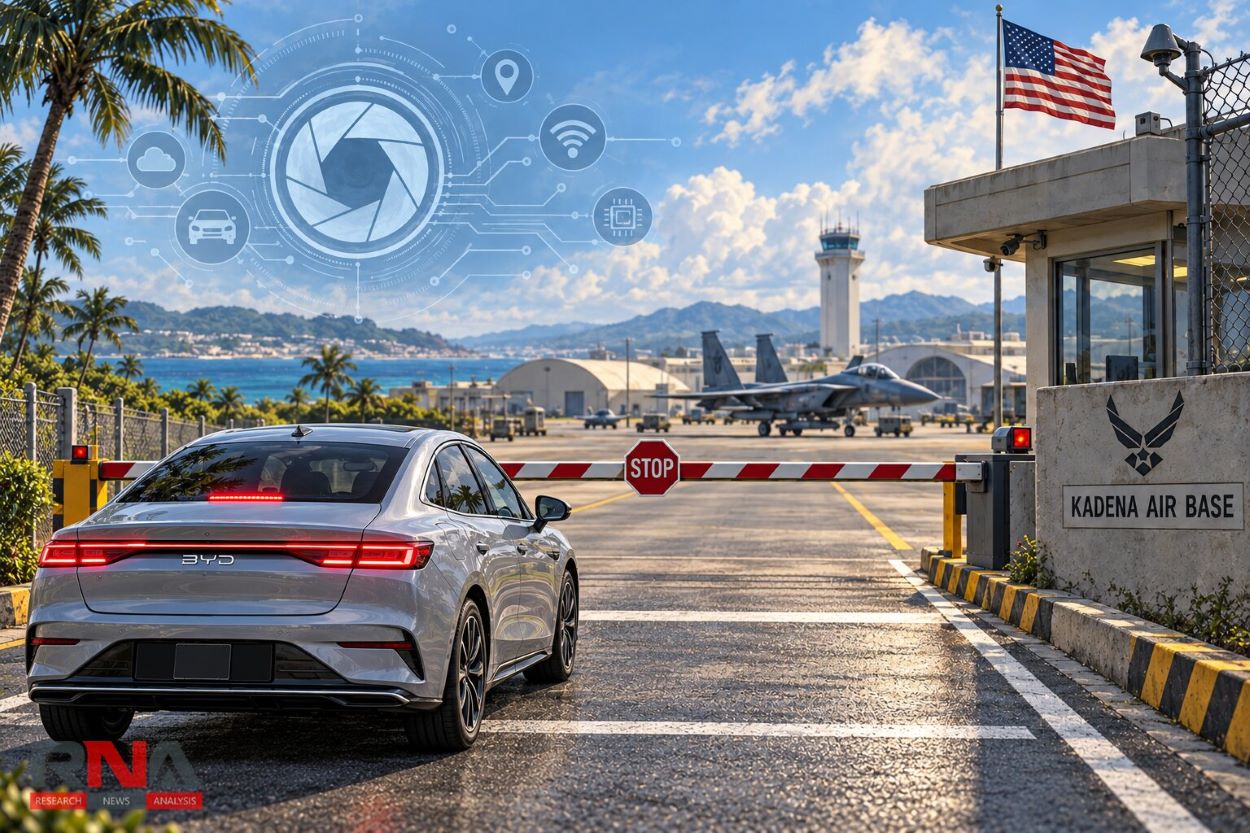
RNA Media illustration for representation.

New Delhi: The US military has barred vehicles made by the Chinese carmaker BYD from the Kadena airbase in Japan, citing security risks at a key American military installation in the western Pacific. The restriction took effect on Monday and covers privately owned cars, taxis, delivery vehicles and vehicles operated by contractors and commercial businesses.
Security personnel at the Okinawa base have been instructed to refuse entry to BYD vehicles regardless of their purpose, according to reporting citing US military officials in Japan. The decision brings connected-car technology into Washington’s wider effort to prevent potentially sensitive information from being collected inside military facilities.
“These vehicles present an unacceptable and unmitigable risk to our personnel and our mission,” Lieutenant Colonel Alli Stormer, a spokesperson for the US Air Force’s 18th Wing at Kadena, told Reuters. Stormer did not identify the specific concern that prompted the decision, and BYD did not immediately respond to the agency’s request for comment.
Concern centres on onboard cameras and sensors
South Korea’s Yonhap news agency, which first reported the restriction, attributed it to concerns that cameras and sensors fitted to BYD vehicles could collect and potentially expose sensitive information from the base. However, the US military has not publicly identified a case in which a BYD vehicle collected or transmitted information from Kadena.
The distinction is significant because the stated concern involves the potential capabilities of connected vehicles, rather than a publicly demonstrated security breach involving the company. Modern cars can combine cameras, location tracking, onboard computing and internet connectivity, creating questions about who can access the information they generate and how their systems are controlled.
The US commerce department has separately warned that malicious access to connected-vehicle technology could enable the extraction of sensitive information or remote manipulation of vehicles. Its concerns extend to communications systems using cellular networks, satellite links, Bluetooth and Wi-Fi, as well as software supporting automated driving.
Why Kadena matters
Kadena is a major forward operating base within the US-Japan security alliance, supporting American military operations across the region. The USAF 18th Wing’s official description identifies its role as providing deployable airpower and a staging base for regional contingencies, alongside support for other US services operating through the installation.
Its activities include aerial refuelling, airborne air control, search and rescue, and aeromedical evacuation, according to the 18th Operations Group. These functions make Kadena important both for combat operations and for sustaining aircraft and personnel across the Indo-Pacific.
Reports have raised the possibility of similar restrictions at other American installations in Japan and South Korea, but no wider decision was announced in the coverage reviewed. US Forces Korea said on October 23 that it had no changes to installation-access policies to announce.
Part of a wider technology dispute
The Kadena restriction follows the Pentagon’s decision in June to place BYD on a list of companies it believes support China’s military. BYD rejected that designation and said it would pursue administrative and legal remedies to protect its interests.
Separately, the US commerce department finalized connected-vehicle restrictions on January 14, 2025, covering specified technology linked to China or Russia. Software-related prohibitions begin with model-year 2027 vehicles, while hardware-related restrictions generally apply from model year 2030, with a separate timetable for units without a model year.
Those rules regulate specified imports and sales in the United States, whereas the Kadena measure governs physical access to a military installation overseas. The immediate consequence in Okinawa is that BYD owners and businesses using the company’s vehicles must use alternative transport to enter the base.