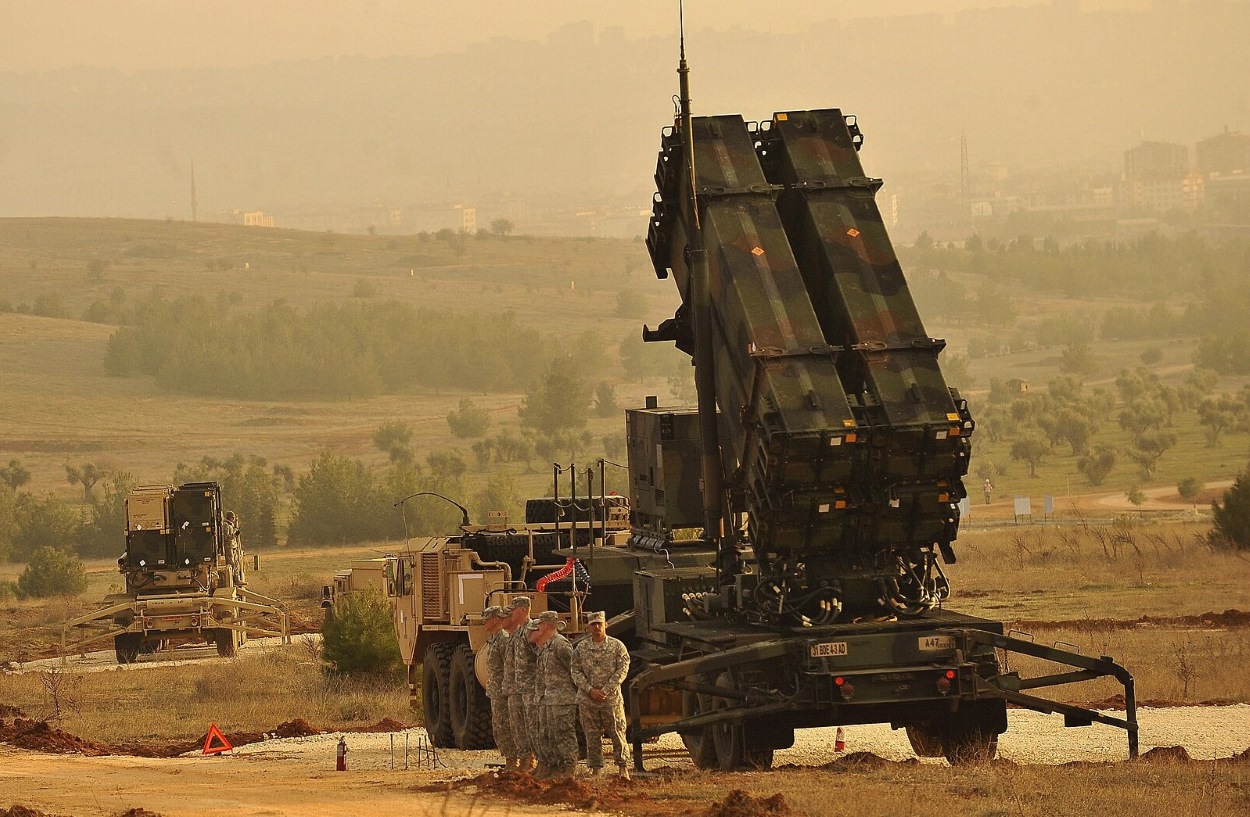



Ukraine’s air shield under strain as Pentagon holds up delivery of 60 Patriot missiles

New Delhi: Ukraine is facing a fresh setback in its efforts to reinforce its air defences ahead of winter, with the United States yet to clear the delivery of around 60 Patriot interceptor missiles already allocated to the country. The delay comes despite Ukraine’s western partners financing the weapons and Kyiv repeatedly warning of dwindling interceptor stocks amid intensifying Russian aerial attacks.
The US defence secretary, Pete Hegseth, has yet to authorize the transfer of the missiles, some of which are held in European military arsenals, the Financial Times reported on Tuesday, November 24, 2026, citing two Ukrainian officials and another person familiar with the matter. The development has raised questions over Washington’s military support for Kyiv at a critical juncture in the nearly five-year-old war.
The weapons awaiting clearance comprise two variants of the US-manufactured Patriot interceptor – the advanced Patriot Advanced Capability-3 (PAC-3) and the older PAC-2. Both are important components of Ukraine’s multilayered air defence network, although the former is particularly valuable in countering Russian ballistic missiles.
According to the reported delivery schedule, Ukraine was to receive eight PAC-3 interceptors in September, 10 each in October and November, and another 12 in December. None of these four consignments has reportedly received the necessary clearance, while around 20 additional PAC-2 missiles remain awaiting authorization.
European funding, American clearance
The delay highlights a fundamental constraint on Europe’s ability to sustain Ukraine’s military resistance independently of Washington. Even when European governments finance the acquisition of American-made weapons or offer equipment from their own inventories, the transfer of such military hardware generally requires US consent under American arms-export regulations.
The president of Ukraine, Volodymyr Zelenskyy, reiterated on Sunday that Washington needed to authorize the delivery of Patriot missiles already paid for by Kyiv’s international partners. The Ukrainian leader had raised similar concerns in October over delays affecting ammunition for both Patriot and National Advanced Surface-to-Air Missile Systems (Nasams).
While the Nasams interceptors have subsequently received clearance and are reportedly being shipped to Ukraine, the Patriot missiles remain held up, according to Ukrainian media reports.
The Pentagon, however, maintained that there had been no change in Washington’s policy towards supporting Ukraine. A Pentagon official told the Financial Times that efforts to expand industrial cooperation with Ukraine and European partners on Patriot air and missile defence systems were continuing but declined to discuss the specific weapons transfers.
Reuters reported that it could not independently verify the latest allegations and that the Pentagon had not immediately responded to its request for comment.
Why Patriot missiles are critical for Ukraine
Developed in the United States, the Patriot is among the most sophisticated ground-based air and missile defence systems available to Ukraine. It became operational in Ukrainian service in April 2023, substantially improving the country’s ability to counter Russian ballistic missiles that its Soviet-era air defence systems struggled to intercept.
The two interceptor variants employ fundamentally different technologies. While PAC-2 missiles primarily destroy aerial targets by detonating fragmentation warheads in their proximity, PAC-3 missiles employ hit-to-kill technology, destroying incoming missiles through direct collision at high velocity.
The PAC-3 is particularly important for Ukraine’s defence against Russia’s Iskander ballistic missiles and air-launched Kinzhal missiles. Ukraine has also claimed successful interceptions of Russia’s Zircon hypersonic missiles using Patriot systems.
However, the effectiveness of Ukraine’s Patriot batteries depends on a continuous supply of interceptors, which are expensive and manufactured in limited quantities. With Russia employing a combination of ballistic missiles, cruise missiles and inexpensive attack drones, Ukraine faces the increasingly difficult task of maintaining adequate ammunition reserves while protecting its cities, military installations and critical infrastructure.
The approaching winter adds another dimension to the crisis. Damage to electricity-generation facilities and power-distribution networks could leave large sections of the Ukrainian population without adequate heating and electricity during periods of sub-zero temperatures.
$2.1 billion deal, little immediate relief
The reported Pentagon delay comes less than a month after the US state department approved a potential $2.1 billion military sale involving 500 advanced PAC-3 Missile Segment Enhancement (MSE) interceptors to Ukraine on October 30, 2026. Canada, Germany and Norway are financing the proposed acquisition, without requiring American taxpayer funding.
However, deliveries under that arrangement are not expected until the early 2030s, offering little immediate relief to Ukraine. Zelenskyy has advocated transferring missiles from existing Western inventories and subsequently replenishing the donor countries’ arsenals with newly manufactured interceptors.
Meanwhile, a separate Ukrainian proposal to manufacture Patriot interceptors domestically with American authorization has also reportedly encountered delays at the Pentagon. Such an arrangement could eventually reduce Kyiv’s dependence on overseas ammunition supplies, although establishing production facilities for sophisticated interceptors would itself take considerable time.
Military assistance as diplomatic leverage?
Since returning to the White House, the US president, Donald Trump, has increasingly shifted the financial responsibility for supplying American weapons to Ukraine towards Washington’s Nato allies and other Western partners.
Under Nato’s “Prioritized Ukraine Requirements List” (PURL) initiative, launched in July 2025, participating countries finance the procurement of American military equipment identified as essential by Kyiv. According to the Ukrainian government, the mechanism accounts for around 95 per cent of its supplies of Patriot interceptors such as the PAC-3.
However, some Ukrainian officials reportedly suspect that the delays are intended to weaken Kyiv’s negotiating position and increase American leverage in efforts to secure a settlement with Moscow. Washington has not publicly acknowledged any such linkage, and there is no independently established evidence that the pending missile transfers form part of a deliberate diplomatic pressure campaign.
The immediate challenge for Ukraine, nevertheless, remains military rather than diplomatic. While Western financial commitments and multibillion-dollar arms deals offer longer-term assurances, their strategic value will depend on whether the weapons reach Ukraine when they are needed most.